

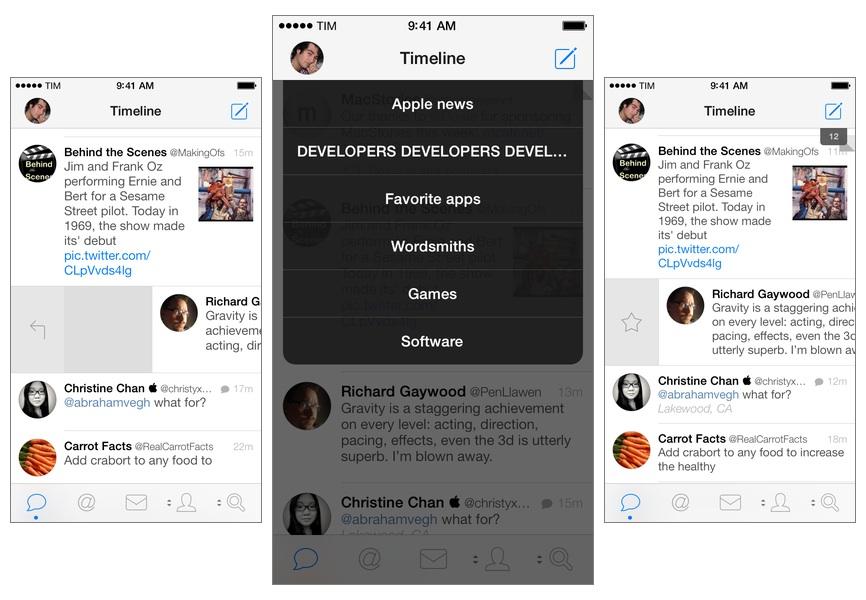
Tweetbot for iPhone may have grown up, but it hasn’t forgotten about the features and design decisions that made it a powerful and popular Twitter client among iOS users for the past two years. Tweetbot 3.1, available today on the App Store, improves upon last month’s major release by bringing back some old features of Tweetbot 2.x and introducing new ones, always taking advantage of iOS 7’s design and structure in interesting ways. Read more
Revolved→
Speaking of crafting apps, here’s one that I’ve been playing around for the past two weeks and that’s pretty impressive. Revolved, developed by Bartosz Ciechanowski, is a $0.99 iPad app that lets you draw lines and watch them turn into 3D shapes in real-time.
Even if you don’t have any particular artistic skills, it’s just cool to play with the app and see how the split-screen layout renders lines on the right as shapes on the left. The app has been built for iOS 7, so there’s minimal interface chrome getting in the way and you can focus on your creations with controls for curves, colors, and sharing.
Seriously fun and a unique concept. $0.99 on the App Store.
Characters As An Interface→
Toca Boca CEO Björn Jeffery describes the unique approach they took with designing the user interface of Toca Builders, the company’s latest construction and crafting app for kids:
Now it may sound counter-intuitive to have characters as an interface, but the fact is that this works surprisingly well for our young builders. Instead of thinking about which buttons to press in order to create a certain effect, kids can identify themselves with certain characters and the construction powers they have. If they want to repaint a structure, they don’t have to look through a menu to find the “repainting button” but instead, remember that Jum Jum the Painter can shoot paint from a long distance to make something a different color. In essence, the player becomes each character for brief periods of time and by that, the question of how to create something is suddenly solved. The app removes the abstraction that a traditional menu would introduce and moves straight into identification instead.
“Desktop-class”→
Fraser Speirs comments on the practical advantages of the iPad Air’s “desktop-class” CPU:
What I know about the iPad Air is that I’m constantly being surprised by these apps being ready and waiting for me as soon as I try them. I’m having to speed up my muscle memory as the iPad is ready sooner than I anticipate.
I notice this in two particular situations. The first is in launching and resuming applications. Multitasking on the iPad has been around for a while now and has grown in capabilities over time. There was always a small wait when switching between applications before the resumed app became active. In large part, that delay no longer exists - except for apps where the resumption depends on some network activity, such as launching Netflix from a cold start.
I work on the iPad every day, and I can’t wait to get these improvements with the Retina iPad mini.
The iPad 2 and Education→
Good take on why Apple may be keeping the iPad 2 around for the educational market by Elia Freedman:
While the iPad mini and iPad Air keep changing on schools and forcing them to consider new devices during the period they are trying to purchase, the iPad 2 remains beautifully the same, keeping a reliable device on hand for them to consider.
IFTTT 1.2→
Released earlier this week, IFTTT for iOS 1.2 improves on native Reminders and Photos integration by allowing users to create recipes that save new items into the Reminders and Photos apps. Previously, IFTTT could only read data from Reminders and Photos and use that as a trigger for other actions.
I wanted to wait a couple of days before posting about this update to test how frequently the new background refresh API in iOS 7 would let IFTTT check for triggers and launch recipes. Unfortunately, I haven’t seen notable changes in execution times – for instance, bookmarks that I add on Pinboard sometimes take about an hour to be added to Reminders. My understanding is that IFTTT isn’t using silent push notifications to instantly trigger recipes in your account, therefore iOS 7 background app refresh can make the app check for updates more often in the long term, but that will require several weeks of testing. Thus, I’m happy to keep testing the feature and report back.
The improved Reminders and Photos integration is very nice. You can add new photos from URLs, create reminders into a specific list, and even set a priority for them. I wouldn’t rely on Reminders integration to save work-related tasks, but I find it very useful to let IFTTT check on, say, Instagram or Facebook from time to time and save the photos I want locally on my device.
I’m still impressed by what IFTTT is doing with their iOS app, and I’m looking forward to seeing what’s next for iOS 7 background sync.
Better Document Management On iOS→
Steven Aquino, writing at Tech.pinions:
The reality is that, as a nerd, I get by fine with Dropbox. However, just because one solution works for me doesn’t mean Dropbox is the answer, or that iOS and iCloud are above improvement. On the contrary, this piece (hopefully) illustrates that iOS and iCloud can be much better at certain things, like document management.
This topic isn’t new, but it’s still relevant because Apple’s implementation is anachronistic and strange considering other advancements in iOS. There’s a glimmer of hope in iPhoto for iOS 7, but nothing more. Open In is not the solution.
Apple Releases Mail Update for Mavericks with Gmail Fixes→
Apple:
Mail Update for Mavericks includes improvements to general stability and compatibility with Gmail, including the following:
Fixes an issue that prevents deleting, moving, and archiving messages for users with custom Gmail settings
Addresses an issue that may cause unread counts to be inaccurate
Includes additional fixes that improve the compatibility and stability of Mail
I don’t use Gmail as my primary email anymore, so I’m looking forward to reading reports about the stability of this update (will Joe Kissell tell us?). You can download it here or through the Mac App Store.
Resolve and Clean URLs with Clean Links for iOS
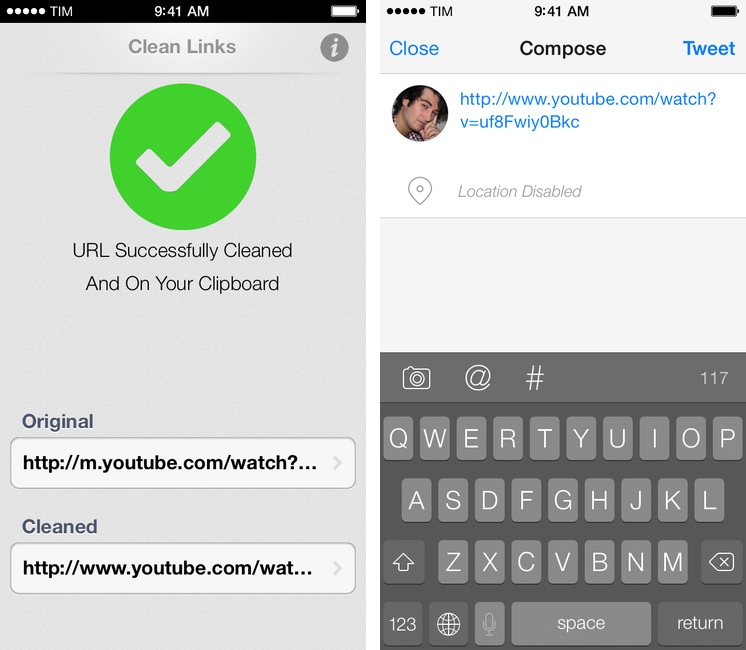
In July, I wrote about my Pythonista script to resolve and clean URLs copied from apps that used shortening services. Clean Links, developed by Griffin Caprio, is a free iOS app that does more than my script as it resolves URLs, removes useless parameters, and supports x-callback-url for inter-app communication.
Clean Links’ sole purpose is to receive a URL that was shortened, put behind a proxy, or cluttered with parameters/tokens and turn it into the clean, basic version that’s the one you want to share with your friends and followers.1 Clean Links can resolve YouTube URLs, links to blog posts generated by FeedBurner, classic Bitly URLs, and more. In my tests, Clean Links never failed to clean up a URL that I gave to it – the recent addition of YouTube URL support is extremely welcome as YouTube mobile redirects are particularly annoying. By default, Clean Links cleans a URL you’ve copied and puts the cleaned version back in the iOS clipboard.
With callbacks, Clean Links can be used with other apps as a “URL cleaning service” in the middle of a workflow. Here’s an example: I’ve found a link in Tweetbot and I want to tweet it, but the URL is ugly. With Clean Links, I can copy the URL and launch this Launch Center Pro action to have it cleaned up and return to Tweetbot’s Compose screen automatically. Or, with this action, you can resolve a URL and automatically add it to the “URL” field of a new event in Fantastical 2.
A tip for x-callback-url power users: when chained to other apps, Clean Links can automatically insert text not by using clipboard hacks, but through a “return parameter” called retParam. If you take a look at the URL schemes that power the actions above, you’ll see that, for Tweetbot, the text parameter is omitted from the Tweetbot URL scheme and given to retParam (same concept for Fantastical). If you want to pass along cleaned URLs with x-callback-url keep this in mind and take a look at the app’s documentation.
Clean Links has a very utilitarian approach to the problem it solves: it’s powerful, but it doesn’t come with a pretty UI for iOS 7. You’re not supposed to be looking at Clean Links all the time though, and the app’s functionality makes it the best solution to clean URLs and send them to other apps I’ve found. Clean Links is Universal and available for free on the App Store.