John Voorhees

5402 posts on MacStories since November 2015

John is MacStories' Managing Editor, has been writing about Apple and apps since joining the team in 2015, and today, runs the site alongside Federico. John also co-hosts four MacStories podcasts: AppStories, which covers the world of apps, MacStories Unwind, which explores the fun differences between American and Italian culture and recommends media to listeners, Ruminate, a show about the weird web and unusual snacks, and NPC: Next Portable Console, a show about the games we take with us.

This Week's Sponsor:

Dropzone 5

Improve your Drag-and-Drop Workflow


The Latest from AppStories and NPC: Next Portable Console

Enjoy the latest episodes from MacStories’ family of podcasts:

This week, Federico and I share tips on iPadOS, macOS, RSS, cross-platform file transfers, and more.

This episode is sponsored by:

  • Sofa – Be More Intentional with Your Downtime.

For episode 3 of NPC, we cover the latest news about the Ayn Odin2 Mini, ONEXPLAYER X1 Mini, Asus ROG Ally X, the Anbernic RG Cube, and more, John finally received his transparent blue Anbernic RG35XXSP, Brendon got a surprise in the mail, and Federico shares his first impressions of the Powkiddy RGB30.

Read more


Highlighting Journalism on Mastodon

Eugen Rochko, writing on Mastodon’s blog today:

To reinforce and encourage Mastodon as the go-to place for journalism, we’re launching a new feature today. You will notice that underneath some links shared on Mastodon, the author byline can be clicked to open the author’s associated fediverse account, right in the app. This highlights writers and journalists that are active on the fediverse, and makes it easier than ever to follow them and keep up with their future work—potentially across different publications. Writers often work with different publishers over the span of their careers, but Mastodon is the perfect platform to amass a loyal audience that you, as the author, truly own, and can take with you across the fediverse.

When Eugen approached us about being one of the first publications to implement this new feature, we jumped at the chance. You may have noticed that we believe pretty strongly in writing and writers, so we’re pleased to be joining The Verge and MacRumors in implementing author bylines. Now, when you see a MacStories post on Mastodon, you can click on the author byline at the bottom of the post to jump to the author’s profile.

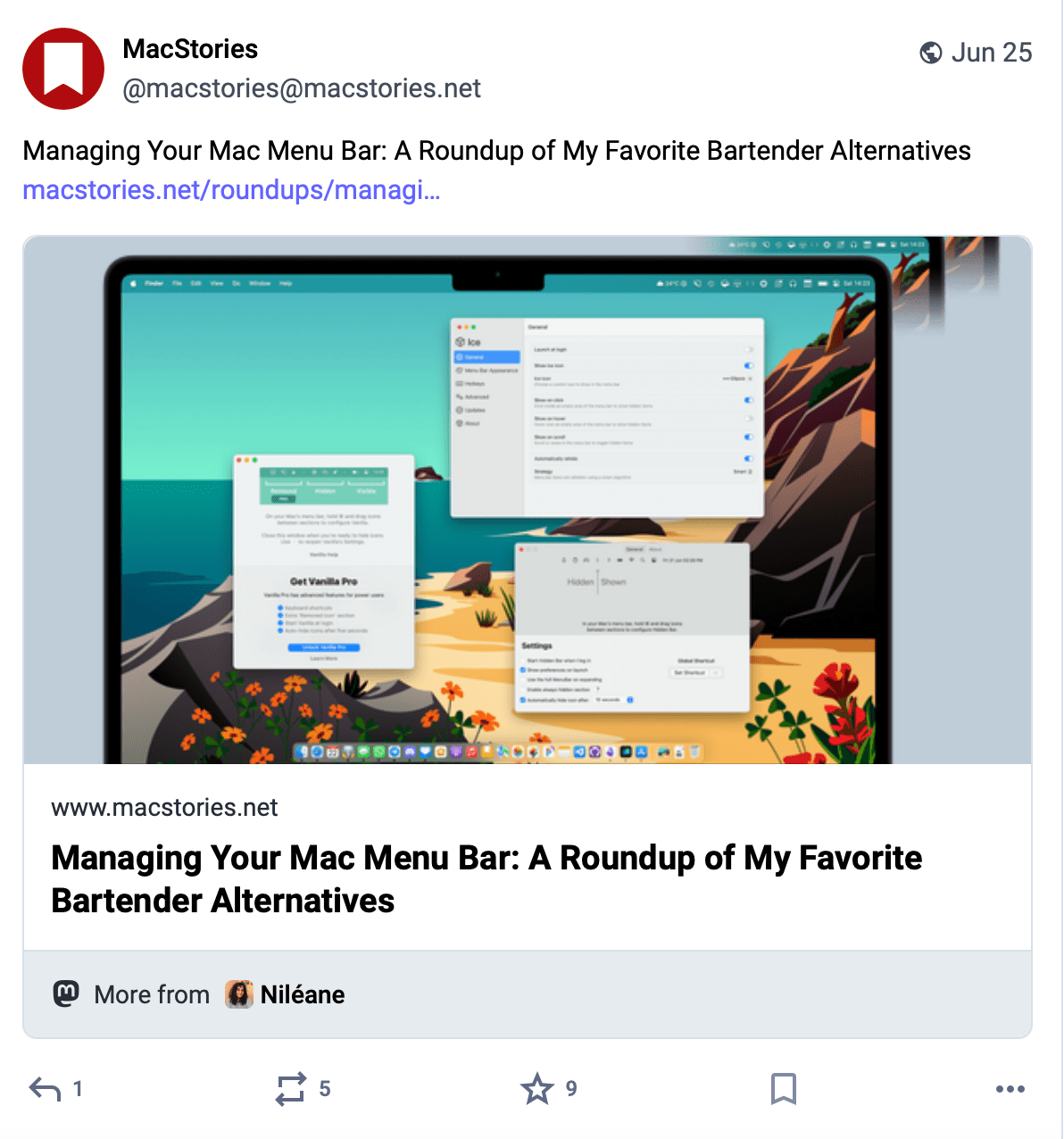
What’s more, the feature is incredibly easy to set up. It took Robb Knight about 15 minutes to add the creator OpenGraph tag to MacStories, and ever since, our posts have linked to our authors’ fediverse profiles:

Clicking the author link in a post takes you to that person's Mastodon profile.

Clicking the author link in a post takes you to that person’s Mastodon profile.

Currently, the authorship feature requires you to use the web version of Mastodon or its official app and have a mastodon.social account or be on a server running recent nightly releases. However, the new feature is part of the Mastodon API, so it shouldn’t be long before third-party apps begin supporting it, too.

Like a lot of people, we follow our favorite publications, but also our favorite writers. Mastodon’s author byline is an excellent way to shine a spotlight on both.

Permalink

AI Companies Need to Be Regulated: An Open Letter to the U.S. Congress and European Parliament

Federico: Historically, technology has usually advanced in lockstep with opening up new creative opportunities for people. From word processors allowing writers to craft their next novel to digital cameras letting photographers express themselves in new ways or capture more moments, technological progress over the past few decades has sustained creators and, perhaps more importantly, spawned industries that couldn’t exist before.

Technology has enabled millions of people like myself to realize their life’s dreams and make a living out of “creating content” in a digital age.

This is all changing with the advent of Artificial Intelligence products based on large language models. If left unchecked without regulation, we believe the change may be for the worse.

Over the past two years, we’ve witnessed the arrival of AI tools and services that often use human input without consent with the goal of faster and cheaper results. The fascination with maximization of profits above anything else isn’t a surprise in a capitalist industry, but it’s highly concerning nonetheless – especially since, this time around, the majority of these AI tools have been built on a foundation of non-consensual appropriation, also known as – quite simply – digital theft.

As we’ve documented on MacStories and as other (and larger) publications also investigated, it’s become clear that foundation models of different LLMs have been trained on content sourced from the open web without requesting publishers’ permission upfront. These models can then power AI interfaces that can regurgitate similar content or provide answers with hidden citations that seldom prioritize driving traffic to publishers. As far as MacStories is concerned, this is limited to text scraped from our website, but we’re seeing this play out in other industries too, from design assets to photos, music, and more. And top it all off, publishers and creators whose content was appropriated for training or crawled for generative responses (or both) can’t even ask AI companies to be transparent about which parts of their content was used. It’s a black box where original content goes in and derivative slop comes out.

We think this is all wrong.

The practices followed by the majority of AI companies are ethically unfair to publishers and brazenly walk a perilous line of copyright infringement that must be regulated. Most worryingly, if ignored, we fear that these tools may lead to a gradual erosion of the open web as we know it, diminishing individuals’ creativity and consolidating “knowledge” in the hands of a few tech companies that built their AI services on the back of web publishers and creators without their explicit consent.

In other words, we’re concerned that, this time, technology won’t open up new opportunities for creative people on the web. We fear that it’ll destroy them.

We want to do something about this. And we’re starting with an open letter, embedded below, that we’re sending on behalf of MacStories, Inc. to U.S. Senators who have sponsored AI legislation as well as Italian members of the E.U. Special Committee on Artificial Intelligence in a Digital Age.

In the letter, which we encourage other publishers to copy if they so choose, we outline our stance on AI companies taking advantage of the open web for training purposes, not compensating publishers for the content they appropriated and used, and not being transparent regarding the composition of their models’ data sets. We’re sending this letter in English today, with an Italian translation to follow in the near future.

I know that MacStories is merely a drop in the bucket of the open web. We can’t afford to sue anybody. But I’d rather hold my opinion strongly and defend my intellectual property than sit silently and accept something that I believe is fundamentally unfair for creators and dangerous for the open web. And I’m grateful to have a business partner who shares these ideals and principles with me.

With that being said, here’s a copy of the letter we’re sending to U.S. and E.U. representatives.

Read more


My 2024 macOS Sequoia Workflow

This year’s macOS review will be a little different. Yes, there are fewer new features than in the past, but the differences don’t end there. More than ever before, Apple is trickling out features throughout the beta period. It’s not just that some Apple Intelligence capabilities will come after the initial release of the OS....


The Tip Jar

AppStories+ Deeper into the world of apps

AppStories Episode 393 - The Tip Jar

0:00
35:35

AppStories+ Deeper into the world of apps

This week, Federico and John share tips on iPadOS, macOS, RSS, cross-platform file transfers, and more.

Read more


Interesting Links

[[John]] Neil Long reported for MobileGamer.biz this week that Appfigures estimates suggest purchases of AAA games on Apple platforms have been low. (Link) Chris Welch at The Verge reviews the Beats Pill, which doesn’t include AirPlay support but can output lossless audio over USB-C and looks like a good on-the-go Bluetooth speaker for both iOS...


A Daily Tot and Things Scratchpad Workflow

The iPhone and iPad versions of Tot by The Iconfactory are currently 50% off on the App Store, so I thought I’d revisit the app to see if there’s a regular place for it in my workflow. It’s too early to say if I’ll stick with Tot long-term, but so far, I’m enjoying using it...


App Debuts

Denim Denim has long been my favorite utility to create great-looking custom covers for playlists on Apple Music, and the much-anticipated 3.0 update is a fantastic next step for the app. Denim has been completely redesigned, and it now features an all-new playlist cover editor UI with many more options than before. For instance,...


The Latest from Magic Rays of Light, Comfort Zone, and MacStories Unwind

Enjoy the latest episodes from MacStories’ family of podcasts:

This week on Magic Rays of Light, Sigmund and Devon highlight new Apple Original bilingual comedy series Land of Women, discuss latest with regards to Apple and the Digital Markets Acts, and recap The Big Cigar.


Niléane tests the gang on their French knowledge (it goes great…), Chris adds some goblins to this productivity system, and Matt tries to connect to the other side.

This episode is sponsored by:

Our thanks once again to ListenLater.net for sponsoring Comfort Zone and MacStories! Let them know you heard about them from us to get 20% more credits with your first purchase.


This week, Federico and I look back at the first half of 2024 and pick our favorite TV shows, movies, videogames, music, and gadgets.

This episode is sponsored by:

  • Sofa – Be More Intentional with Your Downtime

Read more