Because Club MacStories now encompasses more than just newsletters, we’ve created a guide to the past week’s happenings along with a look at what’s coming up next:
Last week, we kicked of 2023’s AV Club series with Avatar: The Way of Water. For the latest Town Hall Federico and I were joined by Jonathan Reed, who helped us organize the event, to talk about James Cameron’s latest epic and its predecessor in the film series.
Club MacStories Town Halls are part of the special live audio events we hold in the Club MacStories+ Discord community. The show is a recorded and lightly edited version of the Town Halls that we produce, so Club MacStories+ and Club Premier members who can’t attend the event live can listen later.
This week, Federico and John look at the history of read-later apps and the many similarities and differences between them and today’s read-later apps, like Matter and Reader, as well as link organizers, such as GoodLinks and Anybox.
Read more
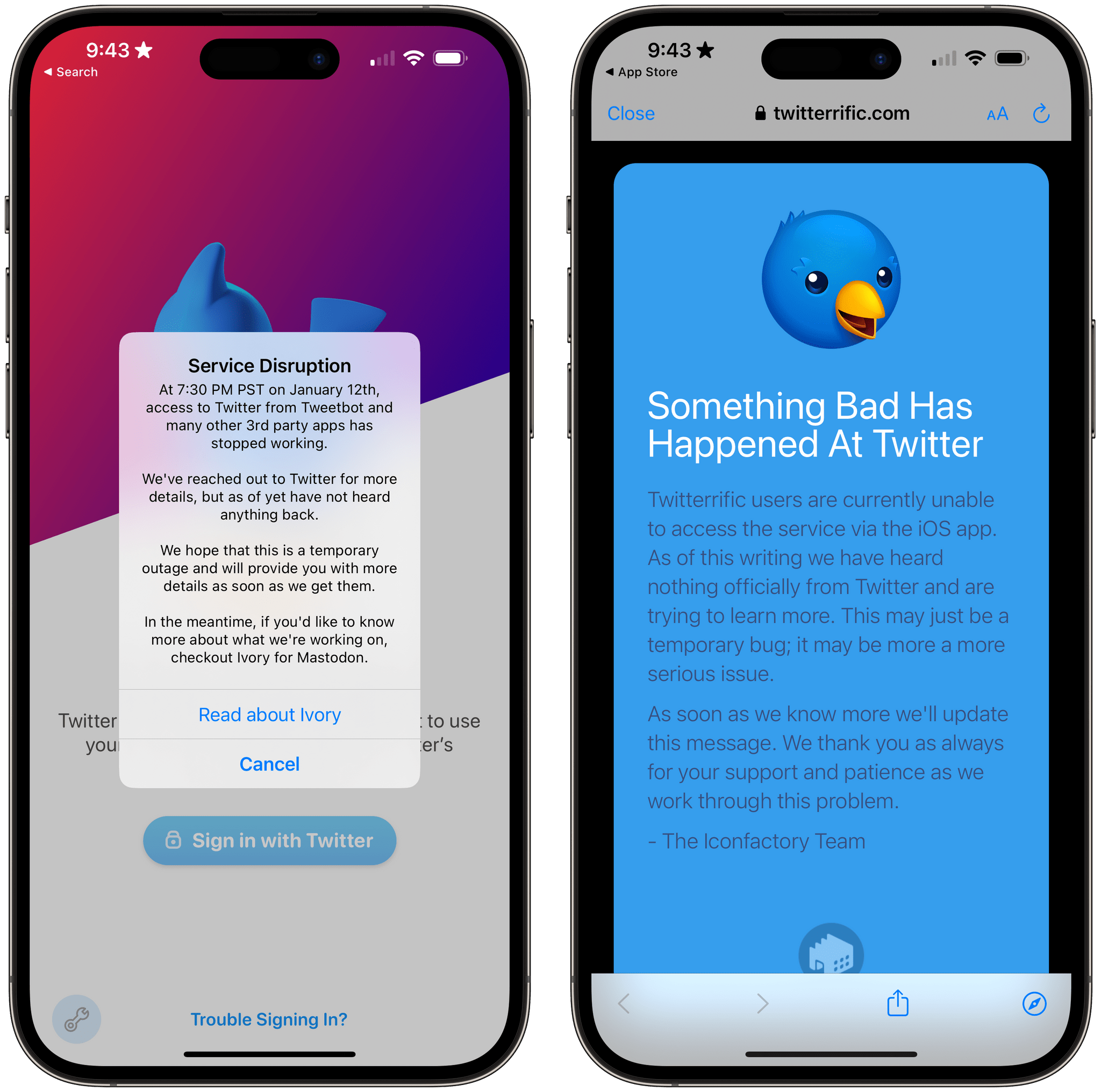
Late yesterday, The Information reported that it had seen internal Twitter Slack communications confirming that the company had intentionally cut off third-party Twitter app access to its APIs. The shut-down, which happened Thursday night US time, hasn’t affected all apps and services that use the API but instead appears targeted at the most popular third-party Twitter clients, including Tweetbot by Tapbots and Twitterrific by The Iconfactory. More than two days later, there’s still no official explanation from Twitter about why it chose to cut off access to its APIs with no warning whatsoever.
To say that Twitter’s actions are disgraceful is an understatement. Whether or not they comply with Twitter’s API terms of service, the lack of any advanced notice or explanation to developers is unprofessional and an unrecoverable breach of trust between it and its developers and users.
Twitter’s actions also show a total lack of respect for the role that third-party apps have played in the development and success of the service from its earliest days. Twitter was founded in 2006, but it wasn’t until the iPhone launched about a year later that it really took off, thanks to the developers who built the first mobile apps for the service.
Read more
Mark Gurman recently reported that Apple’s much-rumored headset will combine AR and VR technologies, which Brendon Bigley argues could be the wrong approach:
… I don’t think the road to mass adoption of virtual reality actually starts with virtual reality, it starts instead with augmented reality — a technology that can quickly prove its function if presented in a frictionless way. While even the best VR headsets demand isolation and escapism, a hypothetical product focused first and foremost on augmented reality would be all about enhancing the world around you rather than hiding from it.
Brendon’s story nails something that has been nagging me about recent headset rumors. The iPhone was a hit because it took things we already did at a desk with a computer and put them on a device we could take with us everywhere we go, expanding the contexts where those activities could be done. As Brendon observes, the Apple Watch did something similar with notifications. AR feels like something that fits in the same category – an enhancement of things we already do – while VR is inherently limiting, shutting you off from the physical world.
Like Brendon, it’s not that I’m not excited about the prospect of an Apple headset or the long-term prospects for virtual reality as a technology, but given where the technology is today, it does seem as though jumping into VR alongside AR could muddy the waters for both technologies. Of course, we’re all still working off of speculation and rumors. I have so many questions still and can’t wait to see what Apple has in store for us, hopefully later this year.
This week on MacStories Unwind, Federico recommends Gossip Girl (Season 2), and I loved the tech angle behind Glass Onion.
Links and Show Notes
Federico’s Pick:
John’s Pick:




 Federico