
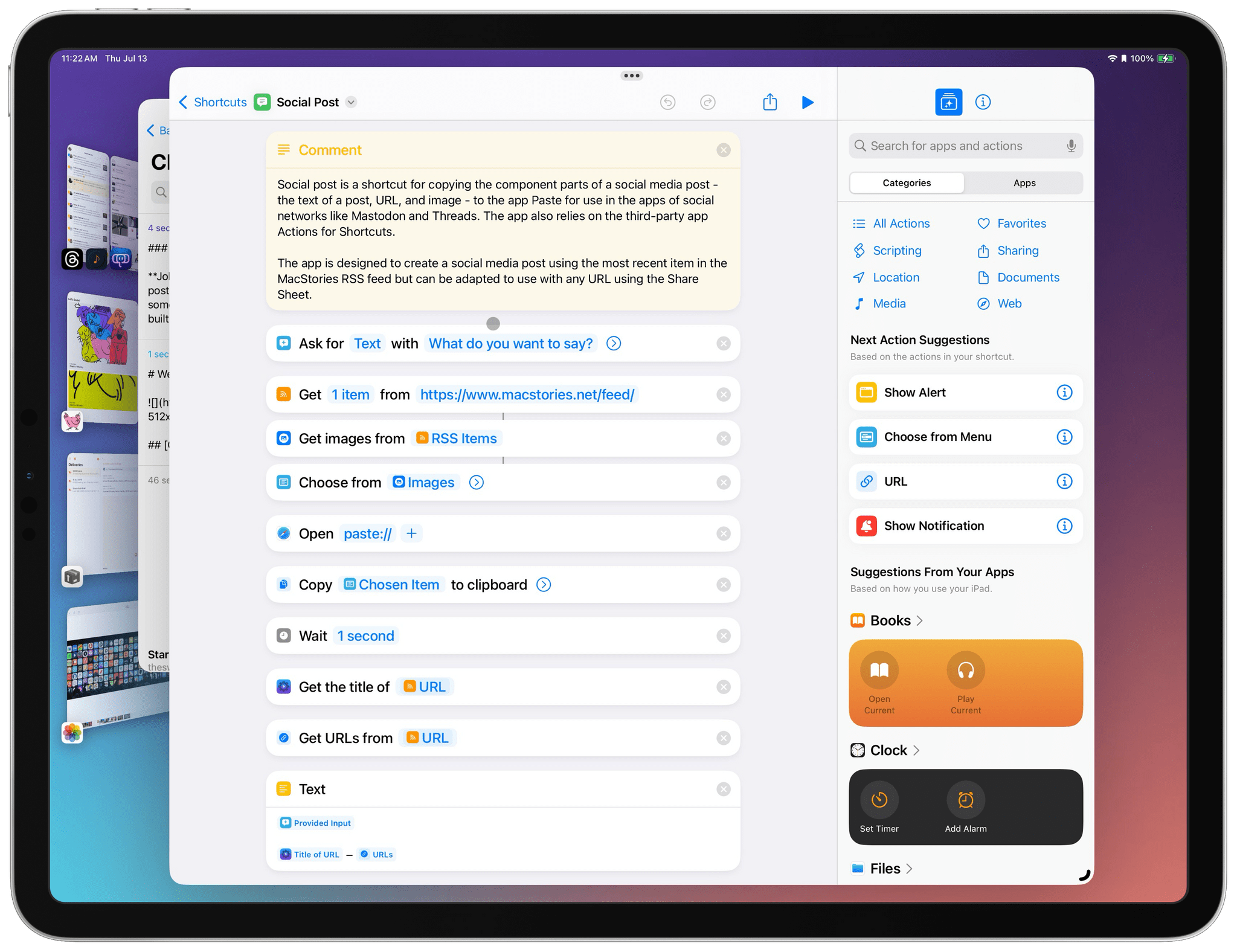
We’re a week into Meta’s new Threads social network. Meta, its app, and social networks in general pose a lot of issues, but I’m always up for trying something new, and so far, I like Threads despite its issues. That said, the fact that Threads is an iPhone-only app adds a lot of friction to...
 Cross-Posting to Social Media Without Shortcuts
As I explored ways to use Shortcuts to make cross-posting on Mastodon and Threads easier, I also tried something different that worked surprisingly well: Apple’s built-in Continuity features. The scenario is the same as I describe in Shortcuts Essentials. I wanted a better way to post to Threads after posting to Mastodon from my Mac....
Eve Environment Sensors

I’ve used various Eve devices for several years and have always been impressed with them. They’re a little on the pricey side, but the build quality and reliability are better than most HomeKit devices I’ve used, so I feel like I’m getting what I paid for. Today, I’ve got two Eve devices to recommend: one...
App Debuts
CardioBot CardioBot for iPhone and Apple Watch added a much deeper catalog of widgets this week. In total, there are over 100 possible variations of its widgets possible now. The widgets include the app’s Heart Points system, heart rate, resting heart rate, heart rate variability, blood oxygen percentage, respiratory rate, cardio fitness, blood pressure,...
Interesting Links
The Athletic takes an excellent in-depth look at Apple’s sports streaming ambitions and how recent deals the company has struck play into them. (Link) Apple’s password management feature is coming to third-party browsers in macOS Sonoma, according to TechCrunch. (Link) Mia Sato of The Verge is right. There’s no good reason for Venmo transactions...
MacStories Unwind: How We Write






This week, Federico and I talk about the writing process, Federico recommends Vampire by Olivia Rodrigo and I recommend Hijack on Apple TV+.
Sponsored By:
- Kolide – It ensures that if a device isn’t secure it can’t access your apps. It’s Device Trust for Okta. Watch the demo today!
Links and Show Notes
Federico’s Pick:
- Vampire by Olivia Rodrigo
John’s Pick:
MacStories Unwind+

We deliver MacStories Unwind+ to Club MacStories subscribers ad-free and early with high bitrate audio every week.
To learn more about the benefits of a Club MacStories subscription, visit our Plans page.
The Case for Videogame and App Preservation
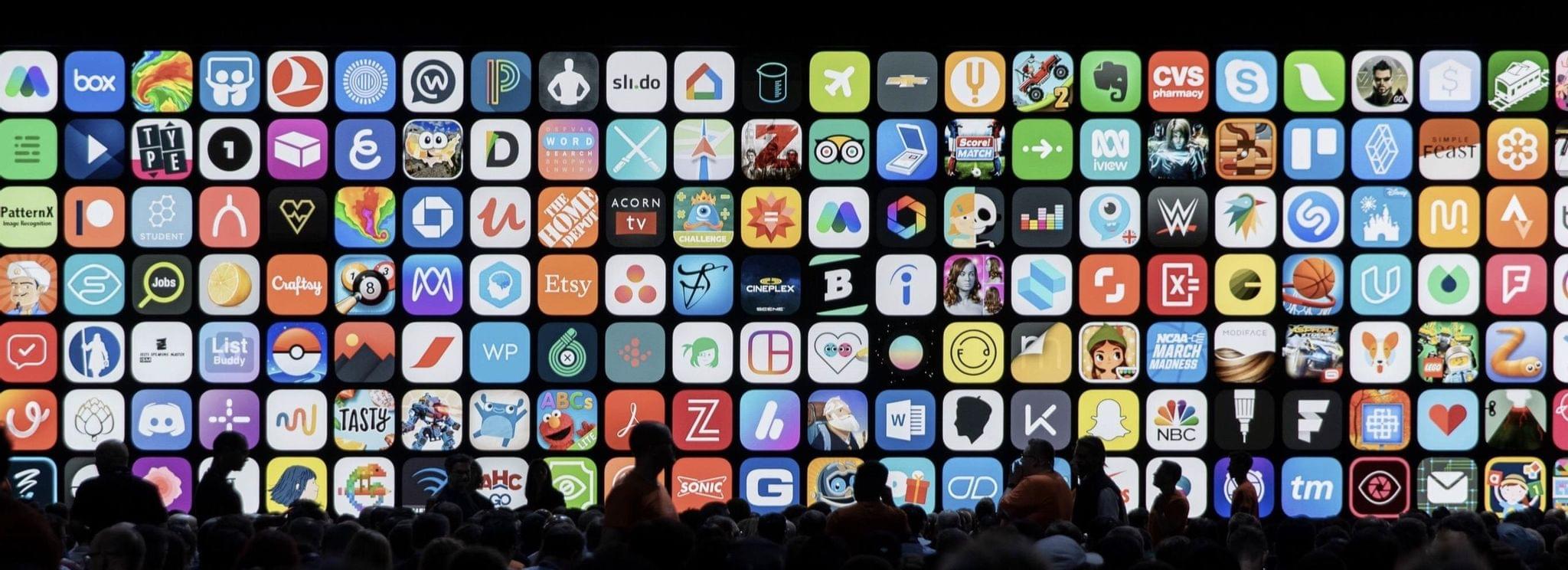
On the same day that the App Store turned 15, the Video Game History Foundation released a study that concludes 87% of all classic videogames released in the US are no longer commercially available. The study looked at a broad cross-section of platforms and found that this isn’t a problem that’s limited to one corner of the videogame industry. It’s universal. As a result, a large segment of videogame history is at risk of being lost forever.
The Video Game History Foundation’s mission is to preserve videogame history, and along with libraries, museums, and archives, they’re seeking exemptions from US Copyright law to make game preservation easier. On the other side of their efforts is the gaming industry, which argues, among other things, that commercial re-releases and remasters of classic games are satisfying preservation needs.
That debate is what prompted the Foundation’s study:
It’s true that there’s more games being re-released than even before. But then why does the gaming community believe that so few classic games are still available? What’s the real story here? If we want to have a productive conversation about game preservation, we need an accurate understanding of where things stand right now.
We conducted this study to settle the facts. It’s not enough just to have a hunch. We need hard data.
The results of the Video Game History Foundation’s study tell a different story than the one the videogame industry tells and is one that’s equally applicable to mobile games and apps on Apple’s App Store. Federico and I have written about app and game preservation before, including during the 10th anniversary of the App Store. And while I applaud Apple’s decision to promote classic iOS games as part of Apple Arcade, the Foundation’s study shows that it’s not enough. It’s a start, but for every game that is given a new lease on life as part of Arcade, there are dozens that lie dormant and unplayable.
The problem extends to apps too. Craig Grannell, with the help of Internet sleuths, set out to recreate the list of 500 apps and games that debuted on the App Store as its 15th anniversary approached. Grannell’s Google Spreadsheet currently lists 355 titles, and guess what? By my count, only 43 of those apps and games have live App Store URLs, which works out to 12%, almost exactly the same results as the Video Game History Foundation’s study. Grannell’s spreadsheet may not have been compiled as rigorously as the Foundation’s study, but the point stands: we’re losing access to culturally significant apps and games on the App Store alongside the videogame industry.
That’s why I was happy to see the Video Game History Foundation take the important step of gathering the facts that support their preservation efforts. Its focus is on games, but hopefully, it will help raise awareness about preserving apps too.
A good way to learn more about the Video Game History Foundation’s study is also to listen to the latest episode of its podcast, where Kelsey Lewin and Phil Salvador of the Foundation were joined by Brandon Butler, Director of Information Policy at the University of Virginia Library and Law and Policy Advisor at the Software Preservation Network.
David Smith on Adapting Widgetsmith’s Weather Features to visionOS→
David Smith has been poking around the visionOS SDK and chronicling his efforts on his website. His latest experiment was to take the weather forecast part of Widgetsmith and adapt it to visionOS. We’ve seen a lot of developers post screenshots of what their app looks like when it’s first built in visionOS, and it’s impressive how little work it seems to take to get an app up and running on the new OS.
However, visionOS apps are fundamentally different from others and require further attention to adapt to the new UI language. That’s what I love about David’s post. This is what it looked like when he started:
](https://cdn.macstories.net/img_1262-1689203046762.png)
Source: david-smith.org
In the post, David walks through all the changes made, big and small, to get to this point:
](https://cdn.macstories.net/img_1263-1689203122137.png)
Source: david-smith.org
The evolution of this view and others is a fascinating lesson in the UI differences between iOS and visionOS apps. Be sure to check out David’s post for more screenshots and details on the process of adapting Widgetsmith’s weather features to visionOS.
macOS Sonoma: The MacStories Preview
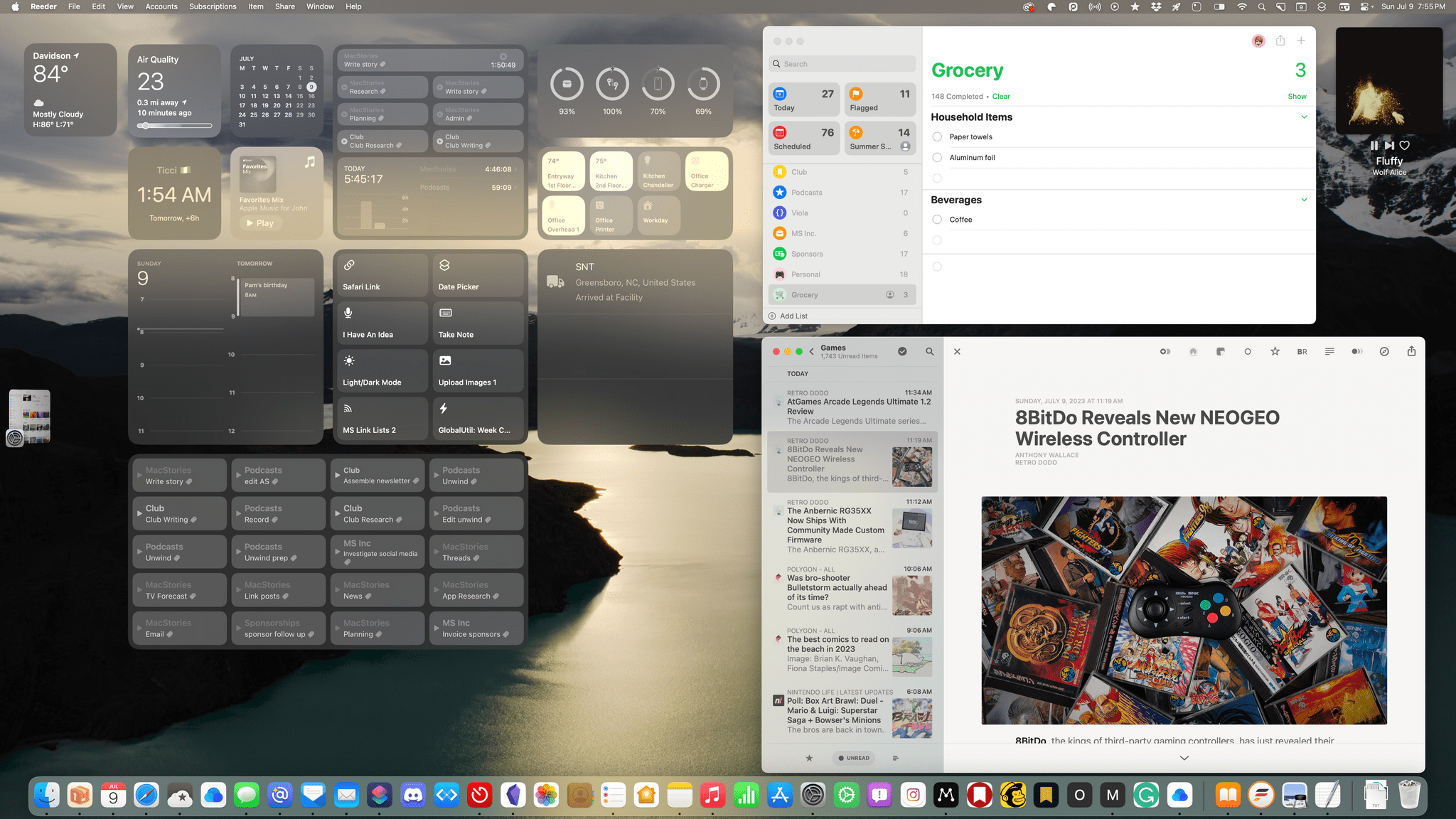
Never before have the iPhone, iPad, and Mac been as interconnected as they are today. It wasn’t that long ago that the iPhone was, well, the iPhone, the iPad was essentially a big iPhone, and the Mac was off doing its own thing. Now, the iPad has its own OS, the Mac is running on a whole new chip architecture, and the design and functionality of virtually every bit of UI and system app of every device have been realigned along a more rational continuum, making it easier than ever to move among them.
A big part of reshaping macOS involved updating system apps to match the functionality available on Apple’s other OSes. That work is largely finished, which leaves us entering a new phase of macOS’s evolution. Instead of playing catch-up to iOS and iPadOS, macOS is moving along the same path, with a collection of genuinely useful new features coming this fall that I’ve been testing as part of Apple’s developer beta program. Now, you too can join in the testing if you’d like because today, Apple released its first public beta of macOS Sonoma as part of the Apple Beta Software Program.
We’ll have full reviews on MacStories of each OS when the final versions are released this fall. However, after about a month of using Sonoma daily, I wanted to hit the highlights of what’s in store this fall for any readers who might be thinking of joining the public beta.