Graham Spencer

917 posts on MacStories since January 2011

Former MacStories contributor.


Tip: Handle iMessage Notification Overload with Contact Settings

Since Apple released a public beta of Messages for Mac, we’ve been having a bit of a notification overload here at MacStories HQ. See, ever since iMessage was released with iOS 5, we’ve had our own group message with everyone on the MacStories team – it was a portable water cooler, where we could chat about random things, share silly pictures and even co-ordinate things for the site, even when we were out and about. We used it quite frequently, but things turned for the worse last week when we all got that Messages for Mac beta. What might have been 10 messages in a given time period, suddenly morphed into 50 messages because of the convenience of having iMessage just a click way on our Macs. Things were becoming chaotic and quite distracting, Don had even turned off vibrations — meaning he got no notification for any message, from anyone.

We didn’t want to give up on using Messages for Mac, and it was probably going to be a hard task to change our messaging behaviours to limit the number of messages sent, but it was clear this week that we had to do something.

Fortunately, we think we have found a solution. In iOS, Apple includes the ability to change the text tone and ringtone on a per-contact basis. What we did for everyone in the MacStories team, was to change the text tone to “None”. You can do this by going into the Contacts app, selecting a contact and tapping the ‘Edit’ button and scrolling to “text tone”.
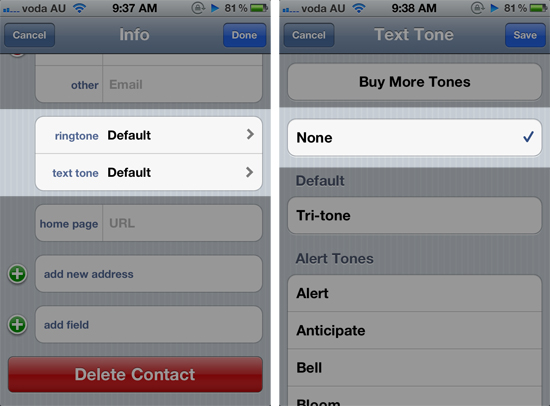
This now means regardless of whether your phone is on Silent or not, you will not get any noise or vibration to alert you to the new message. There are two downsides to this ‘workaround’: the first is that you will still get the notification bar flipping down from the top of your screen. The second problem, which could be a deal breaker for some, is that any messages from that person will not cause a vibration or text tone – important to remember if they are a participant in a few of your group message threads.

There should be another way…

Whilst the ability to change the text tone (and ringtone) on a per-contact basis is really cool (and can be used for a number of other purposes), perhaps there should be another way to control message notifications differently – especially now that iMessage is bundled in iChat, and may lead to an increased number of messages sent to iOS devices. Specifically I’m talking about muting specific message conversations. This would allow me to mute the message thread that has all of the MacStories members, but still receive notifications from Federico, in case he urgently wanted me to cover something.

Apple could easily implement the option inside the Messages app, simply displaying a mute icon next to each message thread when in the ‘Edit’ mode. Just like changing the text tone on a per-contact basis, this power-user option wouldn’t make the UI messy, because it would only appear in the ‘Edit’ screen. That way, users could choose between completely muting on a per-contact basis or on a per-message thread basis – all whilst still receiving notifications for your other messages.



iPad + Office + Apple + Microsoft: Why It All Makes Sense

iPad + Office + Apple + Microsoft: Why It All Makes Sense

Rumors of Office for the iPad flared up again this week after The Daily posted an alleged photo of it, after apparently getting some hands on with a near-complete build. Some of you may recall me tweeting that day, what I thought was a crazy thought: Apple inviting Microsoft on stage next month at the iPad 3 keynote to demo Office for iPad. Apparently it wasn’t as crazy as I originally thought, because others are thinking it might just happen.

Office for the iPad makes total sense, though. And I wouldn’t be surprised if Apple did give Microsoft some stage time to unveil it at the new-iPad event in a few weeks.

Those are the words of Dan Frommer of SplatF, someone who (in my mind) has always made strong, rational cases for his arguments, never sensationalising or using hyperbole for the sake of it. In an article published a few hours ago, he lays out why “iPad + Office + Apple + Microsoft” actually makes sense. In it he lists out all the big arguments for such a Microsoft appearance at Apple’s iPad 3 keynote.

This isn’t like when Microsoft had to scratch and think before making Office for the Mac in the ’90s, when it would be lucky to sell a couple million copies per year. The iPad is way different: It should easily pass 50 million unit sales this year alone, and that’s potentially tens of millions of Office buyers for Microsoft. (Office, by the way, represented significantly more of Microsoft’s sales and profits last quarter than Windows.)

I strongly encourage you to read the full list of arguments in his article, I don’t think anyone could have laid out the argument for such a proposition any stronger than Dan did. On the flip side though, Daring Fireball’s John Gruber doesn’t think it’ll happen.

But what would be in it for Apple to offer such a spot to Microsoft? You can argue that the iPad with Office available is an even more attractive platform/device than the iPad as it stands today, sans Office. But why share the spotlight with Microsoft? Apple doesn’t need to.

Permalink

Apple Purchases Land In Oregon For Another Large Data Center

An Apple spokeswoman has confirmed to news agency KTVZ.com that it has purchased land in Prineville, Oregon and plans to build a data center. The land, purchased from Crook County covers 160-acres and was purchased for a reported $5.6 million. Apple confirmed the purchase after they were named as the purchaser in a February 15th filing in Crook County.

Apple spokeswoman Kristin Huguet confirmed Tuesday that “we purchased the land and it’s for a data center,” but could not speak to details beyond that, other than to say it will be a “green” facility.

Rumors of Apple scouting out land in Prineville for another large data center emerged in December last year when it was reported that Apple was in discussions over purchasing the land. The land Apple purchased is nearby Facebook’s data center in Prinneville, which is pictured above.

[KTVZ.com via MacRumors]


Microsoft Office For iPad Coming Within Weeks? [Updated]

Microsoft’s Office Suite could be launching on the iPad App Store within weeks according to a new report in The Daily. Originally rumoured in November of last year by The Daily, Matt Hickey today says that the design team has “wrapped up the project” but an exact launch date was not known.

Hickey claims to have had a brief hands-on with a working prototype of the Office Suite app and notes that whilst the UI is similar to OneNote for iPad, it has hints of Metro. He notes that Word, Excel and PowerPoint files can be created and edited either locally on the iPad or online (presumably using Microsoft’s SkyDrive cloud service).

According to his sources, OneNote will also receive an update soon to reflect the Metro design. Those same sources also noted that no Android version was in the works.

[The Daily via The Next Web]

Jump the break to view all updates to this story.

Read more


China Telecom To Offer The iPhone 4S From March 9th

Starting from March 9th, China Telecom customers will be able to purchase the iPhone 4S. It comes about two months after China Unicom first offered the iPhone 4S in China.

Unlike China Unicom (the second largest carrier after China Mobile), the smaller China Telecom uses the CDMA technology. Though because the iPhone 4S has support for both CDMA and GSM networks, China Telecom will be selling the same hardware that customers on China Unicom and customers elsewhere across the world purchase.


[via The Verge]


Rovio Teases Angry Birds Space, Launching March 22

It may be on every platform under the sun and there may already be three versions of Angry Birds, but Rovio isn’t stopping any time soon with their Angry Birds franchise. In fact next month they will be launching the third game in the series: Angry Birds Space. Teaming up with NASA and the National Geographic, the new app will (naturally) feature some twists on the physics used in the game, including zero gravity and a new “lightspeed destruction” feature.

Angry Birds Space is a completely new game with innovative new gameplay, but with some of the familiar Angry Birds elements that fans already know and love – plus some surprises!

Rovio is planning on making it their biggest game launch since Angry Birds was first released and is targeting a launch on not only multiple platforms but also push the retail and publishing aspects of the game as well. Rovio will reveal more details about the game in early March, but until then you can visit the teaser site or view Angry Birds Teaser trailer below the break.

[Venture Beat via Eurogamer, Engadget]
Read more


Nightline Given Exclusive Access To Apple’s Foxconn Factories, Program To Air This Tuesday

The ABC’s Nightline program will air on Tuesday a report from Bill Weir that delves inside Apple’s Foxconn factories. ABC News announced the program on Twitter and PCWorld notes that Apple gave Weir “exclusive access” to tour the Foxconn factories, meet with workers as well as interview a “top executive”.

For years, Apple and Foxconn have been synonymous with monster profits and total secrecy so it was fascinating to wander the iPhone and iPod production lines, meet the people who build them and see how they live. Our cameras were rolling when thousands of hopeful applicants rushed the Foxconn gates and I spoke with dozens of line workers and a top executive about everything from hours and pay to the controversies over suicides at the plant and the infamous ‘jumper nets’ that line the factories in Shenzhen. After this trip, I’ll never see an Apple product the same way again.

It’s the latest move by Apple to try and quell the backlash from media and consumers over the treatment of workers at Apple’s suppliers — particularly at Foxconn. Earlier this year they released their 2012 Supplier Responsibility Report a few weeks earlier than previous years. Apple also revealed who their suppliers are and then joined the Fair Labor Association, who are currently conducting an investigation in regards to working conditions at Foxconn.


[PCWorld via TUAW]


The iOS Permission Dialog Dilemma

For anyone who used Windows Vista, you will be well aware of the frustration that UAC (User Account Control) caused. That permission dialog popped up far too frequently, constantly asking the user for permission to execute a particular task. In theory, it was a good idea: give the user more control over what was allowed to run. The problem was that because the dialog box popped up far too often, people quickly learned to ignore it and blindly click “Allow” whenever it appeared - nullifying any of the security benefits of UAC. Thankfully Microsoft relaxed the pervasiveness of UAC in Windows 7 and it is now a far more useful security tool.

Why did I just spend a paragraph talking about UAC? Because to a certain degree, Apple is facing a similar dilemma with iOS and its permission dialogs. It recently faced scrutiny after it was revealed that a number of apps were accessing a user’s entire address book and even uploading it to their servers - without any user approval. Apple has now pushed back and announced it will soon require user permission for apps to access a user’s Contacts. But will it resemble yet another blue dialog box, just like access to Location, Push Notifications and Twitter already do? If so a user will face a barrage of those dialog boxes, asking for permission, one on top of the other.

It’s after reading Marco Arment’s thoughts on this issue earlier today that I thought I would weigh into the discussion and suggest one idea that may (or may not) be a potential ‘solution’. While there can never be a single solution that will be perfect for everyone (what may be overly cautious for one user may be overly lenient for another) the goal as I see it is to arrive at a solution somewhere in the middle ground; one that achieves an acceptable mix of precaution and freedom.

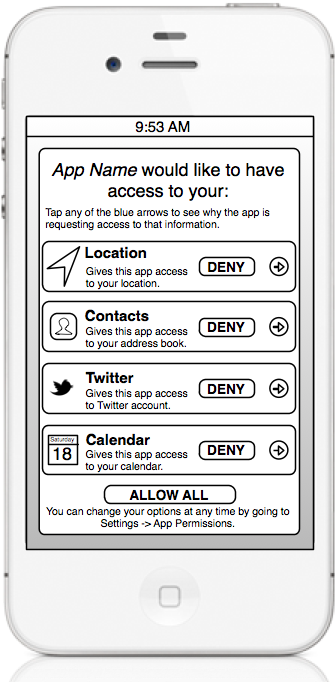
Essentially, my suggestion is that rather than let users face a stacked barrage of blue permission dialogs, is to flatten them all out on one clear screen when they first launch an app after installation. Users would see a list of what the app would like permission to access and the user would be able to (with one tap) allow all, or individually deny permission for the various databases. Furthermore, with one tap, a user could see a short justification from the developer for why the app is requesting that particular access - giving a little bit more control and peace of mind to the user. If a developer lied on this page it would almost certainly be grounds for expulsion from the App Store. The one final goal of my proposal is that it would also inform the user that these options can be changed the Settings, something many users may not be aware of at the moment.

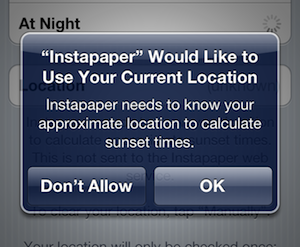
I myself am not sure this is the best option, because there is one critical weakness. With my design, an app would have to upfront ask for permissions for whatever it might want to access in the future - but as Marco points out, some apps (like Instapaper) require access to something like Location for a minor feature that not everyone would even use (in that case it is to determine if it’s night at the users location, in which case it can switch automatically to dark mode).

If I asked most careful people if Instapaper could have their location, they’d refuse, because there’s no obvious good reason. But if the app asks right when they enable a location-based setting from a screen that shows why it’s asking for their location, they can make a more educated decision. Similarly, if an app doesn’t seem to have a good reason when it asks for Contacts, a skeptical person can decline.

Although to counter that point, I would note that not only can a user choose to individually deny Instapaper access to their location, but if they were curious as to why Instapaper would need access to their location, they could quickly read Marco’s explanation with one tap. Furthermore, my suggestion wouldn’t entirely remove the blue permissions dialog, as an app could ask again for permission later on if access was initially denied but a user is trying to use a feature that requires permission – in that case, the app could trigger the dialog to ask the user permission again.

Accompanying my suggestion would be something similar to Rene Ritchie’s app permission sheet in Settings. It would list all apps that have asked for permissions and you could dive in and edit those original options from when you first installed the app. As for allowing an app to send push notifications, I would probably keep that separate, as its own blue dialog box. My permissions “screen” would be solely dedicated to access permissions, to information that is privately stored on your device. One big benefit of such a permissions screen of course is that Apple could theoretically add more things that require permission to be accessed by apps, without a user becoming too overwhelmed, because such a layout is far better than stacking dialog boxes. Think about access to NFC or perhaps your music library.


Messages Will Be Available On Mountain Lion Only After Beta

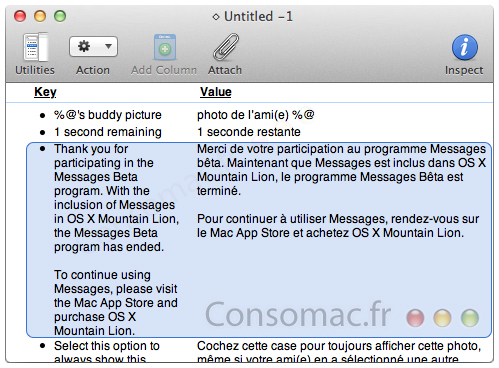
Apple may have released a public beta version of Messages for Lion yesterday, but from what Consomac has discovered, it may only be a temporary situation. Digging into the text strings inside the app’s resources found one particular string which said:

Thank you for participating in the Messages Beta program. With the inclusion of Messages in OS X Mountain Lion, the Messages Beta program has ended.

To continue using Messages, please visit the Mac App Store and purchase OS X Mountain Lion.

This suggests that once the Messages beta has concluded, the app will cease to work and users will have to purchase Mountain Lion to continue using the Messages app.

[Via MacRumors]