Posts tagged with "Epic Games"

Google and Epic Games’ Settlement Is Far from a Done Deal

Last week, Epic and Google made a big show of settling their antitrust dispute. The only trouble is that they didn’t do so until after the judge in the case had entered a permanent injunction requiring Google to make changes to how it operates its Play Store, which were upheld on appeal. That makes it harder to settle, as the mobilegamer.biz reports today:

The agreement was framed by Epic and Google as a conclusion to the court battle between the two that has been rumbling on since 2020. But a report from Law360 quotes the Judge overseeing the case as saying the proposals do not go far enough to rectify Google’s behaviour. Judge Donato also wants another hearing in December or January to straighten it all out.

“My concern here is that these proposed modifications … [are] not providing an adequate remedy for Google’s wrongdoing,” said Judge Donato, according to Law360.

This sort of thing isn’t unheard of, especially when the dispute is over a legal issue that takes into account the effect on consumers along with the parties involved. The judge in the case has scheduled hearings for December and January to consider the proposed settlement, but it looks like this case could end up in the U.S. Supreme Court after all.

Permalink

Proposed Epic–Google Deal Would Expand Access to the Play Store

Late yesterday, Epic Games and Google announced a settlement of their Google Play Store litigation that, subject to court approval, would open Google’s storefront more widely than ever before.

Like Apple’s revisions to its store in response to the European Commission, Google’s settlement is complex, but here are some of the highlights, as reported by Sean Hollister for The Verge:

  • Whereas the U.S. District Court’s injunction only applied to the U.S. Play Store, the settlement is global.
  • The settlement also runs through 2032, which extends beyond the three years ordered by the court.
  • Google has agreed to reduce its standard fee to 20%, and in some cases, 9% depending on the type of transaction.
  • Google will create a registration system to allow third-party storefronts.
  • Developer fees for using Play Billing, Google’s payment system, will be separated from the transaction fees.

As I said, though, there’s a lot more to the proposed settlement that you can read in full in the PDF linked in The Verge’s story, and it’s subject to court approval, but it does seem to reflect significant concessions by Google.

What does this mean for Apple and its App Store skirmishes with regulators around the world? Nothing technically; however, contextually, if the settlement is implemented, it should add to the pressure on Apple to open the App Store more widely in the U.S. and elsewhere.

Permalink

Apple Denied a Stay of Judge Gonzalez Rogers’ Contempt Order

Reuters reported today that the United States Court of Appeals for the Ninth District has denied Apple’s motion to stay the effect of District Judge Gonzalez Rogers’ contempt order that required the company to allow developers to link to payment processing outside the App Store. Had Apple prevailed, Judge Gonzalez Rogers’ order would have been put on hold, allowing Apple to prevent developers from linking to external payment processing. Instead, developers can continue to add external payment options to their apps, which many already have.

The burden for staying an order pending appeal is high. As the Court of Appeals explained in its order:

In deciding whether to impose a stay, we consider:

“(1) whether the stay applicant has made a strong showing that he is likely to succeed on the merits;
(2) whether the applicant will be irreparably injured absent a stay;
(3) whether issuance of the stay will substantially injure the other parties interested in the proceeding; and
(4) where the public interest lies.”

Nken v. Holder, 556 U.S. 418, 426 (2009) (quoting Hilton v. Braunskill, 481 U.S. 770, 776 (1987)).

This doesn’t mean Apple has no chance to win on appeal, but as the Ninth Circuit said quite bluntly in its order:

…we are not persuaded that a stay is appropriate.

And, given that the first factor the court decided was whether Apple is “likely to succeed on the merits,” things are not looking promising.

In a statement to 9to5Mac, an unnamed Apple spokesperson said:

We are disappointed with the decision not to stay the district court’s order, and we’ll continue to argue our case during the appeals process. As we’ve said before, we strongly disagree with the district court’s opinion. Our goal is to ensure the App Store remains an incredible opportunity for developers and a safe and trusted experience for our users.

Given that the writing is on the wall for the appeal, you can bet Apple is already looking ahead to the U.S. Supreme Court and will use the Ninth Circuit case as a dry run for that subsequent appeal.


Developers and Platforms React as App Store Rules Change in the U.S.

On Wednesday evening, Judge Yvonne Gonzalez Rodgers held Apple in contempt, ordering, among other things, that it immediately drop the 27% fee it was charging developers who linked users to the web for purchases. As the judge put it:

This is an injunction, not a negotiation. There are no do-overs once a party willfully disregards a court order. Time is of the essence. The Court will not tolerate further delays.

(Contempt Order at pg. 3).

As Chance Miller reported at 9to5Mac, those changes are already reflected in Apple’s App Review Guidelines. In an email sent to anyone with a developer account, Apple explained:

The App Review Guidelines have been updated for compliance with a United States court decision regarding buttons, external links, and other calls to action in apps. These changes affect apps distributed on the United States storefront of the App Store, and are as follows:

  • 3.1.1: Apps on the United States storefront are not prohibited from including buttons, external links, or other calls to action when allowing users to browse NFT collections owned by others.
  • 3.1.1(a): On the United States storefront, there is no prohibition on an app including buttons, external links, or other calls to action, and no entitlement is required to do so.
  • 3.1.3: The prohibition on encouraging users to use a purchasing method other than in-app purchase does not apply on the United States storefront.
  • 3.1.3(a): The External Link Account entitlement is not required for apps on the United States storefront to include buttons, external links, or other calls to action.

(Source: Apple email to developers on May 1, 2025).

Notably, the changes affect only the U.S. App Store, further fragmenting App Store rules along geopolitical boundaries which began with regulations in China, South Korea, Japan, the Netherlands, and the EU.

Probably the best evidence that Apple’s former rules were restraining competition is the flurry of additional news since Judge Gonzalez Rodgers’ ruling:

  • As I predicted in my story, Patreon has said it will submit an update to its app to allow creators to accept payments outside its iOS app, something that was possible until last summer when Patreon was forced to retrofit its app to account for Apple’s In-App Purchases and payments through its website in what was an inelegant solution that forced creators to either charge more on iOS or absorb Apple’s fees on what are often small monthly payments to begin with.
  • Spotify posted on its blog that it has already submitted an update to its app that will let users see how much a Spotify subscription costs from inside the app and link out to Spotify’s website to upgrade or change their subscription plans.
  • Payment processor Stripe whipped up documentation guiding developers through the process of setting up subscription and digital goods sales outside their apps.
  • Beginning in June, the Epic Games Store will handle payment processing for developers at no cost up to the developers’ first $1 million of revenue. After $1 million of revenue the split will be the existing 88% to developers and 12% to Epic Games. In June, Epic Games will also offer developers the ability to set up their own webshops for ‘out-of-app purchases.’ The webshops will be available to iOS developers in the U.S. and EU and users making purchases in them will get 5% back in Epic Rewards for their purchases. Epic Games has not said how much it will charge developers who set up a webshop.

These moves by big players aren’t surprising, and I’m sure we’ll see more companies explore ways to take advantage of Wednesday’s ruling. Over time, though, the more interesting consequence of Wednesday’s ruling will be whether and how it changes the business models of indie developers and other small businesses that offer apps.



A Breach of Trust: Apple Held in Contempt Over App Store Rules

Late yesterday, U.S. District Judge Yvonne Gonzalez Rogers issued a blistering opinion, concluding that Apple had willfully disregarded the Court’s 2021 injunction, which found that the anti-steering provisions of the App Review Guidelines violated California state law. Judge Gonzalez Rogers also referred Apple’s conduct to the U.S. Attorney to investigate whether criminal prosecution of the company and one of its employees is warranted. For its part, Apple has said it disagrees with the decision and will appeal, but it will comply with the Court’s order in the meantime.

If that all sounds like it’s a big deal, that’s because it is. Judge Gonzalez Rogers’ 80-page opinion and order don’t pull any punches, painting a damning picture of Apple’s response to the Court’s injunction. It’s a unique and unflattering look behind the curtain at how Apple responded to the Court’s 2021 order that’s worth looking at more closely.

Read more


Epic Games Announces iOS Store Expansion in the E.U.

The Epic Games Store, which is available in the E.U. on iOS as a result of the Digital Markets Act and globally on Android, is expanding.

During a press briefing, Epic’s Tim Sweeney said:

Our aim here isn’t just to launch a bunch of different stores in different places, but to build a single, cross-platform store in which, within the era of multi-platform games, if you buy a game or digital items in one place, you have the ability to own them everywhere.

As part of the store expansion, The Verge’s Lauren Feiner reports that Epic will cover Apple’s E.U. Core Technology Fee charged on free games for the first 12 months. Epic will also offer monthly free games, and eventually, weekly freebies. The new games aren’t available just yet, but should be soon.

It’s good to see Epic expanding its offerings on iOS and Android. Alternative marketplaces have grown slowly in the E.U., but with Epic willing to reduce the financial risk of Apple’s Core Technology Fee, we should start seeing Epic’s store expand more rapidly.

Permalink

The Epic Cost of Tim Sweeney’s App Store Disputes with Apple and Google

Source: Epic Games.

Source: Epic Games.

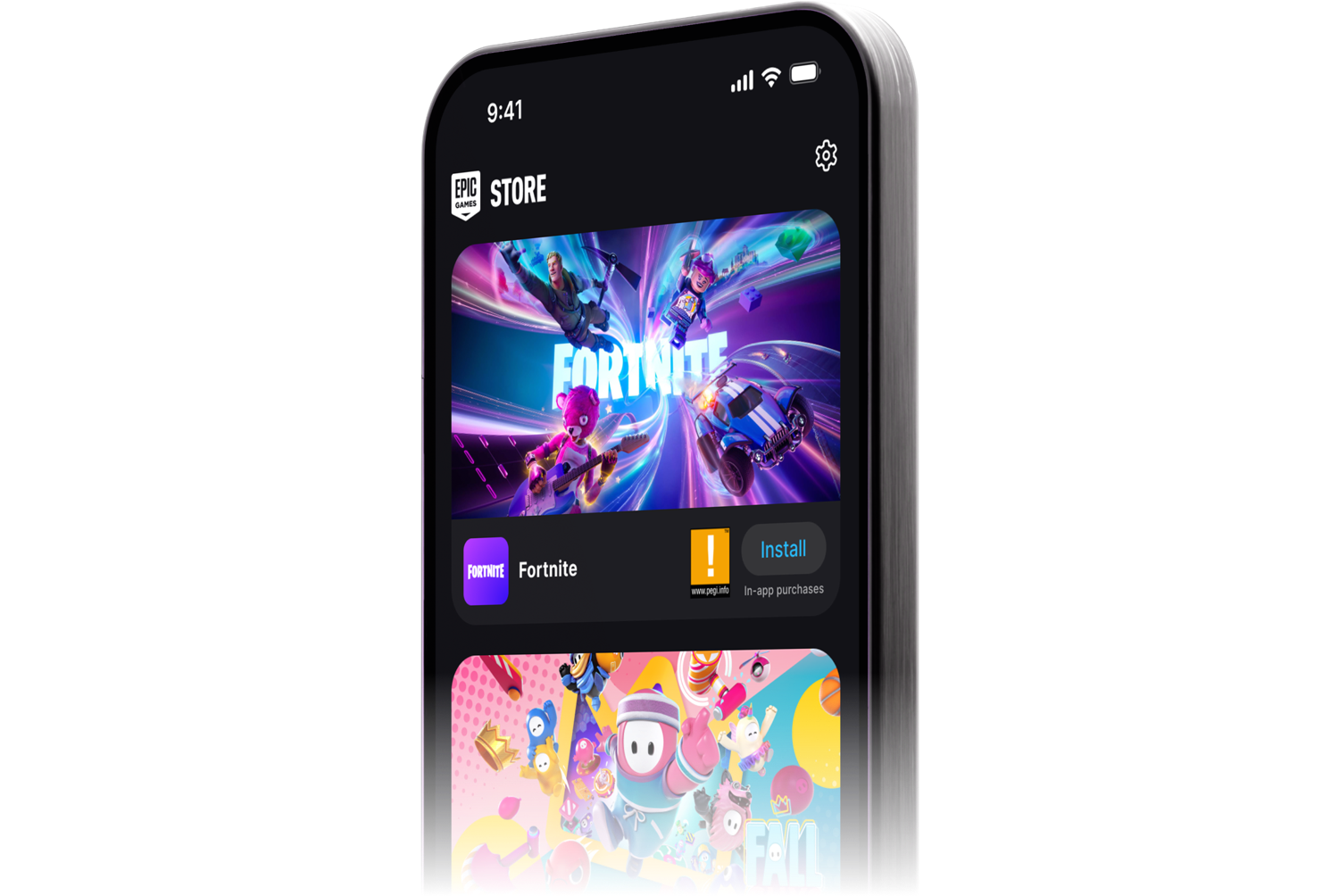
Epic Games launched its iOS alternative app marketplace in the EU today with three of its games: Fortnite, Rocket League Sideswipe, and Fall Guys. Those games are also available from AltStore PAL and will be available later from Aptoide, both of which offer alternative storefronts in the EU. Epic has also said that third-party games will be added by the end of the year.

According to Stephen Totilo, who interviewed Epic CEO Tim Sweeney and others earlier this week for his excellent newsletter Game File:

The company has spent hundreds of millions battling Apple and Google since 2020 to get to this point, Sweeney told Game File during an interview conducted earlier this week.

And, he added, Epic may have missed out on as much as $1 billion in Fortnite revenue in the process,

Tim Sweeney can be a little over the top at times when talking about his company’s disputes with Apple and Google, but his in-depth response to Totilo’s question about the impact of App Store fees on the mobile gaming industry are excellent and rang true to me. Both he and Altstore co-founder Riley Testut explained to Totilo that mobile gaming and Apple would thrive if fees were reduced, with Testut pointing to changes in App Review Guidelines about emulators and virtual machines as evidence of the positive results of competition.

For anyone in the EU interested in installing the Epic Game Store, Epic has published a walkthrough video on YouTube:

Permalink

Fortnite Coming to AltStore PAL as Epic Announces New Plans for Distribution

Yesterday, AltStore co-creator Riley Testut posted on Mastodon that the ‘cat’s out of the bag.’ That cat was the announcement from Epic Games that their hugely popular game ‘Fortnite’ would be coming to AltStore PAL in the EU.

Epic had previously announced they would be launching the Epic Games Store in the EU on iOS and worldwide on Android ‘soon’ with what they called ‘great terms’ for developers. However, this announcement of their most popular title coming to an alternate App Store was somewhat of a surprise.

In the statement, Epic also said they plan to bring their games — including Fortnite — to other mobile stores, though AltStore PAL was the only one confirmed.

This being Epic Games, the statement didn’t forget to take some shots at the larger App Store owners. In addition to mentioning the recent legal battles Apple and Google have faced in Europe, the statement also reminded everyone of Epic’s win against Google in the US before making one final announcement.

In what Epic Games called a ‘protest of Samsung’s anticompetitive decision to block side-loading by default on Samsung Android devices,’ the company announced it would be withdrawing Fortnite and their other games from the Samsung Galaxy Store.

While it was only one sentence in another spicy statement from Epic Games, the announcement of Fortnite on AltStore PAL is a testament to the hard work Riley Testut and Shane Gill have put into the store. It’s also the realization of a joke Riley made way back in 2020.

Permalink