Apple Begins Switching Apple Music Subscribers to Audio Fingerprint-Based Song Matching

A major complaint about Apple Music when it rolled out was that it used a metadata-based matching system, which sometimes caused it to incorrectly match songs in users’ music libraries with Apple’s database. Jim Dalrymple reports for The Loop, that:

Apple has been quietly rolling out iTunes Match audio fingerprint to all Apple Music subscribers. Previously Apple was using a less accurate metadata version of iTunes Match on Apple Music, which wouldn’t always match the correct version of a particular song. We’ve all seen the stories of a live version of a song being replaced by a studio version, etc.

According to Dalrymple, the audio fingerprint matching system that Apple is slowly rolling out to Apple Music is the same system that has been available to customers who subscribe separately to iTunes Match. The new matching functionality is being added by Apple at no additional cost to Apple Music subscribers, which means that if you previously subscribed to Apple Music and iTunes Match, there should be no reason to renew your iTunes Match subscription when it expires. As Jim Dalrymple points out, however, you may want to be sure that the new system is working properly before letting Match expire.

Permalink

GlaxoSmithKline Launches Rheumatoid Arthritis Study Using ResearchKit

Pharmaceutical giant GlaxoSmithKline announced a rheumatoid arthritis study today that takes advantage of Apple’s ResearchKit frameworks. According to Glaxo’s press release:

We are the first in our industry to use Apple’s ResearchKit as part of our research, this time looking at the impact a patient’s disease has on their day-to-day life.

Glaxo will use the app,

to conduct surveys and use iPhone sensors to collect and track common symptoms of rheumatoid arthritis: joint pain, fatigue, and mood. It will also track activity and quality of life measures for 300 patients over a three-month period. 

The app, called GSK PARADE, is available now on the App Store as a free download. Rheumatoid arthritis patients who live in the US and are 21 or older can apply to participate in the study using the app.

Since its introduction last year, ResearchKit has been used to study diabetes, asthma, and a number of other conditions. Last Fall, Apple announced that more than 50 researchers had contributed active tasks in 6 months and more than 100,000 participants had contributed data to ResearchKit. It’s good to see ResearchKit’s use continue to expand in the health care and pharmaceuticals industries.

Permalink

Game Day: klocki

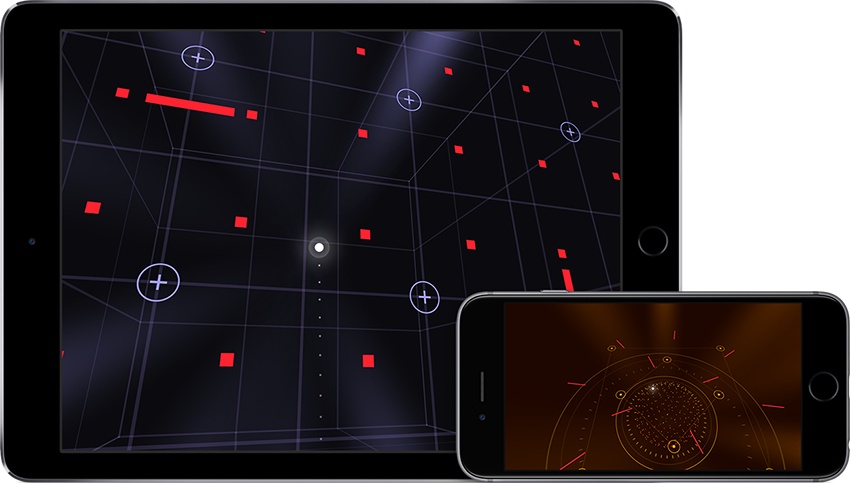
After last weekend’s fast-paced, stress-inducing racing game, Neon Drive, I wanted to play something a little more laid back and mellow this week. I found the perfect game in klocki, a new iOS puzzle game that launched earlier this week.

klocki is from Maciej Targoni, the maker of Hook, a well-regarded puzzler that came out early last year. The tile-based puzzle game is singularly focused on revealing itself through its puzzle mechanics and designed to be relaxing. There are no tutorials, instructions, or text. You play klocki at your own pace, discovering the rules organically as you play.

The goal of klocki, at least in the early stages, is to complete lines by swapping pairs of tiles. When you complete a puzzle, you only advance to the next one after you tap the screen. You are completely in control of the pace of klocki, which is backed by a soothing soundtrack by Wojciech Wasiak.

As you progress through klocki, things get trickier. The 2D puzzles gain a third dimension, the puzzles become larger, and the mechanics become more complex, making it harder to work out the solutions. No worries though, there are no timers or score. It’s just you against each puzzle.

klocki, which was featured on the App Store this week, is the kind of distraction I look for more often than not in an iOS game. It’s challenging without being frustrating and as easy to pick up for short periods of time as it is for an hour.

klocki is available on the App Store for $0.99.


Connected, Episode 99: European Exotic

For episode 99, listener Nathan sent in the best follow-up of all time. After that, the boys talk about Stephen’s PowerBooks, Myke’s two-factor authentication pains and Federico’s new line of work.

Don’t miss the prescient follow-up in this week’s episode of Connected. You can listen here.

Sponsored by:

  • Casper: Because everyone deserves a great night sleep. Get $50 off with the code ‘CONNECTED’
  • MartianCraft: Training crafted just for you.
  • Braintree: Code for easy online payments.
Permalink

Razer Launches Mechanical Switch Keyboard for iPad Pro

Razer, best known for making mice and keyboards for gamers, announced a keyboard case for the 12.9” iPad Pro that features mechanical backlit keys with twenty levels of brightness and a kickstand that allows for multiple viewing angles. Razer’s keyboard, dubbed the Razer Mechanical Switch Keyboard, connects over Bluetooth and includes what Razer calls an Ultra-Low-Profile Mechanical Switch that it says delivers ’the exact same performance and feel as a full-fledged mechanical keyboard.’ With backlighting enabled, Razer estimates you will get 10 hours of battery life. With backlighting turned off, however, Razer says its keyboard will last a whopping 600 hours. Razer’s keyboard is available for purchase in the US for $169.99 with other countries to follow.


Eddy Cue on Apple TV and Apple Music

Eddy Cue, Apple’s senior vice president of Internet Software and Services sat down with The Hollywood Reporter to talk about Apple TV and Apple Music. In response to questions aimed at understanding Apple’s place in Hollywood and its media ambitions, Cue focused primarily on media distribution and the role Apple can play to improve it for consumers:

The problem with it is the way that we end up consuming it — generally a cable box. A satellite receiver is, to me, nothing more than a glorified VCR. And so I think there’s huge opportunities in that space because people now want to watch on their phones, they want to watch on their iPads, and they want to watch on their TVs.

Cue also threw cold water on the notion that Apple is getting into the business of creating TV shows like Netflix, Amazon, and HBO do:

We’re not in the business of trying to create TV shows. If we see it being complementary to the things we’re doing at Apple Music or if we see it being something that’s innovative on our platform, we may help them and guide them and make suggestions. But we’re not trying to compete with Netflix or compete with Comcast.

Finally, in comments reminiscent of the interviews with playlist curators at Apple Music published by BuzzFeed yesterday, Cue explained that Apple Music:

… can’t be about a service that’s just providing the songs, because anybody can do that. It starts by the level of integration that we have within our product. Second of all, we do a lot of curation. Third is radio.

As a hardware manufacturer first and foremost, Apple’s approach to Hollywood content makes sense and reminds me in many ways of its approach to third-party app developers.

Permalink

The Enormity and Precision of Apple Campus 2’s Glass Structures

The scale of Apple Campus 2 is hard to comprehend. Built on 176 acres in Cupertino, California that was previously owned by Hewlett-Packard, Apple Campus 2 will have a circumference of one mile and accommodate around 13,000 employees.

Just as hard to grasp is the level of precision and detail that has gone into building Apple Campus 2. Apple Insider takes a look at the thought and care that has gone into one aspect of Apple Campus 2 – the glass.

The vast glass façade panels surrounding the exterior Spaceship Ring are 46 foot (14m) long and more than 10 feet (3m) tall, while the interior, courtyard-facing panels are just under 36 feet (11m) long. Both sets of panels are precisely curved to form the iconic building’s cylindrical glass curtain.

Apple Insider explores the process by which sedak, a German glass manufacturer that has worked on projects like the glass staircases in some Apple stores, built hundreds of giant curved-glass panels to within 0.8mm of Apple’s specifications, which is a substantially closer tolerance than standard glass panels. Once completed, each panel weighs up to 2 tons and was shipped across the Atlantic Ocean, through the Panama Canal, and then trucked to Cupertino in 20 ton bundles.

While the story behind the enormous glass installation at Apple Campus 2 is impressive in its own right, I agree with Apple Insider that:

Apple’s ability to design and implement products ranging from the microscopic A10 [chip] to the massive Campus 2 to the human scale of Mac Pro—and its ability to partner with both leading, global giants and groups of smaller, local businesses—suggests incredible potential for the company in other new markets, ranging from clean energy to automotive to new cloud services and advanced new computing devices.

Permalink

Profiles of Playlist Curators at Apple Music, Spotify, and Google Play

BuzzFeed has a fantastic feature post by Reggie Ugwu that goes inside the teams that create playlists for Apple Music, Spotify, and Google Play.

Ugwu explains that:

In the two years since the Beats acquisition, three of the largest services, including Apple Music, Spotify, and Google Play Music (and smaller ones like Tidal and Rhapsody, too), have increasingly relied on these playlists to accomplish two important goals at once: 1) helping users inundated by a catalog of more than 30 million songs more easily find the ones they actually want, and 2) creating difference in a market where everyone has more or less the same goods.

That’s a tall order. Discovery of digital media, whether it’s music, apps, or something else, is tough when many people are browsing vast media collections on their phones. Early attempts to curate music focused heavily on algorithmic solutions, but increasingly, streaming music services have invested in building editorial teams of music experts to create hand-picked playlists for subscribers.

One of the earliest champions of curated playlists was Jimmy Iovine, co-founder of Beats Music, which was acquired by Apple in 2014. Scott Plagenhoef, head of Apple Music’s editorial team of about a dozen employees, explains Apple’s Iovine-inspired approach to music curation:

“It’s not about us projecting our personal opinions on people, it’s about us kind of being good shepherds and stewards and cutting through this entire vast catalog,” he says. “What’s important isn’t just the most popular artists, or the sort of soft center that’s going to be palatable to a lot of people. It’s finding the artists people are going to either love or have intense reactions to, the ones that are going to mean the most and have the biggest impact.”

Music fans, Plagenhoef argues, echoing Iovine, can smell the difference between a service where much of the product is dictated by algorithms or charts and one that is guided by more knowledgeable but equally passionate versions of themselves. By building its house on a foundation of experts, Apple Music has bet that it can be marginally more trustworthy to users than the competition, and that that margin could make a tie-breaking difference.

As a life-long music fan, I don’t find this as particularly surprising, though maybe I would if I were approaching music curation from a purely technical standpoint. There are lots of clever things you can do algorithmically to group similar songs, but the human element makes a difference.

Permalink