
 MacStories Weekly: Issue 115
YouTube’s Apple TV App Scores a Redesign
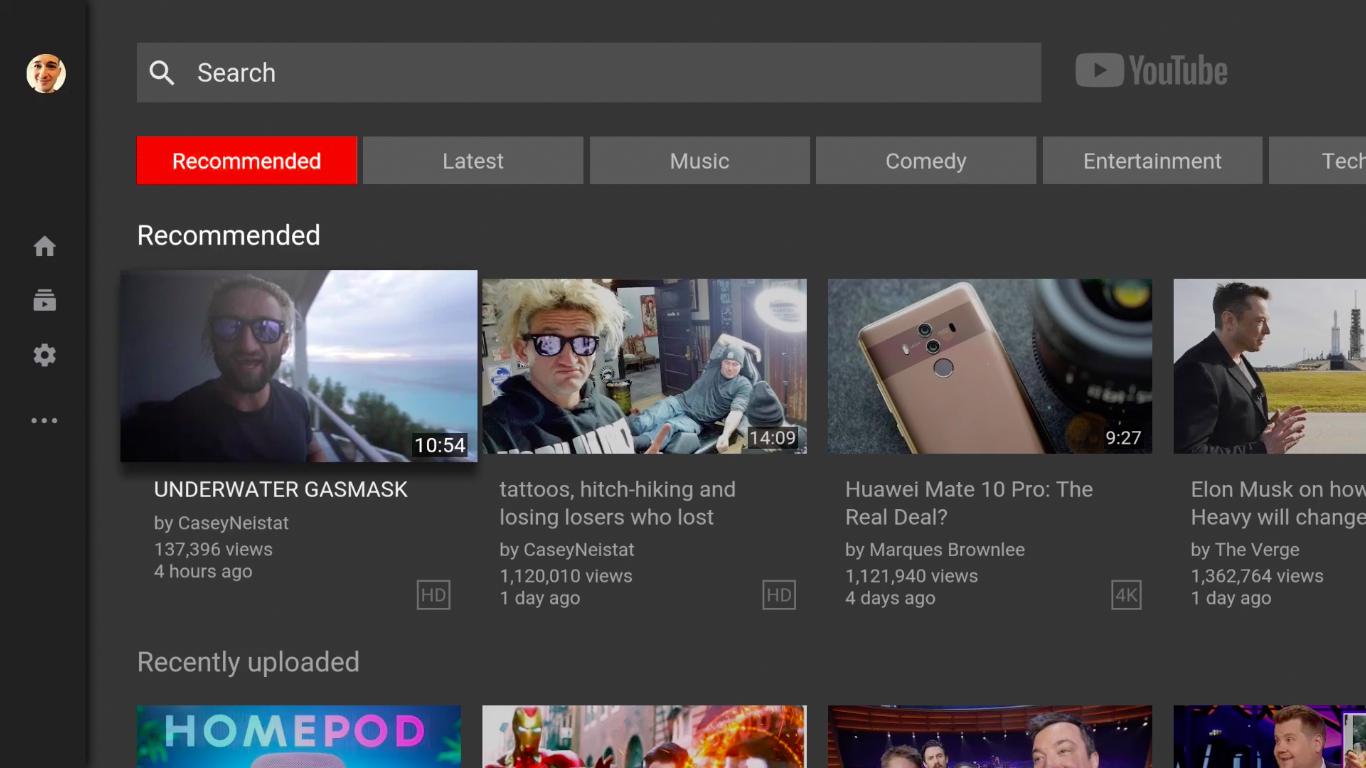
YouTube has released a major update to its Apple TV app, bringing the first major redesign since the app launched in late 2015.
The Problem of Many Siris→
Bryan Irace writes about one of the biggest challenges Apple faces with Siri:
It’s no easy task for a voice assistant to win over new users in 2018, despite having improved quite a great deal in recent years. These assistants can be delightful and freeing when they work well, but when they don’t, they have a tendency to make users feel embarrassed and frustrated in a way that GUI software rarely does. If one of your first voice experiences doesn’t go the way you expected it to – especially in front of other people – who could blame you for reverting back to more comfortable methods of interaction? Already facing this fundamental challenge, Apple is not doing themselves any favors by layering on the additional cognitive overhead of a heavily fragmented Siri experience.
I think Irace is right on in this observation – Siri’s fragmentation is a real problem.
On the more optimistic side, it could be taken as good news that the fix appears fairly obvious: create a single Siri that’s consistent across all platforms. This seems like it would be a clear net positive, even though such a change could reduce Siri’s accuracy in some cases; for example, I’m guessing Siri on the Apple TV is currently tuned to expect TV and movie queries more than anything else, so it can more effectively produce the right kind of results – tweak that tuning, and Apple will have to work even harder at helping Siri understand context.
One thing that’s concerning about the apparent simplicity of this fix is that Apple hasn’t made it yet, meaning, perhaps, that the company thinks there’s nothing wrong with Siri’s current fragmentation. This conversation would be different entirely if Apple had begun showing an increased effort to unify Siri across its platforms, but recently, the opposite has been true instead. The latest major Apple product, HomePod, includes a stripped-down Siri that can’t even handle calendar requests. And SiriKit, which launched less than two years ago, was designed in a way that fundamentally increases fragmentation. Irace remarks:
If the Lyft app is installed on your iPhone, you can ask Phone Siri to order you a car. But you can’t ask Mac Siri to do the same, because she doesn’t know what Lyft is. Compare and contrast this with the SDKs for Alexa and the Google Assistant – they each run third-party software server-side, such that installing the Lyft Alexa “skill” once gives Alexa the ability to summon a ride regardless of if you’re talking to her on an Echo in your bedroom, a different Echo in your living room, or via the Alexa app on your phone.
The only recent occasion that comes to mind when Siri has moved in the right direction – gaining knowledge on one platform that previously existed only on another – was when iOS 10.2 brought the full wealth of Apple TV Siri’s movie and TV expertise to iOS. This only happened, though, because iOS 10.2 introduced the TV app.
Until Siri can answer the same requests regardless of what platform you’re on, most people simply won’t learn to trust it. Users shouldn’t have to remember which device’s Siri can answer which questions – all they should have to remember is those two key words: “Hey Siri.”
Media Outlets Use ARKit to Bring the News into Your Living Room
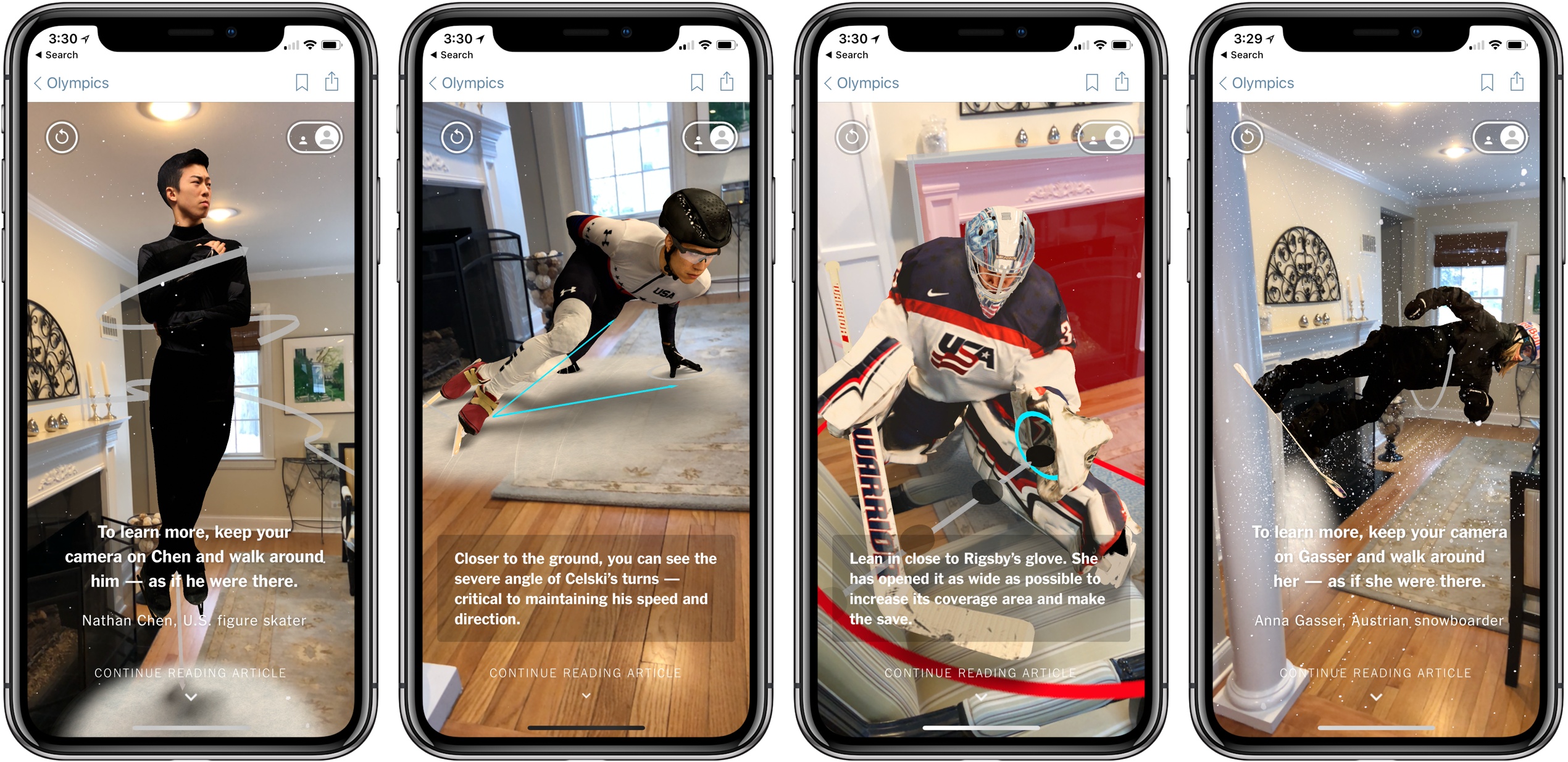
Last week, The New York Times announced that it had added an augmented reality feature to its iOS app. The first article with embedded AR content was a preview of the feature published last week that explained to readers how it worked. At the bottom of the article was a newspaper box that could be dropped into your surroundings. I showed it off to some friends over the weekend, and everyone was impressed by how realistic it looked as they walked around the box in a neighbor’s kitchen.

This week, the Times rolled the feature out as part of its Winter Olympics coverage. In Four of the World’s Best Olympians, as You’ve Never Seen Them Before, the publication spotlights figure skater Nathan Chen, speed skater J.R. Celski, hockey player Alex Rigsby, and snowboarder Anna Gasser. The results are impressive. I placed each athlete in my living room, then walked around them. From each angle, snippets of text about what I was seeing were overlaid on the image providing additional details and context. The app also makes use of haptic feedback on the iPhone to alert users to new information as they examine a scene.
Connected , Episode 179: The Tiny Head Pandemic→
The boys are joined by Emojipedia founder Jeremy Burge to talk about a rash of App Store rejections regarding the use of emoji. After that, discussion turns to HomePod reviews and the possibilities of watchOS 5.
Another fun episode of Connected this week, with a great discussion about a recent emoji controversy with the Master of emoji himself, Jeremy Burge. You can listen here.
Sponsored by:
- Linode: High performance SSD Linux servers for all of your infrastructure needs. Get a $20 credit with promo code ‘connected2018’
- Squarespace: Make your next move. Enter offer code WORLD at checkout to get 10% off your first purchase.
- Casper: Start sleeping ahead of the curve. Get $50 off select mattresses with the code ‘CONNECTED’.
New Emoji Announced for 2018→
Today the latest batch of emoji approved for addition to the Unicode standard was announced. Jeremy Burge at Emojipedia has the scoop:
The emoji list for 2018 has been published which adds 157 new emojis to the standard. This brings the total number of approved emojis to 2,823.
The latest emoji set includes (finally!) a redhead option, along with a superhero and super villain, kangaroo, llama, bagel, cupcake, and much more.
Emojipedia has created a video featuring designs of the newly approved emoji in a style resembling Apple’s emoji set. While we won’t get a glimpse at Apple’s own designs until later in the year, the video does a great job providing a preview of what we can expect.
In recent years it has become tradition for Apple to add the newest emoji to a point release of iOS, so if that pattern holds, we’ll get our hands on these newest emoji options with iOS 12.1 or 12.2 before the end of the year.
What Is Apple’s Video Strategy?→
Pavan Rajam shares a broad look at Apple’s video-related efforts, evaluating the company’s current position and its potential for greater impact in the fast-shifting market.
Today, there is no meaningful exclusive video content on Apple platforms. Apple, thus far, has relied on its design and engineering prowess to differentiate its video offerings.
It’s clear this strategy isn’t working.
The iTunes Store is arguably the best transactional video storefront, but that alone is not enough to stop consumers from adopting subscription services. The TV app has a great UI and cross app integration, but that does not justify the $150 price to get it on your TV. Apple TV is the best designed, most capable streaming video box on the market, but that isn’t enough to justify its premium pricing when the same streaming services are available on every other platform with a significantly lower cost of entry.
Rajam’s overview makes clear the significant challenges Apple faces in this market. Though the company is making heavy investment in developing original content, it’s unknown what the plan for distributing that content will be: will it be widely available across all platforms, or exclusive to Apple hardware? Both approaches have clear benefits and drawbacks, so the question goes back to what the bigger goal is.
Apple ultimately has to decide what is more important: Apple TV as a premium hardware product line or a streaming video service that runs across all of its platforms.
I expect that by the end of this year, whether Apple’s video content is released by then or not, we will at least have the answer to that question.
Currently, a big reason video services like Netflix thrive is that they’re available to a huge number of customers – regardless of what TV, phone, or computer you own, you can get Netflix. It would be against industry practice for Apple to create a video streaming service that’s exclusive to its hardware. Hollywood likely wouldn’t appreciate that either, as creators want their work shared as widely as possible. For those reasons, I have a hard time seeing Apple launch a service that isn’t, at the very least, available to users on some other platforms.
If Apple did make its service available on select other platforms, such as Android and the web, it could still position Apple TV as the only way to watch its shows on the big screen. Non-Apple users would still have access to the service, but if Apple does its job and creates truly compelling new shows that people love, many of those users may then be willing to splurge for a premium set-top box. Asking anyone to pay $150 for access to a streaming service is a hard sell, but if you can first hook people on shows they love, they’ll eventually want to watch those shows in a way that’s most comfortable: on their TV.
AppStories, Episode 41 – iOS 11’s Effect on Our iOS Habits→
On this week’s episode of AppStories, we take a look at how iOS 11 has changed not only the way we work, but also how it has impacted our use of lifestyle, health and fitness, media consumption, and other types of apps.
Sponsored by:
- WALTR 2 - A Magic Drop Area to Convert & Push Media into Any iPhone, iPad or iPod
- Use the coupon code APPSTORIES for 30% off
AppStories Episode 41 - iOS 11’s Effect on Our iOS Habits
0:00
38:23
38:23






Slack Overhauls Emoji Support Across Platforms→
In other emoji-related news, Slack today announced that they’re going to support new emojis (including those from Emoji 5.0 released in 2017) across multiple platforms. If you use Slack on a regular basis, you know that the company has been notoriously slow over the past couple of years in adopting the latest emojis despite having launched features based entirely on them.
As noted by Jeremy Burge at Emojipedia, however, better emojis on Slack have brought a deeper change for Slack users on non-Apple platforms:
Users of iOS or macOS will see the least change to design in this release, as Slack previously defaulted to using Apple designs on all platforms.
Apple’s emoji designs remain the set displayed when accessing Slack on any Apple platform.
Those using on Windows, Android, or any non-Apple platform will see a consistent set between: but it’s not what you might expect. Google’s emoji designs are being used for all non-Apple platforms now as shown by this alert:
And:
While Apple’s emoji font is entirely owned and copyrighted by Apple, Google’s emoji font (named Noto Color Emoji) is provided with an open source license which allows other projects to use this within the terms set out in the SIL Open Font License. Given this, it’s possible that Slack believes it is on firmer ground to be using Noto Color Emoji rather than embedding Apple emoji images on competing platforms.
Jason Snell argues that this move will lead to a different emoji experience for Slack users who access the service from non-Apple platforms:
The result is emoji fragmentation, where different users of Slack will see different versions of the same general concept. Also, users like my friend Erika might prefer one set of emoji designs to another, but they no longer have a choice in the matter.
That’s the bad news. The good news, at least, is that Slack is rolling out support for new emojis, including gender splits and skin tones, that it previously didn’t.
I wonder if Apple’s apparent push toward locking their emoji designs to the iOS ecosystem may have played a role in Slack’s decision to implement an open-source emoji set instead (see also: WhatsApp). Still, I’m happy that I can share all modern emojis on Slack; I’ll have to rethink some of my typical emoji reactions now.