Connected, Episode 232: The Unique Blend of Tattoos and Automation

After skipping follow-up, Myke and Federico try to explain the new USB branding, discuss fingerprint sensors and the merits of Evernote in 2019, and wish for apps that don’t exist (but should).

On this week’s episode of Connected, I share more details about my Evernote experiments as well as an idea for an app I’d like to exist. You can listen here.

Sponsored by:

  • eero: Never think about WiFi again. Get $100 off the ‘Eero base unit and 2 beacons package’, and a year of eero Plus.
  • Luna Display: The only hardware solution that turns your iPad into a wireless display for your Mac. Use promo code CONNECTED at checkout for 10% off.
  • Squarespace: Make your next move. Enter offer code CONNECTED at checkout to get 10% off your first purchase.
Permalink

USB 3.0 and USB 3.1 Merged Under New USB 3.2 Branding

Juli Clover, writing for MacRumors about the latest rebrand in USB spec land:

The USB Implementers Forum (USB-IF), this week announced a rebranding of the USB 3.0 and USB 3.1 specifications, under the USB 3.2 specification. As outlined by Tom’s Hardware, USB 3.0 and USB 3.1 will now be considered previous generations of the USB 3.2 specification.

Going forward, USB 3.1 Gen 1 (transfer speeds up to 5Gb/s), which used to be USB 3.0 prior to a separate rebranding, will be called USB 3.2 Gen 1, while USB 3.1 Gen 2 (transfer speeds up to 10Gb/s) will now be known as USB 3.2 Gen 2.

It gets better though:

If the swap between USB 3.1 Gen 1 and Gen 2 to USB 3.2 wasn’t confusing enough, each of these specifications also has a marketing term. The new USB 3.2 Gen 1 with transfer speeds up to 5Gb/s is SuperSpeed USB, while USB 3.2 Gen 2 with transfer speeds up to 10Gb/s is known as SuperSpeed USB 10Gbps. The USB 3.2 Gen 2x2 specification with transfer speeds up to 20Gb/s is known as SuperSpeed USB 20Gbps.

Make sure to check out the comparison table on MacRumors to admire the full extent of these changes.

As someone who’s been experimenting with USB-C accessories compliant with the USB 3.1 spec over the past few months, I can’t even begin to stress how confusing for the average consumer all of this stuff can be. It took me days to wrap my head around the differences between the physical USB-C connector, the underlying specs it can support, and the DisplayPort compatibility mode – and I do this for a living. In my experience, if you’re looking to buy modern USB accessories compatible with an iPad Pro or MacBook Pro, you’re better off looking for a technical spec label rather than the “friendly names” such as “SuperSpeed”, which manufacturers often fail to mention in their spec sheets.

Until today, if you wanted to buy USB-C accessories supporting the highest data transfer rates on the 2018 iPad Pro, you had to look for devices compliant with USB 3.1 Gen. 2; with today’s rebrand, the 2018 iPad Pro supports USB 3.2 Gen. 2 for transfers up to 10 Gbps, but not the similarly-named USB 3.2 Gen. 2x2. I’m sure this is going to be so easy to explain to someone who’s looking for the “fastest” USB-C cable for their iPad Pro.

Permalink

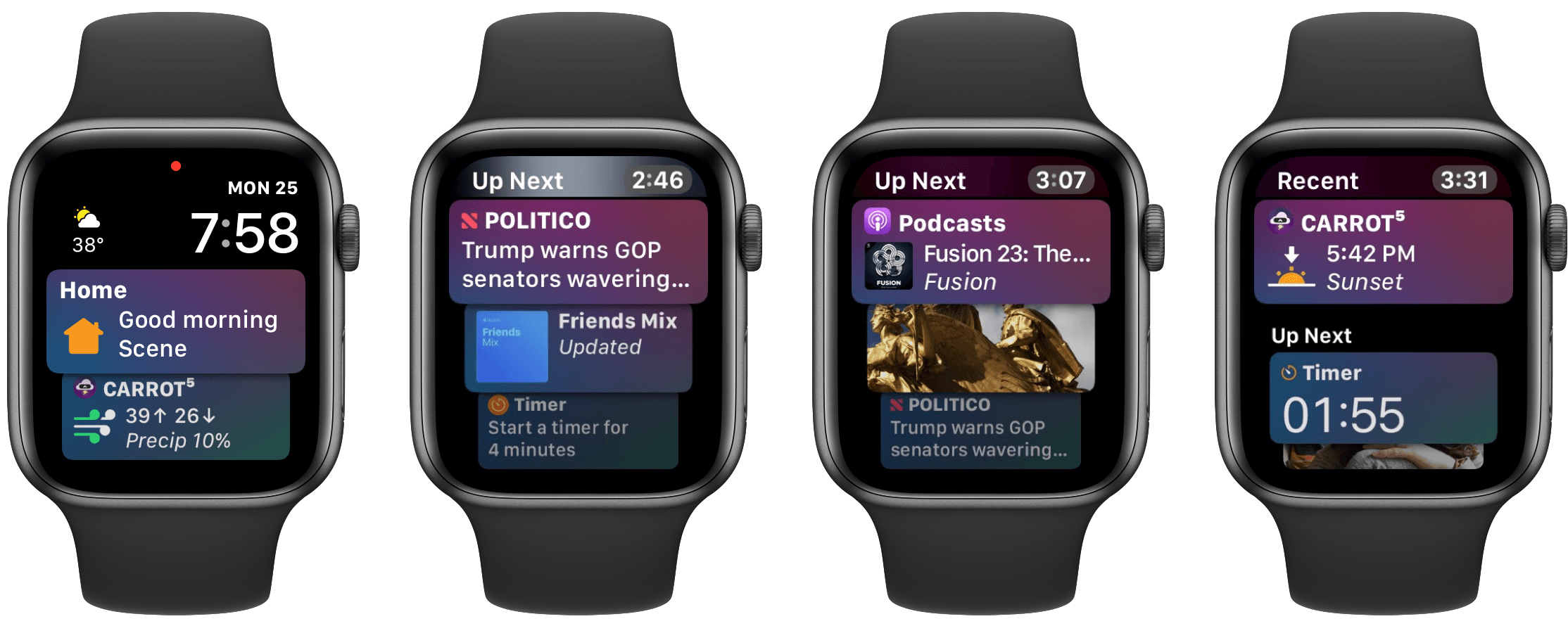
Why the Siri Face Is All I Need from My Apple Watch

What should a wrist computer ideally do for you?

Telling the time is a given, and activity tracking has become another default inclusion for that category of gadget. But we’re talking about a computer here, not a simple watch with built-in pedometer. The device should present the information you need, exactly when you need it. This would include notifications to be sure, but also basic data like the weather forecast and current date. It should integrate with the various cloud services you depend on to keep your life and work running – calendars, task managers, and the like. It doesn’t have to be all business though – throwing in a little surprise and delight would be nice too, because we can all use some added sparks of joy throughout our days.

Each of these different data sources streaming through such a device presents a dilemma: how do you fit so much data on such a tiny screen? By necessity a wrist computer’s display is small, limiting how much information it can offer at once. This challenge makes it extremely important for the device to offer data that’s contextual – fit for the occasion – and dynamic – constantly changing.

Serving a constant flow of relevant data is great, but a computer that’s tied to your wrist, always close at hand, could do even more. It could serve as a control center of sorts, providing a quick and easy way to perform common actions – setting a timer or alarm, toggling smart home devices on and off, adjusting audio playback, and so on. Each of these controls must be presented at just the right time, custom-tailored for your normal daily needs.

If all of this sounds familiar, it’s because this product already exists: the Apple Watch. However, most of the functionality I described doesn’t apply to the average Watch owner’s experience, because most people use a watch face that doesn’t offer these capabilities – at least not many of them. The Watch experience closest to that of the ideal wrist computer I’ve envisioned is only possible with a single watch face: the Siri face.

Read more


AppStories, Episode 100 – App Trends

On this week’s episode of AppStories, we discuss some of the trends we expect will drive app development on iOS and the Mac this year and into the future.

Sponsored by:

  • MacStadium – Private clouds and dedicated Macs for developers and teams doing iOS/Mac app development. Start a Mac mini subscription and get two months for the price of one with the code APPSTORIES.
  • Luna Display – The only hardware solution that turns your iPad into a wireless display for your Mac. Use promo code APPSTORIES at checkout for 10% off.

AppStories+ Deeper into the world of apps
0:00
34:30

AppStories+ Deeper into the world of apps

Permalink

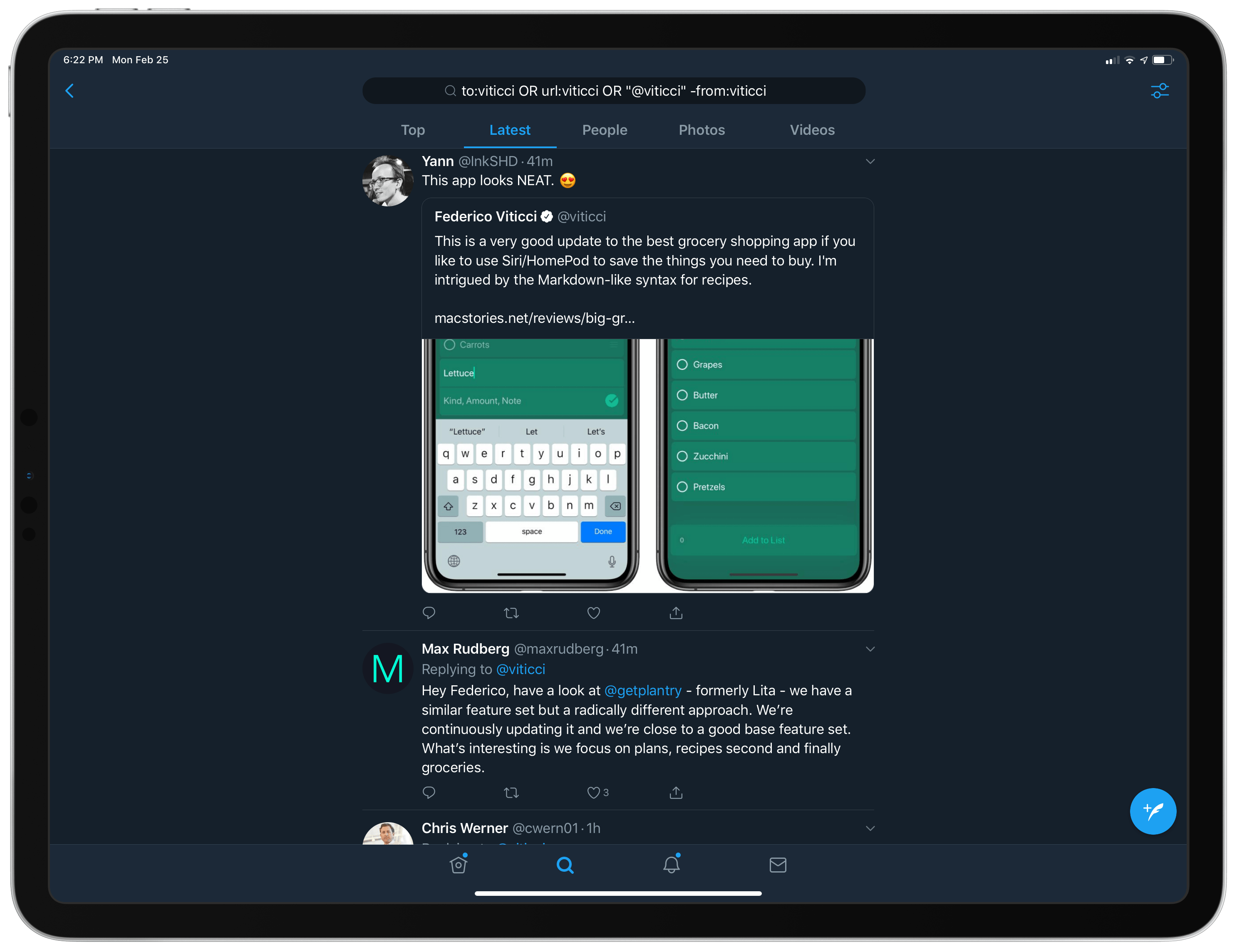
Using a Twitter Saved Search to Read Replies, Mentions, and Quoted Tweets in a Single View

Every few months, I like to use Twitter’s official app for iPhone and iPad for a while and reassess its advantages over third-party clients, as well as its shortcomings. This is something I’ve been doing for several years now. While I’ve often come away unimpressed with Twitter’s native offerings, switching back to Tweetbot or Twitterrific after a couple of days, it’s been a week since I started using the official Twitter app on my iPhone and iPad again and I don’t find myself craving Tweetbot’s UI design or timeline as much as I thought I would.

Read more


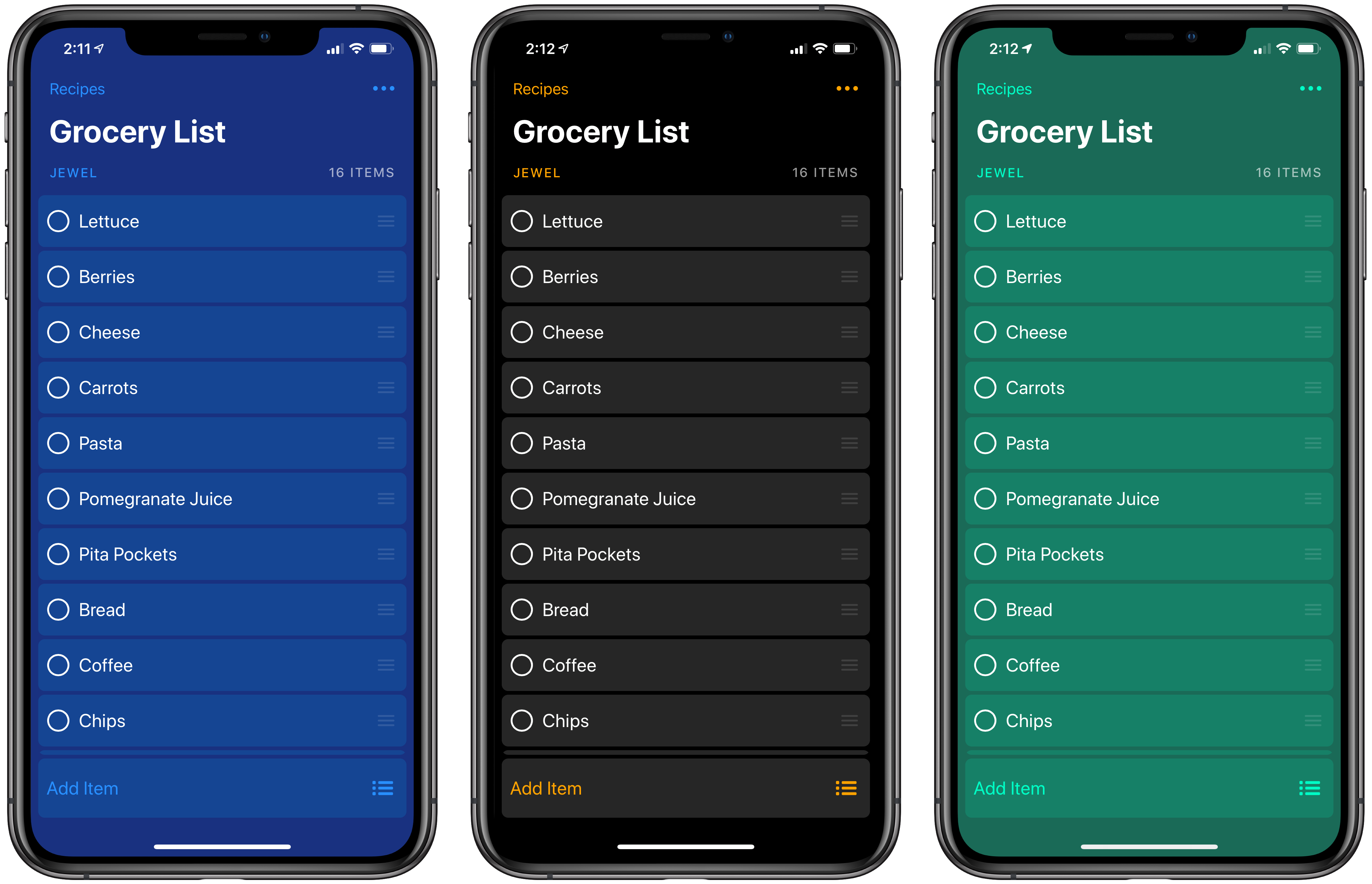
Big Grocery Update Adds Recipe and Meal Planning Support Along with Other Refinements

I’ve used Grocery on and off for a long time, but what finally made it stick in a way that it never did in the app’s early days was the addition of a HomePod in my living room/kitchen area. The app is built on top of Apple Reminders, which means that even from the earliest days of the HomePod, adding items to our family grocery list using Siri was reliable. Grocery’s Siri support was available before the HomePod, but the ability to add things to the list while I’m cooking or rummaging through the refrigerator transformed Grocery into an app I use throughout the week.

With version 2.0, Grocery has added a new level of power to the app by creating a flexible system that allows you to do everything from storing a template grocery list that you can reuse over and over to recipe management and meal planning. The new features add some complexity to Grocery, but if you invest a little time in understanding how the app works and take advantage of its Shortcuts integration, the update opens up interesting uses far beyond what was possible before.

Read more


Home: A Powerful, Flexible Alternative to Apple’s Home App [Sponsor]

Apple’s Home app is great when it comes to controlling your smart home accessories. But once you start adding automations to your home, you quickly encounter the limits of the Home app. HomeKit is much more capable and flexible than what Apple has to offer.

There is another Home app in the App Store developed by Matthias Hochgatterer. This app has been around for over 3 years and was released long before Apple introduced its Home app with iOS 10. The app is a full-featured HomeKit app that lets you configure, control and automate your HomeKit accessories.

You can configure your home, create rooms and zones, and arrange accessories as you like. You can create accessory groups to group multiple devices together. The app even creates smart groups for you, so you can turn off all lights in your home with a single tap.

The app offers multiple Today widgets and a watchOS app to view your most important accessories at a glance too. There is even dedicated camera widget, where all your favorite cameras are listed.

One of the most beloved features of the Home app is that you can create automations
that are not possible with any other HomeKit app. For example, you can turn on your heater when the current temperature drops below a certain threshold. There are endless possibilities to create your own smart home with HomeKit and the alternative Home app.

Now is the best time to get a copy of Matthias Hochgatterer’s Home app because it’s 30% off until March 4, 2019. To learn more about the app and HomeKit in general, visit the Home website.


Third-Party Vendors Fill the Void Caused by Overwhelmed Apple Geniuses

Molly McHugh writing for The Ringer:

The saturation of iOS and Mac products means more and more people own Apple devices—which means more and more people need help using them. Each iOS and MacOS release reveals a new suite of tools and capabilities, but also new challenges and complications (and sometimes bugs). At the same time, Apple’s Genius Bar has become a purgatory no iDevice owner wants to find themselves stuck in.

That in a nutshell is one of the greatest challenges facing Apple retail today, and one that’s been years in the making. It’s not really surprising either. Especially since the introduction of the iPhone, the number of Apple devices in consumers’ hands has grown exponentially, while the number of Apple Stores and Geniuses that work in them has not.

McHugh ultimately resorted to a third-party repair shop to solve a software problem with Voice Memos and had a good experience. The story, however, strikes an increasingly common refrain that highlights a problem Apple needs to address.

Permalink

How Apple Music Could Own the Classical Music Audience

Mitchel Broussard of MacRumors recently published an in-depth look at the problems classical music fans have with Apple Music’s approach to that expansive genre. Unlike many other common genres, such as hip-hop, pop, and country, the range of music deemed ‘classical’ bears its own unique challenges in a variety of areas. Broussard spoke to Benjamin Charles and Franz Rumiz, classical music enthusiasts, who shared their frustrations with how Apple Music fails to optimize for classical music’s distinctness. He writes:

[Apple Music’s Classical] section spans centuries, including all of the notable composers like Mozart (born 1756, died 1791), Maurice Ravel (b. 1875, d. 1937), and John Cage (b. 1912, d. 1992), but this grouping is frustrating for classical music aficionados, given how little these musicians have in common among one another…Rumiz: “The sorting of recordings follows the rules of pop & rock genre. For classical music this doesn’t fit at all, because you very often want to compare different recordings of the same pieces by the same composer with different soloists, orchestras and conductors.”
[…]
Charles says that one aspect of classical music that’s mixed up in the shuffle is the listener’s interest in a piece’s composer versus its performer. While some artists, like Leonard Bernstein, both compose and perform their music, Charles questions how Apple Music determines the best recording for a piece of music: “Is a recording more significant because it is composed by Bach, or is it more significant because it is performed by Glenn Gould?”

Classical music also can be extremely difficult to request of Siri due to the unique names for many classical tracks, and there are several other issues highlighted in the article, all of which appear like legitimate hindrances to a great classical music experience on Apple’s platform.

Overall Apple Music’s handling of classical music seems more like an oversight than an intentional design choice, but Broussard and his interviewees make a strong case that Apple should take note of. As the last line of the article states:

“This is a completely untapped market,” Charles tells me. “One streaming service could completely own the classical music audience if it wanted to.”

Permalink