
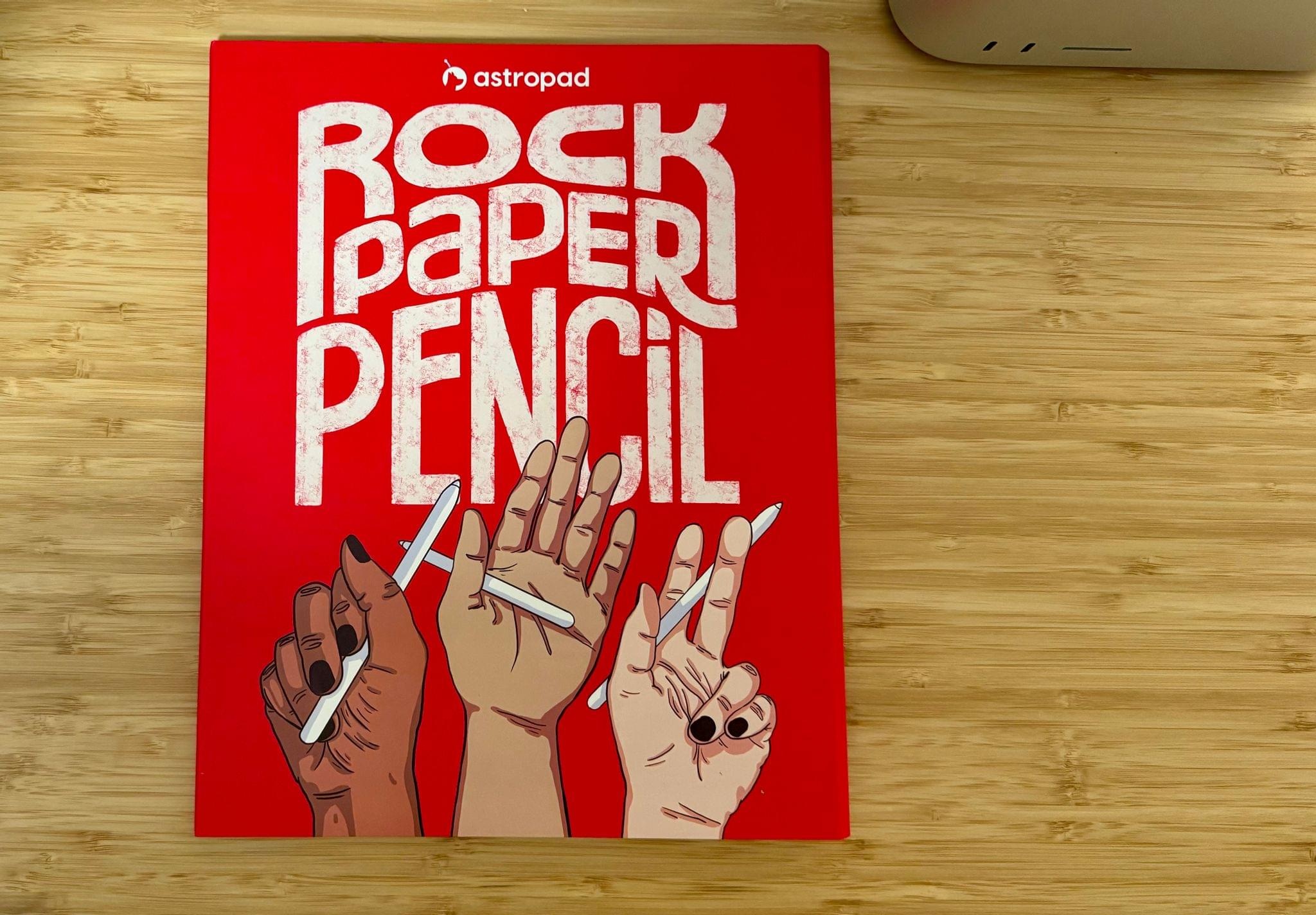
It’s been years since I took a serious run at handwritten notes on the iPad. However, that changed with my recent experiments with the Boox Tab Ultra, which led me back to the benefits of jotting down handwritten notes as a quick capture system while I work. That’s why Aspropad’s new Rock Paper Pencil bundle of a nano-textured iPad screen protector and replacement Apple Pencil tips that mimic the feel of paper caught my eye. I’ve had bad luck with screen covers that feel like paper in the past, but as I’ll explain below, Astropad has created a unique package that offers the closest experience to writing or drawing on paper that I’ve ever tried while also being easy to use.
Astropad’s Rock Paper Pencil Delivers A No-Compromise, Simple Paper-like Experience on iPad

Access Extra Content and Perks
Founded in 2015, Club MacStories has delivered exclusive content every week for nearly a decade.
What started with weekly and monthly email newsletters has blossomed into a family of memberships designed for every MacStories fan.
Club MacStories: Weekly and monthly newsletters via email and the web that are brimming with apps, tips, automation workflows, longform writing, early access to the MacStories Unwind podcast, periodic giveaways, and more;
Club MacStories+: Everything that Club MacStories offers, plus an active Discord community, advanced search and custom RSS features for exploring the Club’s entire back catalog, bonus columns, and dozens of app discounts;
Club Premier: All of the above and AppStories+, an extended version of our flagship podcast that’s delivered early, ad-free, and in high-bitrate audio.
The Dirty Secret of OS Updates [Sponsor]

Getting OS updates installed on end user devices should be easy. After all, it’s one of the simplest yet most impactful ways that every employee can practice good security.
On top of that, every MDM solution promises that it will automate the process and install updates with no user interaction needed.
Yet in the real world, it doesn’t play out like that. Users don’t install updates and IT admins won’t force installs via forced restart.
Let’s talk about the second problem first. Sure, you could simply schedule updates for all your users, and have them restart during non-work hours. But this inevitably leads to disruptions and lost work. This, in turn, leads to users (especially executives) who simply demand to be left out of your update policy. The bottom line is: any forced restarts without user approval will lead to data loss events, and that makes them so unpopular that they are functionally unusable.
There is another class of tools that claim to get users to install updates themselves, through “nudges.” These reminders pop up with increasing frequency until users relent or the timer runs out. This is an improvement, since it involves users in the process, but users still tend to delay updating as long as possible (which for some tools can be indefinitely).
At Kolide, OS updates are the single most common issue customers want us to solve. They come to us because we have a unique (and uniquely effective) approach to device compliance.
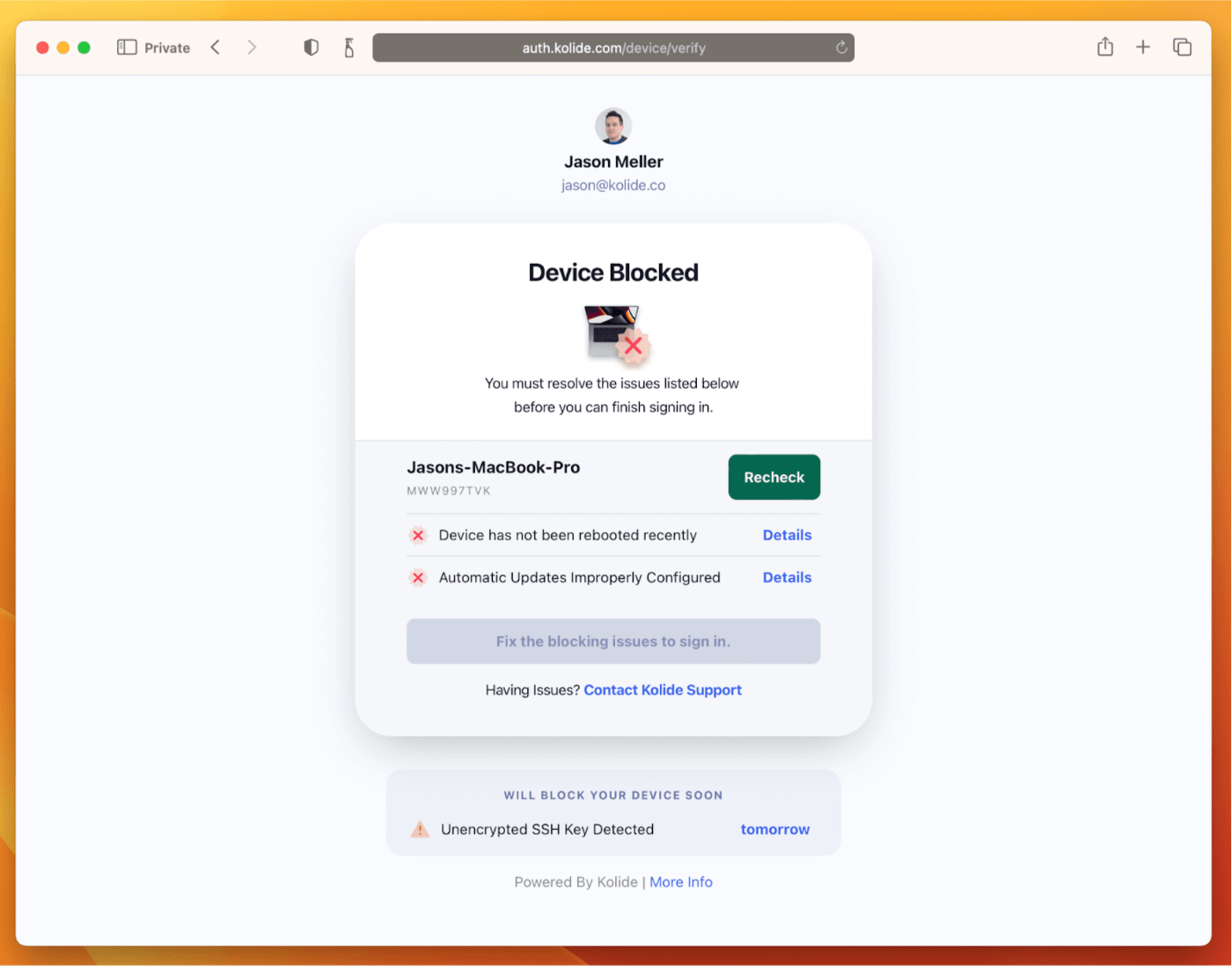
With Kolide, when a user’s device–be it Mac, Windows, Linux, or mobile–is out of compliance, we reach out to them with instructions on how to fix it.
The user chooses when to restart, but if they don’t fix the problem by a predetermined deadline, they’re unable to authenticate with Okta. (At present, Kolide is exclusive to Okta customers, but we plan to integrate with more SSO providers soon.)
If your fleet is littered with devices that stubbornly refuse to update, then consider these two principles:
- You can’t have a successful patch management policy without involving users.
- You can’t get users to install patches unless you give them both clear instructions and real consequences.
Installing OS updates is a top priority for both security and IT, and when you make it part of conditional access, you can finally get it done without massive lists of exemptions or massive piles of support tickets.
To learn more about how Kolide enforces device compliance for companies with Okta, click here to watch an on-demand demo.
Our thank to Kolide for sponsoring MacStories this week.
Access Extra Content and Perks
Founded in 2015, Club MacStories has delivered exclusive content every week for nearly a decade.
What started with weekly and monthly email newsletters has blossomed into a family of memberships designed for every MacStories fan.
Club MacStories: Weekly and monthly newsletters via email and the web that are brimming with apps, tips, automation workflows, longform writing, early access to the MacStories Unwind podcast, periodic giveaways, and more;
Club MacStories+: Everything that Club MacStories offers, plus an active Discord community, advanced search and custom RSS features for exploring the Club’s entire back catalog, bonus columns, and dozens of app discounts;
Club Premier: All of the above and AppStories+, an extended version of our flagship podcast that’s delivered early, ad-free, and in high-bitrate audio.
MacStories Weekly: Issue 391
MacStories Unwind: Don’t Bend the Fiber






This week on MacStories Unwind, Federico and I discuss the Ecobee HomeKit doorbell, an obscure USB-C adapter Federico discovered, and BBQ. Plus, with my Internet out for part of the week, we learn that my Internet service Plan B is rather ordinary compared to Federico’s, which involves a picnic table and getaway car.
Links and Show Notes
Gadgets
Food

We deliver MacStories Unwind+ to Club MacStories subscribers ad-free and early with high bitrate audio every week.
To learn more about the benefits of a Club MacStories subscription, visit our Plans page.
Access Extra Content and Perks
Founded in 2015, Club MacStories has delivered exclusive content every week for nearly a decade.
What started with weekly and monthly email newsletters has blossomed into a family of memberships designed for every MacStories fan.
Club MacStories: Weekly and monthly newsletters via email and the web that are brimming with apps, tips, automation workflows, longform writing, early access to the MacStories Unwind podcast, periodic giveaways, and more;
Club MacStories+: Everything that Club MacStories offers, plus an active Discord community, advanced search and custom RSS features for exploring the Club’s entire back catalog, bonus columns, and dozens of app discounts;
Club Premier: All of the above and AppStories+, an extended version of our flagship podcast that’s delivered early, ad-free, and in high-bitrate audio.
watchOS 10: The MacStories Review
In my watchOS 9 Review last year, I spent the introduction reminiscing on the more exciting days of watchOS yore. Those early years were full of whimsy and foolishness, with many wild and ambitious new features that failed far more often than they succeeded. By my count, it took until watchOS 4 for Apple to find its footing, and by watchOS 6 the predictable pattern of iteration that I laid out last year had begun.
As I said last time, it’s hard to argue against the slow and steady march of watchOS. This software joined with the Apple Watch hardware has resulted in a years-long market domination that shows no sign of stopping. Yet, market be damned, I couldn’t help but feel disappointed. Health and fitness features were flourishing, but the rest of watchOS never quite felt fully baked.
As it turns out, Apple seems to have agreed.
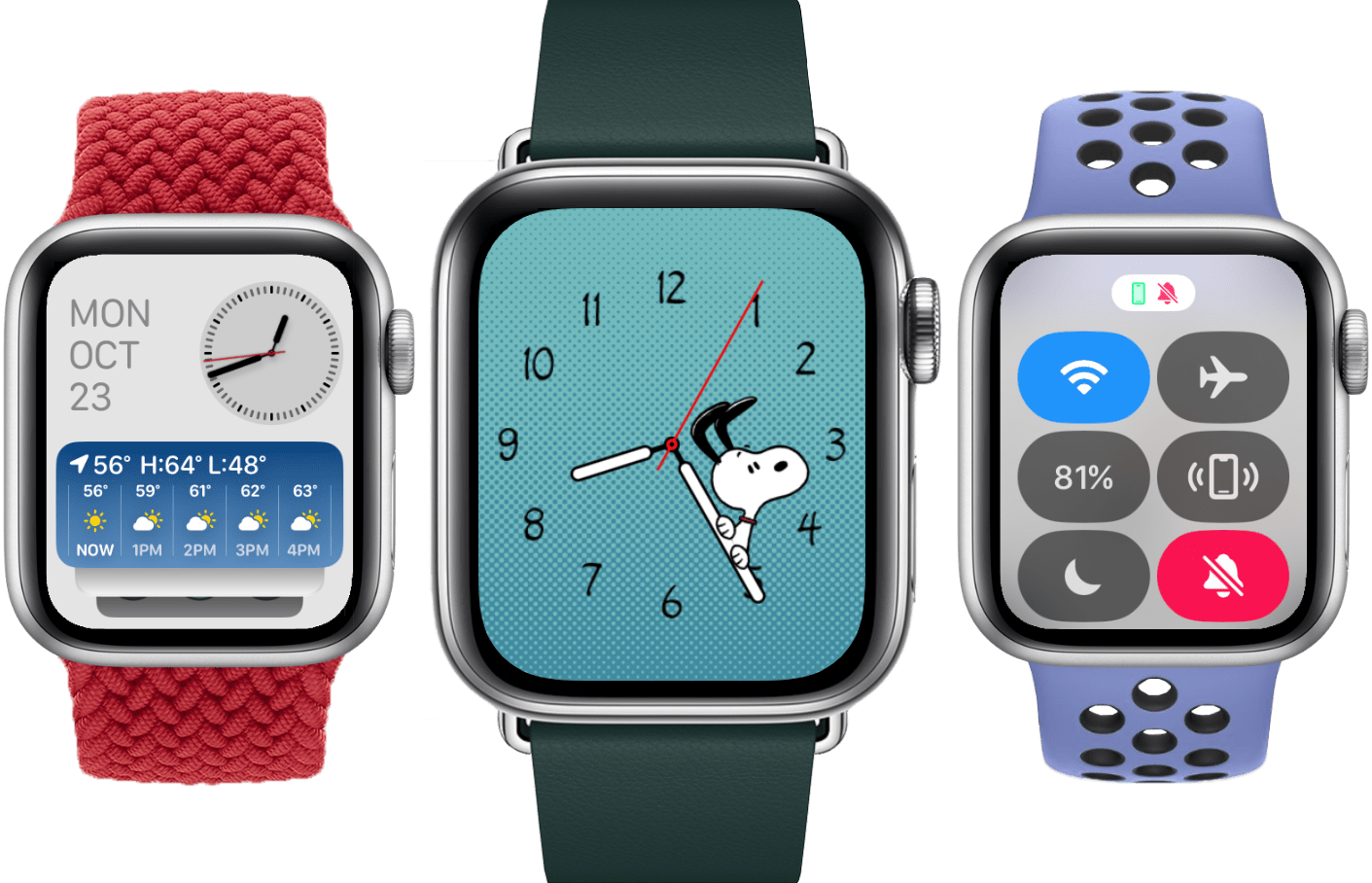
In watchOS 10, for the first time in years, the iterative update pattern is broken. Rather than the usual handful of minor app updates, new watch faces, and health and fitness features, Apple has instead dropped another major rethink of Apple Watch interaction methods. The side button has been reassigned, the Dock has been demoted, apps have a new design language throughout the system, and widgets have made their Watch debut.
This is the largest year-over-year change to watchOS since version 4, and I am here for it. Let’s jump in and see if Apple has hit the mark this time, or if they’ll be back to the UI drawing board again in the years to come.
Access Extra Content and Perks
Founded in 2015, Club MacStories has delivered exclusive content every week for nearly a decade.
What started with weekly and monthly email newsletters has blossomed into a family of memberships designed for every MacStories fan.
Club MacStories: Weekly and monthly newsletters via email and the web that are brimming with apps, tips, automation workflows, longform writing, early access to the MacStories Unwind podcast, periodic giveaways, and more;
Club MacStories+: Everything that Club MacStories offers, plus an active Discord community, advanced search and custom RSS features for exploring the Club’s entire back catalog, bonus columns, and dozens of app discounts;
Club Premier: All of the above and AppStories+, an extended version of our flagship podcast that’s delivered early, ad-free, and in high-bitrate audio.
iOS 17.2 Beta’s Sticker Reactions Need a Different Approach→
The first developer beta of iOS 17.2 was released earlier today, and among a variety of new features (I’ve been sharing some of the highlights on my Mastodon), there’s the highly anticipated expansion of Tapbacks with custom sticker reactions.
The problem is that, put simply, this feature just isn’t good enough in this first version of iOS 17.2. And since I’m always told to “file feedback early in the process to make sure things get seen”, and since blogging about iOS feature requests on my website makes me feel better than begrudgingly filing actual feedbacks about them, here we are.
Jason Snell, writing for Six Colors:
This new feature has no connection at all with the fun double-tap gesture that’s synonymous with Tapbacks. I didn’t expect stickers to be a peer to Apple’s classic collection of six Tapback icons, but I did sort of assume that at the very least, performing the Tapback gesture would also give you the option of choosing a sticker. (And the right thing for Apple to do would be to display recently used stickers alongside the Tapback icons.)
Instead, to send a sticker response you have to tap and hold on a message and then choose Add Sticker from the resulting contextual menu, then choose a sticker or emoji. It’s an extra step that really shouldn’t be necessary and makes stickers feel like an afterthought, which they apparently are.
I get why Apple doesn’t want to let users customize the default roster of “official” Tapbacks. iMessage is used by hundreds of millions of people every day, and they don’t want to overcomplicate an established feature with too many options. However, I think a much better compromise would be the following:
- Align custom sticker reactions with regular Tapbacks in the message bubble so they don’t cover text;
- Make the ‘Add Sticker’ button appear when you double-tap a message instead of requiring a long-press.
That’s it. I really like this feature, but the design isn’t quite there yet. Hopefully, there’s enough time (and willingness on Apple’s part) to change it.
With Version 1.2, Matter Now Supports over 20 Device Types→
Jennifer Pattison Tuohy, writing for The Verge on the latest update to Matter, the interoperable home automation standard:
Matter — the IOT connectivity standard with ambitions to fix the smart home and make all of our gadgets talk to each other — has hit version 1.2, adding support for nine new types of connected devices. Robot vacuums, refrigerators, washing machines, and dishwashers are coming to Matter, as are smoke and CO alarms, air quality sensors, air purifiers, room air conditioners, and fans. It’s a crucial moment for the success of the industry-backed coalition that counts 675 companies among its members. This is where it moves from the relatively small categories of door locks and light bulbs to the real moneymakers: large appliances.
And:
While it’s possible today to get your lights to flash when your laundry is done, turn a light red when your fridge’s temperature rises, or shut off the HVAC system if the smoke alarm goes off, it can be complicated to set up and often wholly unreliable. You need to download multiple apps, maybe buy a sensor or two, deal with laggy cloud integrations, and worry about whether your washer is even compatible with your smart home app in the first place. With Matter support, this type of simple command and control should be much easier to implement in any ecosystem.
I spent the past year making as many parts of my new home as connected as possible (our apartment is powered by KNX; I had this bridge installed to bring lights, temperature sensors, and shutters into HomeKit) so, as you can imagine, I’m very much on board with the idea of having my accessories be compatible with multiple ecosystems at once. We live in a “mixed assistant” household (we use Siri in English and Alexa in Italian), so the idea behind Matter is the kind of technology we’re looking for.
The problem, at least from my perspective, is that I have very little hope regarding Apple’s ability to support the new device types added to Matter in their Home app anytime soon.
Apple’s Home app is, by far, the UI I use most for manually controlling my smart home, whether it’s from the Home app itself or Control Center. It’s also leagues beyond the terrible design of the Alexa app; its integration with automations and the Shortcuts app is also incredible. But let’s be honest: the Home app already struggles to fully support device types that were added years ago, such as sprinklers; realistically, how long is it going to take Apple to integrate with robot vacuums and air purifiers?
The way I see it, any connected home standard is only as useful as the UI that lets you control its accessories. So while I’m excited about Matter and strongly believe in the initiative, the weak link for me remains Apple’s Home app.
Apple Releases iOS and iPadOS 17.1 with New Apple Music Features, Small iPad Enhancements, and More
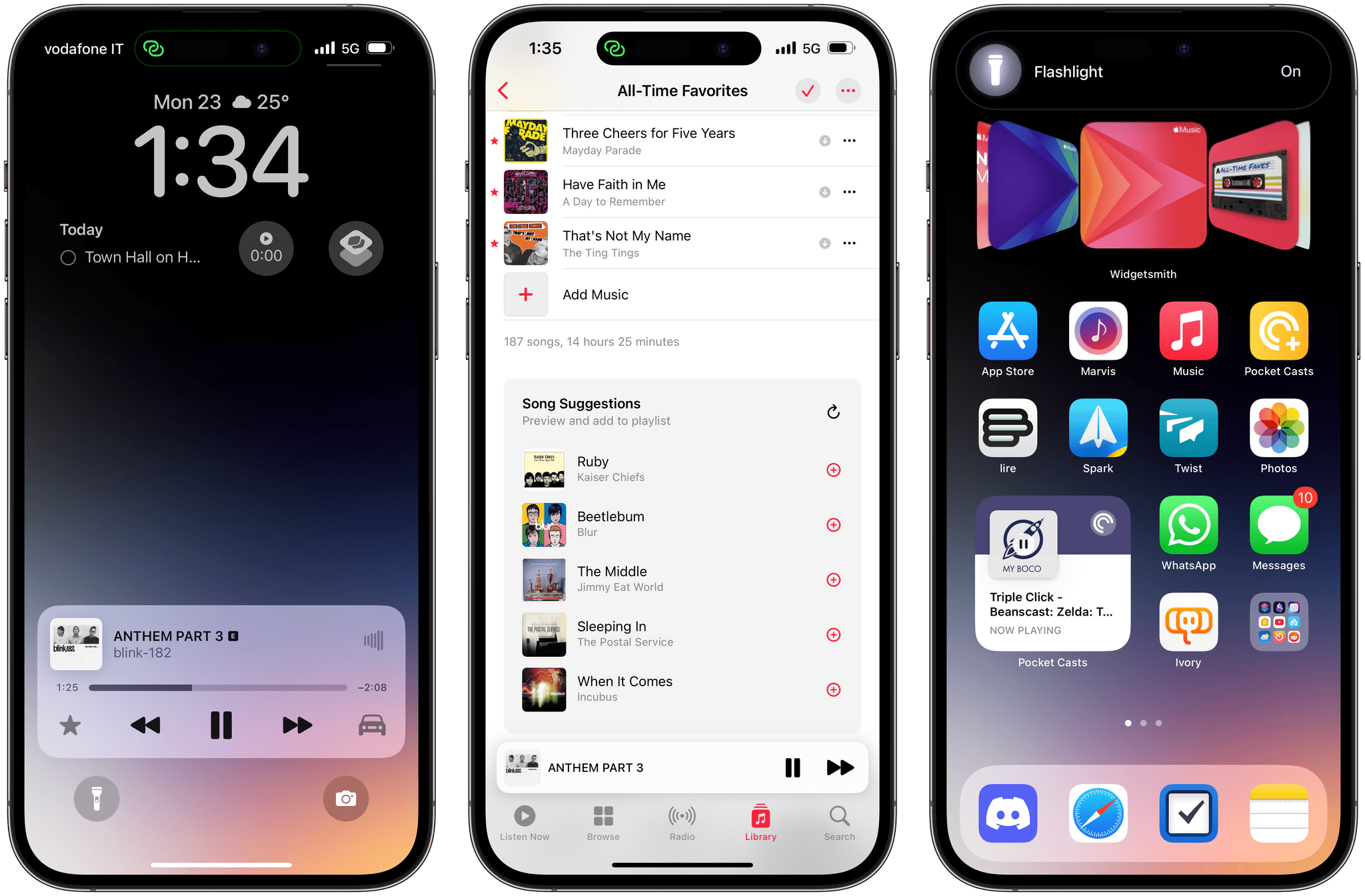
Today, Apple released iOS and iPadOS 17.1 – the first major updates to the operating systems that launched (and I reviewed) in September. I’ll cut to the chase: these are not big updates and don’t come with new emoji. Instead, iOS and iPadOS 17.1 bring a variety of previously-announced (and then delayed) features such as AirDrop over the Internet and new cover art templates in Music, but they don’t address the complete list of functionalities for this OS cycle that Apple originally announced last June.
Let’s take a look.
Access Extra Content and Perks
Founded in 2015, Club MacStories has delivered exclusive content every week for nearly a decade.
What started with weekly and monthly email newsletters has blossomed into a family of memberships designed for every MacStories fan.
Club MacStories: Weekly and monthly newsletters via email and the web that are brimming with apps, tips, automation workflows, longform writing, early access to the MacStories Unwind podcast, periodic giveaways, and more;
Club MacStories+: Everything that Club MacStories offers, plus an active Discord community, advanced search and custom RSS features for exploring the Club’s entire back catalog, bonus columns, and dozens of app discounts;
Club Premier: All of the above and AppStories+, an extended version of our flagship podcast that’s delivered early, ad-free, and in high-bitrate audio.
Shazam Introduces Dedicated In-App Concerts Section
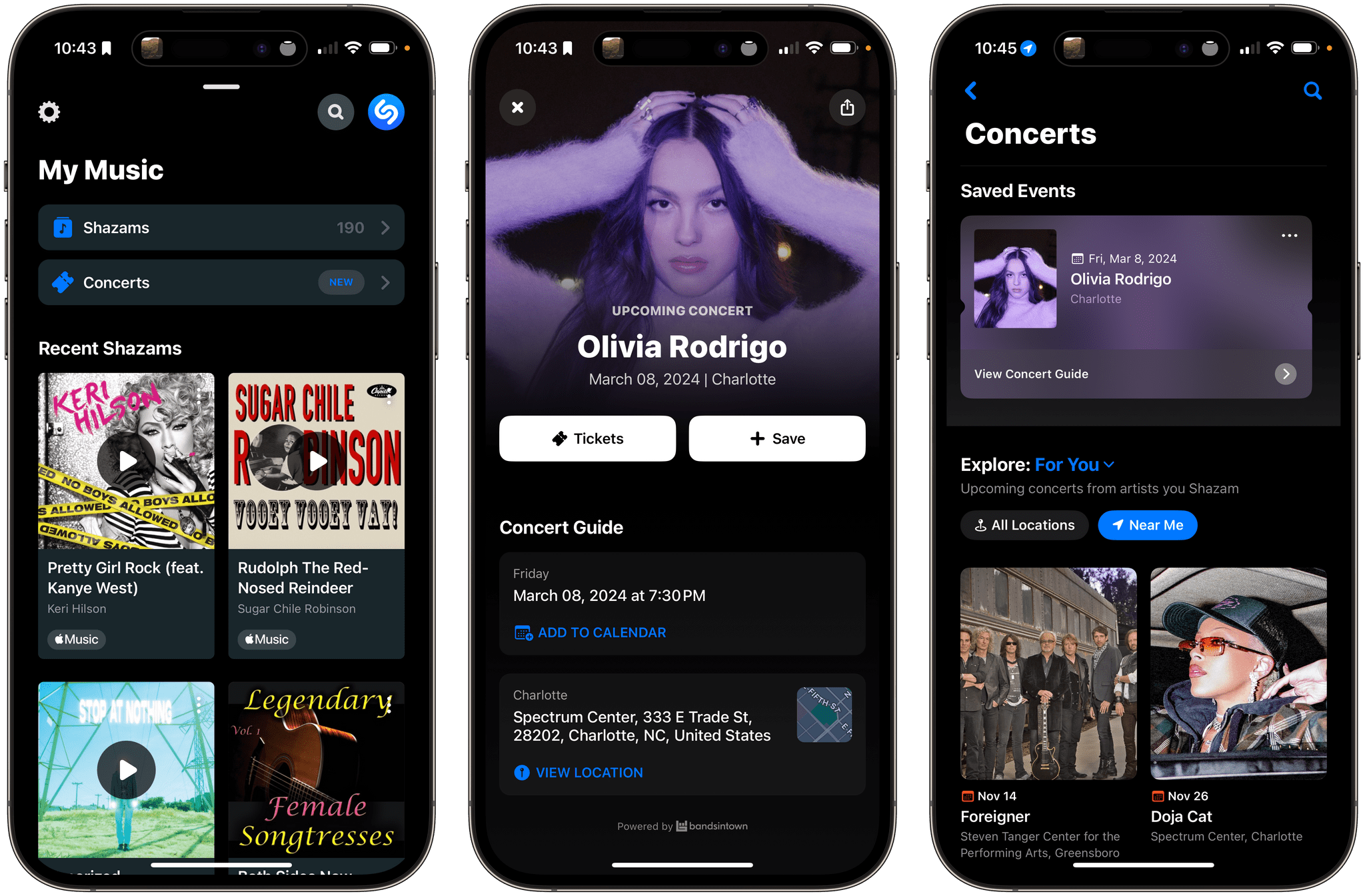
Today, Shazam introduced a dedicated Concerts section in its music discovery app that lets you explore upcoming shows that are recommended based on your Shazam history. Users can look at all recommended shows or narrow recommendations to those that are scheduled nearby. There’s also an option to display popular shows irrespective of your listening history.
When you find an artist’s show that you want to learn more about, tapping on the event listing offers additional options to:
- Buy tickets via Ticketmaster or BandsInTown
- Save the show for later, which moves it to the top of the Concerts section
- Add the show to your calendar
- View a map of the venue in Apple Maps
- Access playlists, albums, singles, and music videos in Apple Music
- View additional tour dates on a dedicated Concert Guide screen
Apple says other perks will be available too:
Shazam now also gives users the ability to save and revisit events, set reminders about upcoming shows, view tickets and unlock concert exclusives from select artists, which include brand new Watch faces and wallpapers available for download, behind the scenes video, tour photos, show set lists and more.
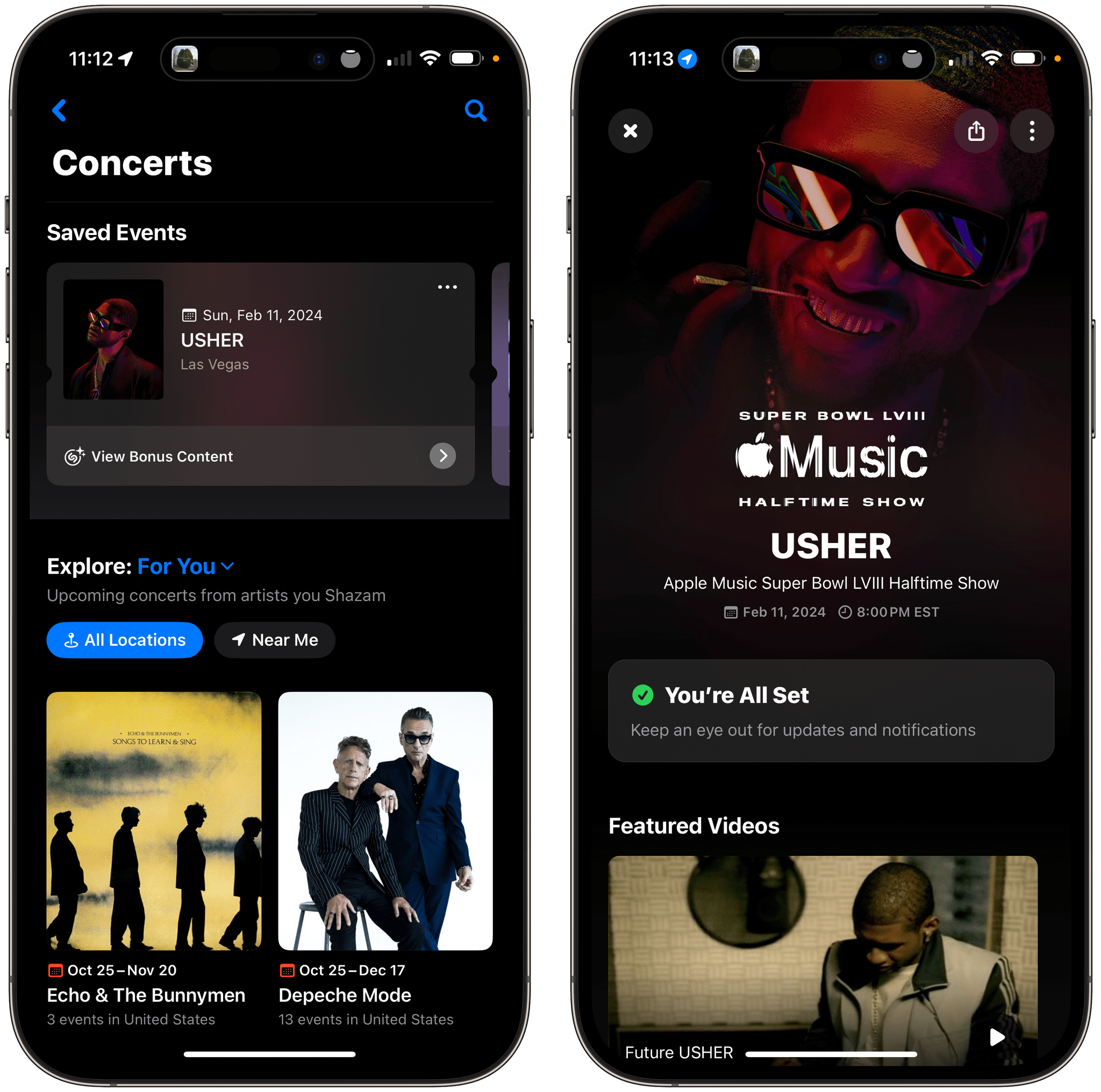
For example, USHER’s Super Bowl concert in Las Vegas next February includes bonus content that links to information about his appearance, which is sponsored by Apple Music.
Events can be shared via the share sheet and accessed via Spotlight Search, too.
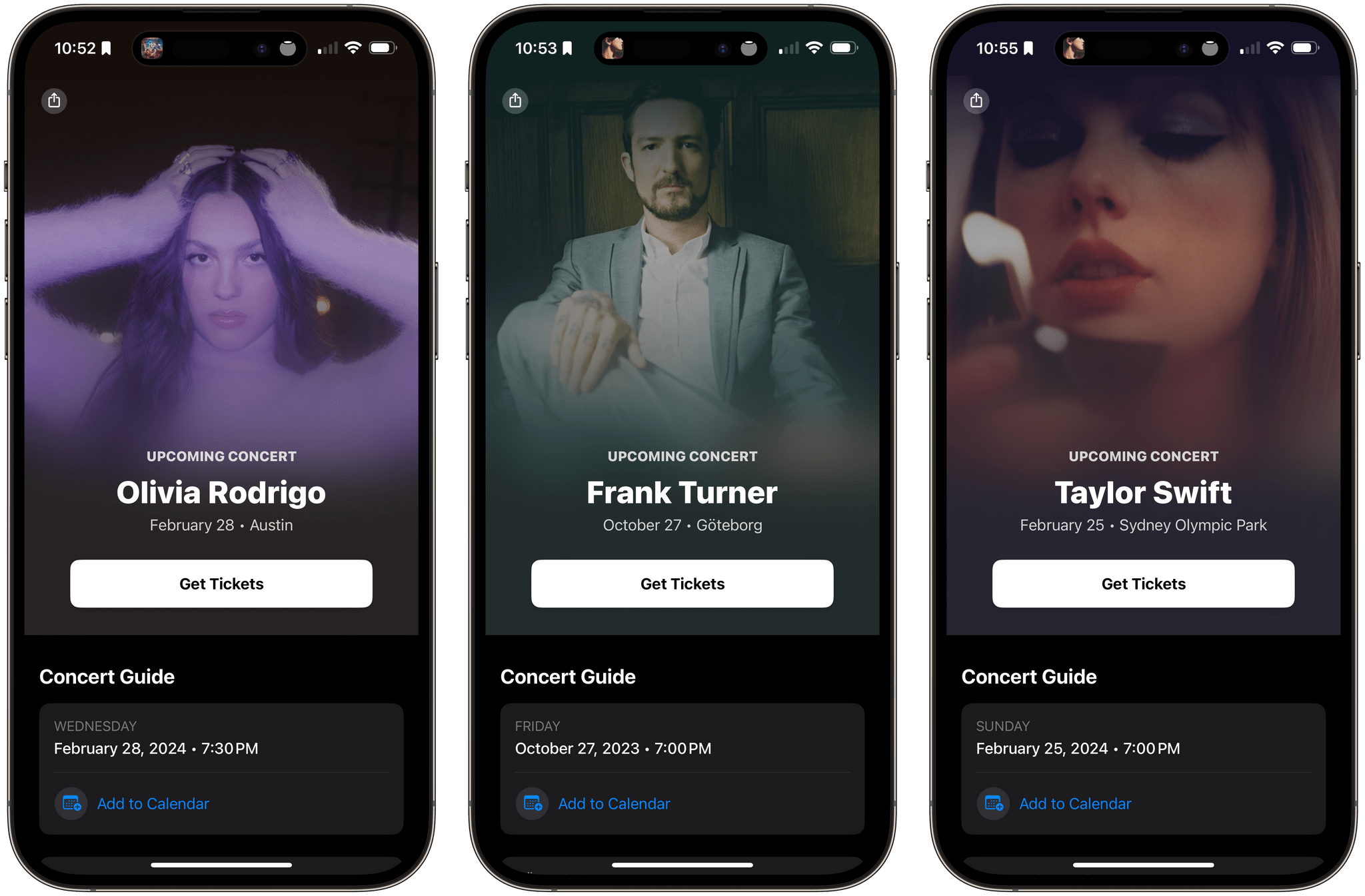
Some of the functionality found in Shazam’s Concerts section was previously added to the app. However, it’s great to see concerts get a dedicated space in the app. The update will make it easier for fans to discover upcoming shows and learn more about newly-discovered artists.
The Shazam update is available now for iOS and iPadOS users and will be released in the Android version of the app soon.
Access Extra Content and Perks
Founded in 2015, Club MacStories has delivered exclusive content every week for nearly a decade.
What started with weekly and monthly email newsletters has blossomed into a family of memberships designed for every MacStories fan.
Club MacStories: Weekly and monthly newsletters via email and the web that are brimming with apps, tips, automation workflows, longform writing, early access to the MacStories Unwind podcast, periodic giveaways, and more;
Club MacStories+: Everything that Club MacStories offers, plus an active Discord community, advanced search and custom RSS features for exploring the Club’s entire back catalog, bonus columns, and dozens of app discounts;
Club Premier: All of the above and AppStories+, an extended version of our flagship podcast that’s delivered early, ad-free, and in high-bitrate audio.