The (Un)Obviousness of iCloud

The (Un)Obviousness of iCloud

Chris Bowler writes (via Shawn Blanc) about his slow yet inexorable migration to iCloud:

And so it has gone with iCloud overall. I never really set out to use it to its fullness, but it has become integral to my computing experience. It should have been an obvious transition, but instead it was subtle. This past year came with migrations to two new laptops. The ease of setting up each blew me away both times. The combination of Dropbox (my data), Rdio (my music) and iCloud (preferences, OS X integrations, applications and everything else) is a powerful one and a testament to the time we live in.

I have previously written about how, for the end user, iCloud may as well look like “the operating system”.

When I think about it, I’m thankful for the kind of integration that iCloud provides. I use Calendar, Safari Tabs, and Find My iPhone on a regular basis and I enjoy their functionality. On the other hand, I’m less excited about iCloud Mail and its continuous downtimes, and I understand third-party developers who lament the poor state of iCloud sync and APIs for their apps.

Major shifts like iCloud take time. When you consider that Apple hasn’t traditionally been great at web services, what they have managed to make work reliably is quite a remarkable achievement. Yet, like Maps, average users don’t care about this: they just want their devices to work. And if Apple gave them iCloud, then Apple needs to make sure users can trust it.

As an aside, I’d point out that several friends of mine constantly ask me about iCloud – the things it does and what it is. Maybe my friends are lazy, but I’d go all the way out to guess perhaps Apple needs to tweak the initial guided setup to make iCloud even more understandable. I’ve always thought the short trackpad videos Apple embeds in OS X are nice and effective because they show features in context. Rather than using an animated cloud, short videos and actual screenshots would be a nice addition to iOS’ first setup guide.
Permalink

Rdio 2.0

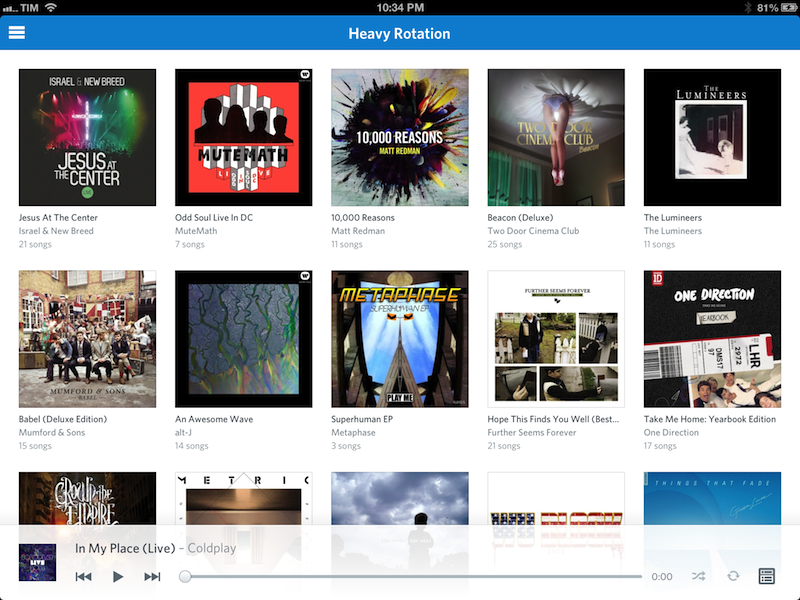
Today, Rdio showed Spotify how to make a modern iOS client for a music streaming service.

I’ve been a Rdio user for over a year now. As I’ve previously written, tweeted, and discussed on various podcast appearances (including one on Generational that will be posted next week) I was a Spotify fan for years. At some point, however, I realized that the playlist-based nature of the service wasn’t working for me, and I switched to Rdio, a competing music streaming service that, like Spotify, lets you listen to a huge catalog of music for a monthly fee.

The distinction between a playlist-based user experience and being able to organize my music in a Collection with albums, songs, and artists made all the difference for me. I don’t like Spotify’s approach to forcing the listener to organize music in a playlist. A group of albums isn’t a playlist: it’s a collection. Read more


Scan 2.0: QR Codes and Beyond

Scan 2.0 app icon

Scan 2.0 app icon

I’ve certainly seen my fair share of complaints on Twitter, but QR Codes have their place. It’s unnecessary in advertising and definitely silly on T-Shirts, but I’ve found QR Codes save me heaps of time for things like importing contact information from business cards. Like it or not, these bit-by-bit squares of data are likely here to stay.

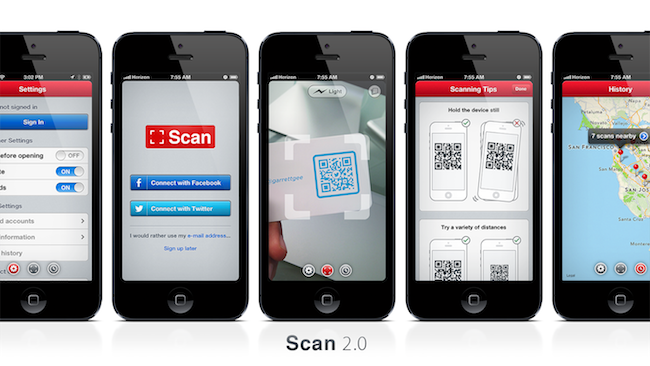
The QR Code itself necessarily isn’t the problem. It’s convenient shorthand for linking something physical to something digital. (I’d rather scan than open a web browser and type in a short URL.) The biggest point of friction, in my opinion, is the tool used to scan these codes. Likely, it’s an app on a smartphone. As I’ve said before, these scanners need to be effortless to use. Results have to be instant.

A row of iPhones displaying different Scan screenshots

A row of iPhones displaying different Scan screenshots

Last August, Scan earned my pick as the App Store’s best scanner. Over a year later, I’ll say it still holds that title. Starting with a remarkably easy to use iOS app, Scan is now a complete web service. Scan offers businesses a way to generate and manage codes and get analytics. QR Codes can be generated that instantly Like something on Facebook or Follow a business on Twitter (with your permission of course). And Scan makes available Scan Pages, which hosts a short bio and links to your various online profiles. For the rest of us, Scan’s app alone fulfills the simple role of getting scanning codes quickly. No longer just a simple scanner, Scan is a complete service that goes beyond the QR Code. There’s something for everyone.

Read more


Spaced 3.0

Spaced 3.0

I’m no expert of astronomy or space missions, but I enjoy reading about the subject because I’m completely fascinated by it. I don’t subscribe to dedicated blogs about space news, because I don’t really follow the scene actively – I’m casually interested in reading what’s new when I have the time. For the past two years I’ve been using Spaced to keep up with the most important space news and discoveries; the team behind the app released today a major 3.0 update that adds a completely redesigned UI, iCloud support, and more sections.

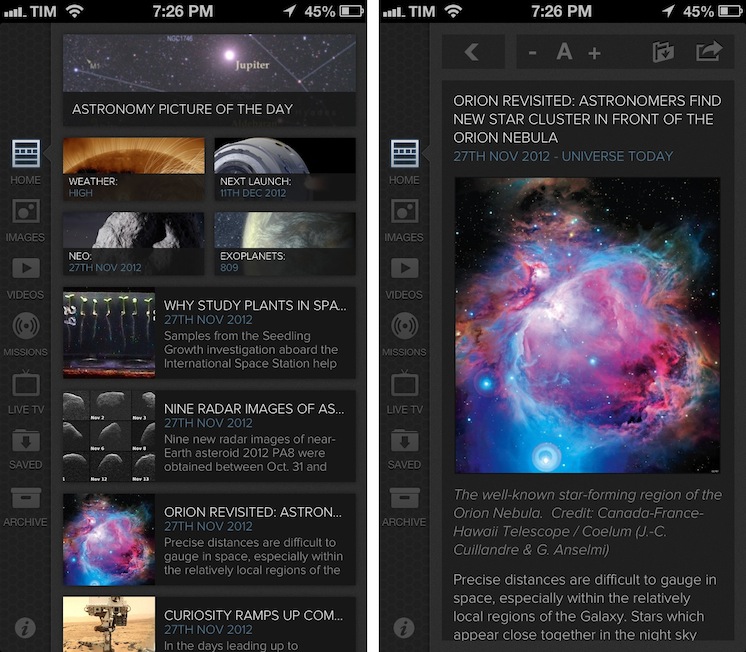
Spaced aggregates news from well-established publications and sources and it is perfectly suited for people like me: folks who are curious to know about space but who don’t have the time to read every news item from blogs and magazines they are not even following. The new Spaced comes with a gorgeous black UI that gives even more depth and contrast to the beautiful imagery of NASA including Astronomy Photo of the Day and Image of the Day. In a sidebar on the left, you can now access a Home page featuring a collection of news, missions, NEO data, and photos, or you can browse individual sections to see more photos, videos, and live TV from NASA (including a programming schedule). You can tap on the Missions tab to learn more about single missions like the Webb Telescope and Mars Science Laboratory, or you can just head over Videos, tap Play and watch.

The big new feature of this 3.0 version is iCloud sync: in the Saved view, you access photos, articles, and videos you’ve saved from your iPad or iPhone. iCloud integration has been working reliably for me both on WiFi and 3G. You can also activate push notifications in the Settings for articles and other items, but I decided to keep them off as I prefer opening the app when I have time to read.

I recommend Spaced 3.0 to anyone who’s interested in space news but doesn’t have the time or patience to keep up with blogs, NASA webpages, and magazines. The app is only $0.99 on the App Store.

Permalink


Nasturtium Player Beta

Nasturtium Player Beta

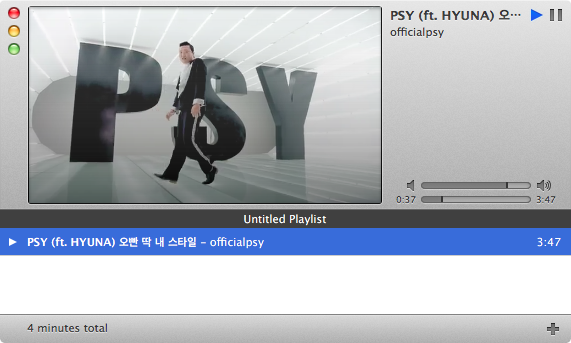
Interesting idea for a new Mac OS X audio player, currently in open beta. Nasturtium (which, by the way, is a plant that produces great-looking flowers) is based on playlists that you can save and re-open at any time; playlists can be made of music from iTunes or videos from YouTube.

Listen to your own music library alongside YouTube videos for the optimal mix of old favorites and new tunes. Both sources play directly in Nasturtium Player, with no extra helpers required. But if you like, you can also queue up tracks with drag and drop from iTunes and the YouTube website, and import and export your playlists.

The concept of combining local music with YouTube videos resonates with my music workflow. While I tend to listen to music on Rdio, there are some older albums and songs that I need to keep locally either in iTunes or, most recently, Plex with PlexSync; similarly, there are YouTube videos of older demoes or live concerts of my favorite bands that I want to access every once in a while. I like how Nasturtium unifies search of local media and YouTube videos in a single interface.

Nasturtium is in beta, so I’ll save longer considerations for a proper review of the final version. Right now, I can say that I appreciate the existing selection of keyboard shortcuts and the iTunes 11-like look of the mini player. The inline YouTube video player could probably use resizing options, and it’d be nice to have a system-wide keyboard shortcut to pause playback. I like the unified search panel, but I believe filters for YouTube-only content and inline thumbnail previews could come in handy.

I’ll keep an eye on Nasturtium as, like I said, it is a powerful concept that fits my music listening habits. You can download the free open beta here.

Permalink

Announcing Weekly Sponsorships

Developers willing to promote their company or product on MacStories have always been able to buy ad spots on our site.

Today we’re introducing weekly sponsorships.

The exclusive and week-long sponsorship is the best way to promote your app or service to MacStories’ fine, clever, and influential readership. MacStories’ audience includes creative, professional and tech-savvy readers who care about quality software designed for Macs, iOS devices, and the web, as well as detailed reviews and editorials.

MacStories’ readership consists of:

  • Over 1.3 million monthly page views
  • Over 23,000 daily RSS subscribers
  • 40,000 followers across our Twitter accounts

At the start of the week, we will publish a thank-you post telling our readers that you are the sponsor for the week and also informing then about your company or product(s). During the week of the sponsorship, your company or product will also be linked in the site’s sidebar. Two tweets will be sent – one at the start and one at the end of the week – thanking the sponsor.

To schedule a sponsorship or for additional information, please email us. BackBeat Media is taking care of this for us, and you’re in good hands with John, Jeff or Dave there.


Apple’s New 21.5” iMac Available This Friday, 27” iMac Shipping In December

Apple has just announced that the new 21.5-inch iMac will be available for purchase online and in retail stores from this Friday, November 30th. The larger 27-inch iMac will be available for pre-order on Apple’s online store from Friday but it won’t ship until December.

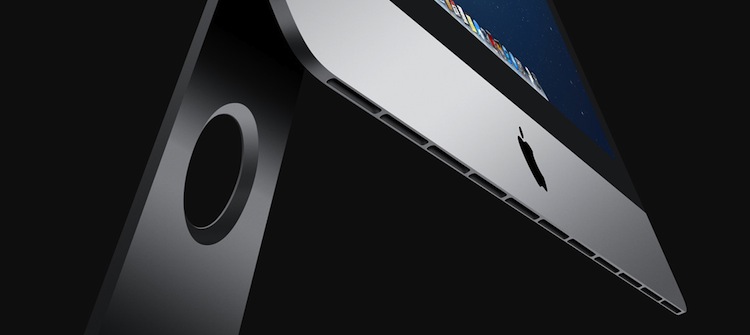
Apple revealed the new look iMac at its iPad mini event back on October 23rd. The new design features a new tapered enclosure that is just 5mm thick at its thinnest point. Whilst on the hardware side, it includes a new Fusion Drive which combines the “performance of flash” and the “capacity of a hard drive” as well as a reengineered display and upgraded performance.

Redesigned from the inside out, the new iMac packs high performance technology into an aluminum and glass enclosure that measures just 5 mm thin at its edge and features a reengineered display that reduces reflection by 75 percent. The new iMac includes 8GB of 1600 MHz memory, a 1TB hard drive, third generation quad-core Intel Core i5 processors that can be upgraded to Core i7, and the latest NVIDIA GeForce graphics processors that deliver up to 60 percent faster performance.

Prices start from US$1,299 for the 21.5” iMac with a 2.7 GHz quad-core Intel Core i5 and NVIDIA GeForce GT 640M. The 27” iMac will start at US$1799 and contain a 2.9 GHz quad-core Intel Core i5 with Turbo Boost speeds up to 3.6 GHz and NVIDIA GeForce GTX 660M. Apple has the full technical specs and prices up on its website.