Posts in reviews

Social Radio Reads Your Friends’ Status Updates Aloud

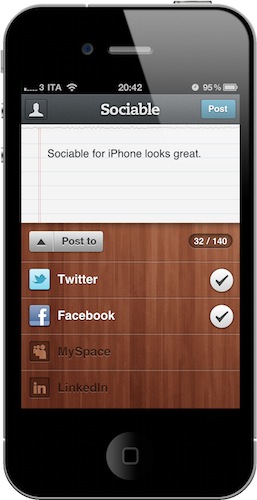
Social Radio for iPhone is a new app developed by @anshuchimala which is available at $0.99 in the App Store. And it has to be one of the weirdest, most original and useful utilities for Twitter and Facebook I’ve seen in a while. Or should I say “listened to”. This app, in fact, once granted authorization to access your Twitter and Facebook timelines, can read your friends’ status messages aloud. And, you can control the app with your voice, too. That’s it.

What’s cool about Social Radio, besides the fact that it’s developed by our friend Anshu, is that it looks minimal, it’s got Helvetica and it really reads Twitter and Facebook with iOS’ built-in accessibility features. I also appreciated the fact that each status updates comes with the original author, so you’ll listen to the app say something like “Federico Viticci wrote”. Usernames will be spoken aloud, http:// links will be excluded. Smart. The app plays a continuos stream of messages from your timeline starting from the most recent ones, until you hit pause or tell it to stop. You can swipe on the screen to move between status updates or just let Social Radio do its job and auto-play them.

Social Radio may look like a silly experiment to get iOS to read Twitter and Facebook messages. If you think about it, though, the app can be very useful for the visually impaired (just set it up once, then listen to it) or for when you’re driving and you really want to stay on top of your social networks.

Social Radio is a cool app that can be yours for just .99 cents. Give it a try.


Mac App Store Review: Contacts Cleaner

Developed by Spanning Sync and available in the Mac App Store at $4.99, Contacts Cleaner is a simple utility aimed at fixing the little problems that can slowly take over your state-of-the-art Address Book organization. I’m talking about unrecognized Unicode characters (because admit it, you tried to paste weird symbols next to your boss’ phone number), missing info and extra spaces between names that shouldn’t be there. Contacts Cleaner can fix these issues thanks to a minimal and simple interface that makes it easy to go through the most scary list of broken contacts. Read more


Mac App Store Review: RemoteSnap

RemoteSnap is the first app I downloaded from the Mac App Store as I managed to go past the “Error 100” the store was returning minutes after its launch. RemoteSnap has one and only purpose: it acts a server on your Mac capable of receiving photos from your iPhone and iPod touch wirelessly, as you take them. RemoteSnap for Mac is available for free here.

To use the Mac app, though, you’ll need to download the iOS counterpart. RemoteSnap for iOS is available in the App Store for free or at $0.99. The free version will apply a watermark to your photos. Once you download and run the app on your Mac (you just have to click on the icon that will jump from the Mac App Store to your dock), start the app on your iPhone and wait as it connects to the Mac’s server. It should take less than 2 seconds. After that, you’ll see a camera interface saying “connected to computer name” in the upper left corner. Once you’re connected and you’ve chosen the destination folder for photos on your computer, you can start snapping pictures. Within seconds, they’ll be transferred onto your Mac via WiFi. No passwords or manual copy needed.

RemoteSnap is that kind of simple utility that we’re sure we’ll do very well in the Mac App Store. It’s not an app for the most sophisticated photographers, but it can come in handy for when you need some pictures to quickly end up on your Mac. Go download RemoteSnap on the Mac App Store here.


Twitter for Mac Review: Love It, Hate It, Tweet It

At some point in the past months, I thought I would never had the chance to write this review. But it’s happening. Twitter for Mac, what you expected to be called Tweetie 2.0 before Atebits became part of Twitter, is now live in the Mac App Store. It’s available for free here.

Like I said, months ago an idea started to grow on me: Tweetie 2.0 for Mac, the way I saw it back then, was never going to happen. Kaput. Vaporware. Twitter killed it, and with it – Loren Brichter’s enthusiasm and passion and willingness to provide millions of Mac users out there the sequel to what I think it’s still one of the finest Twitter clients ever created for the platform. And it’s not that the term “sequel” doesn’t apply really well to this whole saga: Twitter acquired Atebits but Loren had promised that MacHeist customers would get early access to Tweetie 2; Tweetie for iPhone was rebranded; the guy even started making promises and interviews about an app that “was coming”. Just like in the best stories of sequels that seem to never happen, people began to lose faith in Brichter, Twitter and Tweetie 2.0. They moved on. Read more


Preview: Chronos Is A Simple Time Tracking Utility Heading To The Mac App Store

While we’re literally mere hours from the Mac App Store launch in MacStories time, I wanted to show you all a nifty little utility that you can get your hands on tomorrow. While I don’t like the idea of developers simply porting iOS apps to the desktop (I’m afraid of “gunking up” OS X), I do like the idea that small developers such as myself can get encourage to just start making things and have almost instant visibility. Chronos is one of those apps, a tool made to fill a missing spot on the OS X desktop that keeps track of how long you spend on a project, and its various tasks. What’s really neat is that it’s super simple to use: add a project, a few tasks, and start the timer. If you need to, you can add time to an existing task just in case you forgot to set the clock when you began coding away. Little indie apps like this are what I’ll be looking forward to: I like seeing good ideas that fill a gap and can be improved on over time.


WebCamera Puts iSight On Your iPhone, iPod For Video Chatting

The iSight is actually pretty darned good when it comes to taking photos and video. My Twitter avatar? That’s totally done with just the iSight. When I was asked to check out WebCamera, I had my doubts about how well it would function as a disembodied iSight. Turns out it works pretty decently, though I can’t see myself deploying WebCamera full-time. It’s handy when you need to show off pics of your family in real time - you’d look kind of silly walking around with a MacBook, prying the lid back, and trying to aim the darned thing everywhere. WebCamera gives you the freedom to move and record over your local network by turning your iPhone into a WebCam, making it useful to revisit all the relatives who already miss you from the Holidays.

Read more


Remote Conductor: All-in-One OS X Controller for iPad

If you’re that kind of user who has set up a home entertainment system based on a machine running OS X, then probably you’re always looking for the next big thing in remote control. Several users, instead of buying a dedicated set-top box like an Apple TV or a Roku Player, prefer to get a relatively entry-level machine like a Mac Mini and route all their music, movies and photos through it. Because entertainment aside, the thing also happens to be a computer that can backup itself on a daily basis and serve content to other computers or iOS devices in the house. Just think of all the iTunes libraries or Plex installations shared through Mac Minis or, at best, Mac Pros that are powerful enough to be both desktop machines and entertainment systems for when the work is done and all you need is a good movie. A Mac computer set for such tasks, however, needs a good remote control system because, frankly, you just can’t use a mouse and keyboard on your couch.

Sure, you could use an Apple Remote and get most of your things done without having to lift a finger, but what about all those times when you want to use the stuff a computer also comes with – you know, like a web browser and high-def Youtube videos scaled to take all your TV screen? After all, even if geared towards home entertainment purposes, it’s a computer. And it needs to be remotely controlled. You could buy a VNC app like Screens for your iPhone and iPad, and control the computer that’s running on the TV in front of you with the comfort of also having it in your hands, in a portable app. Perhaps, though, you don’t need to have its screen mirrored on an iOS device and you just want a remote app that acts like a touchpad and lets you quickly launch and quit apps, and check on running ones.

Remote Conductor, a new iPad app by m3me, aims at reinventing the “remote controlling” app genre by combining in a single package features like a touchpad, multi-touch gestures support and some sort of application launcher and OS X-like Exposè to let you easily and effortlessly control your Mac’s screen from anywhere in your room using an iPad. Read more


Draftpad, The Simple Notepad That Works With Any App

On your iPhone or iPad, I bet you’re using a note taking app like Simplenote, PlainText or Writings to organize your notes and have them backed up online. There are hundreds of alternative note-taking applications available in the App Store, and I’m not going to pretend I haven’t thought about trying a different one each week at least a couple of times. They all look so attractive. But I sticked with Writings, in the end. Still, aside from those users who are firmly convinced Apple’s own Notes app is the best you can have on the iOS platform no matter what, the note-taking app genre is strong and alive in the App Store.

Draftpad, developed by Manabu Ueno, might look like yet another take on mobile note capturing, but it’s not. Indeed it is a notepad that lets you jot down quick notes and thoughts, but it hasn’t got built-in online sync nor any other tagging or folder management capability. Instead, Draftpad is all about doing stuff with the text you just wrote. This app can “route” text to a plethora of external native / 3rd party apps, like Apple’s SMS app or Facebook. You can write text and then share it via email or Twitter, search on Google, add it as a Calendar event or make it the body text of a new SMS, send it to Facebook or search in Maps. The “assist library” (the commands you can perform on text) can be extended and you can even write your own actions if you know how to play around with custom URI handlers.

Draftpad comes with a bunch of non-app related actions, too, like “insert timestamp” or “copy all text”. There’s also the possibility to switch to a black theme and check on your previous notes by tapping on the History button in the main page. What I really like, though, is that the app comes with support for multiple Twitter clients out of the box, and if you know how to find your way around iOS you can make Draftpad work with any app that supports text input. It’s really neat. And all of this for free, both for iPhone and iPad.

Draftpad won’t become your new Simplenote but it’s a great addition to iOS – a notepad that’s customizable and you can extend to work with your favorite apps. This is exactly what I’d like to see in a “Services” menu in iOS 5.


With The 1.4 Update, Dialvetica Aims At Replacing Apple’s Phone App

Dialvetica is a “contact contacter” for the iPhone developed by the same creators of the hugely popular Calvetica calendar application. In his review of the first version of Dialvetica, Chris wrote:

Dialvetica is such a breeze to use, and once you get your contact defaults set up, prepare to move your Contacts.app to a folder and off the home screen. Where else can you email, call and SMS within the same app and keep it clean and simple? It’s also faster than using iOS’s Spotlight too.

Dialvetica is faster than Apple’s contacts app, but most of all it allows you to quickly call, email or text someone with just a few taps. Thanks to a custom “sticky” keyboard that sits at the bottom of the app, you’ll be able to filter out your contacts list and get to the friend you need to email the party invitation to. Dialvetica learns from your habits and will display the most contacted people at the top of the window over time.

With the latest 1.4 update, which is propagating in iTunes now, Dialvetica aims at completely replacing Apple’s Phone app in your dock. With the introduction of a custom dialpad, the app now lets you compose phone numbers, but as you can guess relies on the Phone app to initiate the actual calls. The advantage is that if you’ve been using Calvetica to quickly go through your contacts, you can now use it to make phone calls, too, and put Apple’s phone app in a folder away from your homescreen.

I don’t know if I’m going to replace Favorites on my iPhone with this, but I’m pretty sure thousands of users will find Dialvetica 1.4 the best alternative to the stock phone application. Give it a try.