Posts in reviews

iOS 6: Mail, Phone and Safari Feature Additions

Mail, Phone and Safari have all been around since the original iPhone launched in 2007. They all have seen subtle changes here and there over the years and in iOS 6 that trend continues but with the addition of some really neat new features.

The big new thing for Mail is VIPs which gives you more control over how you deal with your inbox and who you pay most attention to – but there’s also the addition of the pull to refresh gesture and the ability to add images directly to a new message. Phone gets two really useful and practical features: the ability to reject a call and then quickly reply to them or set a reminder to call back, and the new “Do Not Disturb” feature. Finally, the core of what made the iPhone a ‘smartphone’ in the early days, Safari, gets a new full-screen landscape mode, the ability to sync tabs across devices, upload photos and videos, and offline mode for Reading List.

To get the full overview of these new features and some neat tips, jump after the break.

More iOS 6 coverage here.

Read more


Hands On with iOS 6 Maps

When Apple launched the iPhone in 2007, Google was a partner and not a competitor. Apple’s Maps, with data supplied by Google, was famously demoed by Steve Jobs when he searched for nearby Starbucks establishments and made a prank phone call with a tap of his finger. When Apple unveiled their iPad three years later in 2010, Steve Jobs was equally delighted to show off Maps, as he pinched the display to get a bigger overhead view of the Eiffel tower.

Initially, Maps was a simple mobile companion to Google Maps. Standard, hybrid, and satellite views were there, as was the ability to show traffic congestion and get driving directions between two locations of interest. It wasn’t until just over a year later with iOS 2.2 that Maps was improved with walking directions, public transit information, and street view. On the iPad, a terrain view was added. Alternate routes for directions came later in iOS 5 alongside estimated time of arrival and the ability to print directions via AirPrint. Over time, it became a robust Maps application that was better than Google Maps on the web.

What Apple did with Google Maps was pretty incredible when it was first introduced with the iPhone and later on the iPad. In contrast to using sliders and buttons on the web, Apple demonstrated that maps could be intuitive to navigate with just your fingertips. Panning around a map with your finger, tapping on search results to pull up business information, and navigating the world with Street View simply felt right on a touchscreen. Google provided often accurate search results and map data, while Apple provided a delightful interface to show their world through.

Today, using maps on our smartphones to find our way is an everyday habit. Frequent fliers rely on their smartphones to find their way in new locales, while city dwellers actively use smartphones to request public transit information. The convenience offered by our smartphones makes it possible for us to actively plan our days around city schedules, plan road trips, and get directions to a business for an all important interview. Beyond Apple’s Maps, companies like TomTom, Garmin, and Navigon added to the iPhone’s capabilities by providing real-time navigation and voice-guided directions through apps from the App Store. Yet competitors, such as Android with Google Maps and Google Maps Navigation, and Windows Phone 7 with Bing Maps and Nokia Drive, were offering GPS navigation on their ecosystems for free. For iOS 6, the missing piece to be filled-in for Apple’s Maps would have to be such a feature.

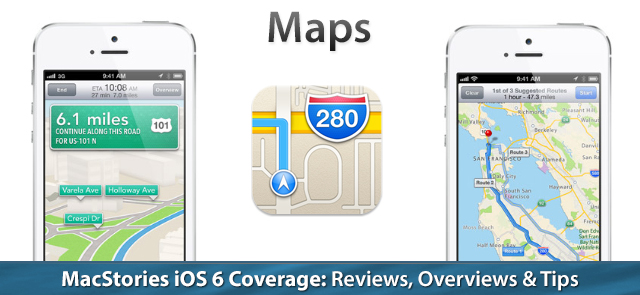
In iOS 6, Apple’s Maps is a headlining feature. During this year’s WWDC 2012 Keynote on June 11th, turn-by-turn navigation was showcased for Apple’s brand new Maps application in concert with the display of real-time traffic conditions. Apple added interactive 3D views and Flyover to select cities, giving maps a 3rd dimension on top of a traditional satellite view. As impressive as Apple’s demonstrations were, the most interesting feature are Apple’s new vector based maps, completely redesigned “from the ground up” as a replacement for Google’s Map data.

Read more


Uberlayer Is A Handy Tool For Pixel-Perfect Design

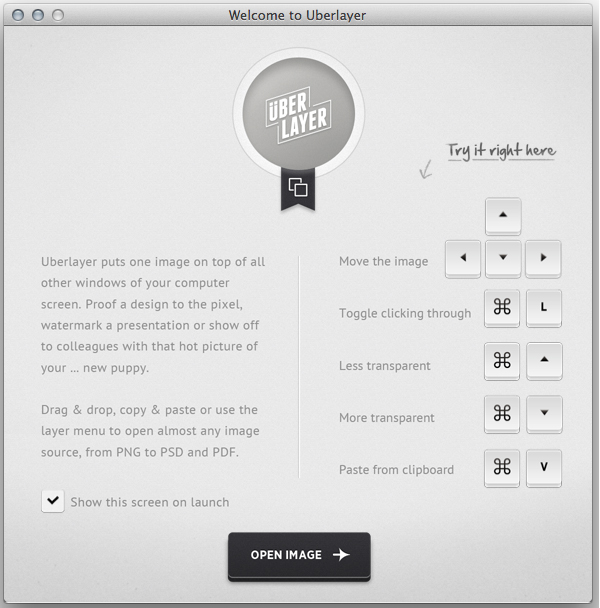
Twelve Twenty, the Dutch maker of the print-size checking OS X app Will It Fit and the iOS calendaring tool Get Together, recently published their third app, Uberlayer. Uberlayer is a small tool for UI and web designers on Mac OS X to quickly overlay images of a new design work onto your desktop.

Let’s say you just designed a mockup of an update to an existing website or application. Drop it onto Uberlayer to bring it on the screen. Using shortcuts you can move it around in pixel steps, make it more or less transparent, and activate click-through options. If you make the design half-transparent and you have the current version of an app or website just behind it, you can easily check how the current design changes will affect the overall look of the whole product. Using the click-through option, it’s easy to select certain parts you want to change to copy or delete them in the “real” version of your product.

I tried Uberlayer on my personal website by trying out a different style for an ad I currently have on it. This is what a half transparent “uberlayed” image looks like:

It’s actually pretty hard to describe how the app works using only words and pictures. If you’re curious, I recommend you head over the Twelve Twenty website and check out their Uberlayer demo video. I think Uberlayer can be a useful tool in a web or application designer’s workflow. Uberlayer is $1.99 on the Mac App Store.


App.net’s First Two iOS Clients: Rhino and Adian

Speaking of App.net, the developer community has been busy building iOS, Mac, and web clients for the service, which promises it’ll never try to purposefully harm or limit the third-party ecosystem. Of all the iOS and Mac clients currently in development (I’m testing a bunch of them, and good things are coming soon), two are currently available on the App Store: Rhino and Adian.

As John Gruber wrote in 2009, Twitter clients used to be a UI design playground for developers attracted to the service that was just about to become mainstream. The App.net clients available today sit in the middle ground of leveraging the conventions established by Tweetie, Twitterrific, and Tweetbot while working with a service that’s not nearly as popular as the Twitter of 2009, when third-party clients exploded in terms of popularity and usage.

Most of the App.net clients currently in development look and perform exactly like Twitter clients, but they are working with a platform with a much smaller scale, even by 2009 Twitter standards. This is perhaps indicative of the current status of App.net – a service that uses the foundation of Twitter while quickly adding its own unique features – and is undoubtedly helping with creating these clients (a smaller community means easier scaling and lots of feedback), but it also leaves a strange feeling of “seen that, done that”.

App.net clients will have to find their own identity just like App.net will have to grow into a different yet solid alternative to Twitter. Developers need time to figure this out. Read more


Living Earth HD — My First Mac OS X Weather App

I’ve never seen the need for a desktop weather application. I’ve always considered it way easier to fire up Chrome, go to the website of my favorite German weather forecast provider, look up the forecast, then get to work. So why should I clutter my menu bar or even my desktop with another app I have to update and look at to justify its purchase? On iOS the situation is completely different: I need a weather app on my iPad for quick glance without the hassle of typing in a web address into Mobile Safari.

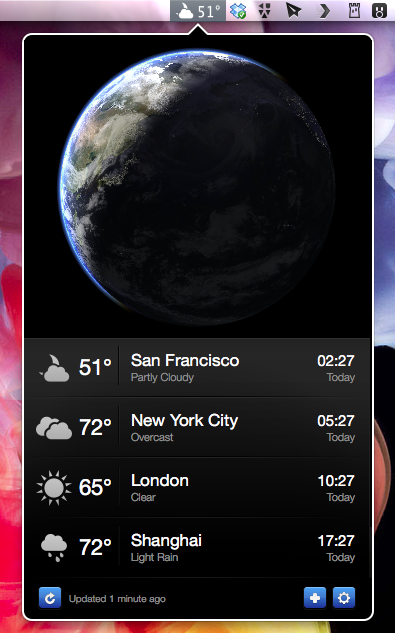
Living Earth HD is one of the newest iPad weather apps featuring an interactive 3D animated world globe with live weather forecasts. After testing it, I realized that this concept didn’t suit me on the road, although the app looked pretty awesome on a Retina Display. I want precise forecasts I could quickly glance at, just like Weather HD 2’s new Quick View feature. So although I like Living Earth HD for iOS, it didn’t have any chance to become my default weather app. Two weeks ago, Ryan and Moshen from Radiantlabs published a port of Living Earth HD to Mac OS X, which I will refer to as Living Earth Desktop throughout this review. I got curious and started testing it. After more than a week now it is still in my menu bar, right beside the Dropbox and Tweetbot icon, which means it’s a really good app.

Read more


Quick, Effective Reminders with Sticky Notifications

Sticky Notifications by Matt Gemmell is a utility to create “sticky” reminders on the OS X desktop using Mountain Lion’s Notification Center (Growl is also supported, and the app runs on 10.7 as well).

OS X comes with Stickies, but, admittedly, Apple’s own app feels outdated and out of shape. By integrating with a system-wide feature users are already accustomed to, and adding neat integrations like Automator and hotkey support, Sticky Notifications greatly simplifies the process of putting information on the desktop for later. And it has a lot of clever touches that, in spite of the app’s simplicity, show a profound attention to detail and care for optimal experience.

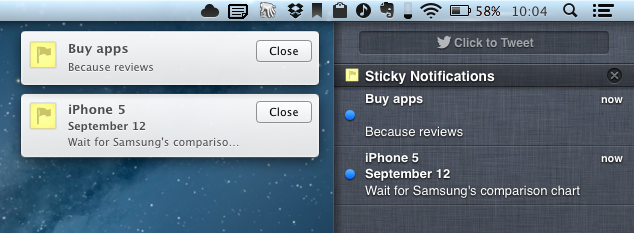
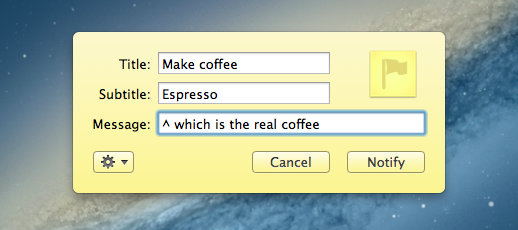
By default, Sticky Notifications sits in the menubar. Upon clicking its icon, a post-it, sharing sheet-like menu pops up, allowing you to write down your reminder. You can write down a title, hit Enter, and the reminder will be created on the desktop using Notification Center’s “alert” style, which is sticky and is displayed until manually dismissed.

Obviously, because it’s based on a native functionality, you can head over Notification Center’s preferences to set the app’s style to banner, but that would defeat the purpose of Sticky Notifications, at least partially (banners will be dismissed after a few seconds, but they’ll still be saved in Notification Center). You can also attach a subtitle and a message, and create multiple stickies to sit on your Desktop.

That would be it as long as the main functionality goes. But developer Matt Gemmell was clever enough to bake in some sweet integrations with system and third-party utilities to extend the capabilities of Sticky Notifications.

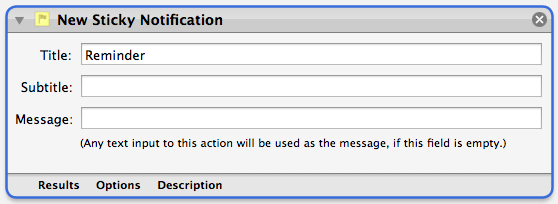
There is an Automator service to create workflows that trigger new reminders using the app. I would love to see AppleScript support in a future version of the app in order to further improve scriptability.

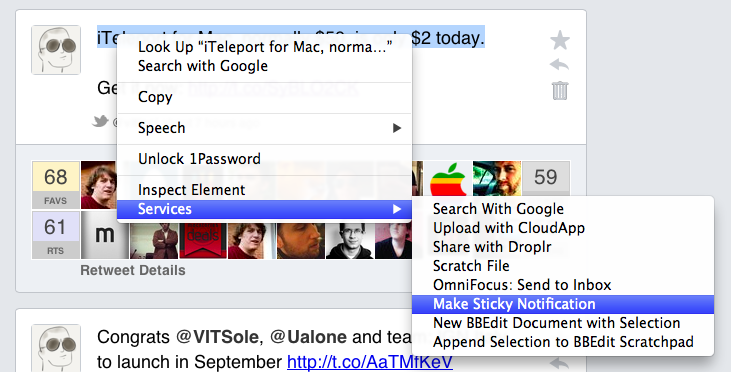
You can select any text on your Mac, and use a system Service (optionally paired with a keyboard shortcut) to save it as a message in a reminder.

Too, the app is smart enough to recognize URLs saved in a reminder’s message, so when clicking on one, the URL will automatically open in the default browser. I find this to be an excellent solution to save links for later without bookmarking them.

Speaking of URLs, Sticky Notification has a URL scheme. By URL-encoding parameters in a single string (just concatenate them using &), you can create new reminders outside of Sticky Notifications in the background, or bring up the app’s menu by using the prepare option in the URL. Because of this URL scheme, you can combine Sticky Notifications with Alfred (or LaunchBar) to set up custom searches. I really like having custom URL schemes in the apps I use daily, as they allow me to fiddle and build custom workflows tailored to my needs.

Sticky Notifications is the perfect example of a fairly complex piece of software presented as a simple and intuitive app. This doesn’t come as a surprise, considering, again, the amount of thought and work that Gemmell put into this app. As Matt wrote, it’s the little things.

Sticky Notifications is only $2.99, either from the Mac App Store or the developer’s website. If you’re looking for a modern, easy to use, and powerful Stickies replacement, you can’t go wrong with Sticky Notifications. Recommended.


Denominations: A Simple Currency Converter

Developed by Abraham Vegh, Denominations is a simple currency converter that focuses on the concept of converting money to another currency, rather than the functionality alone.

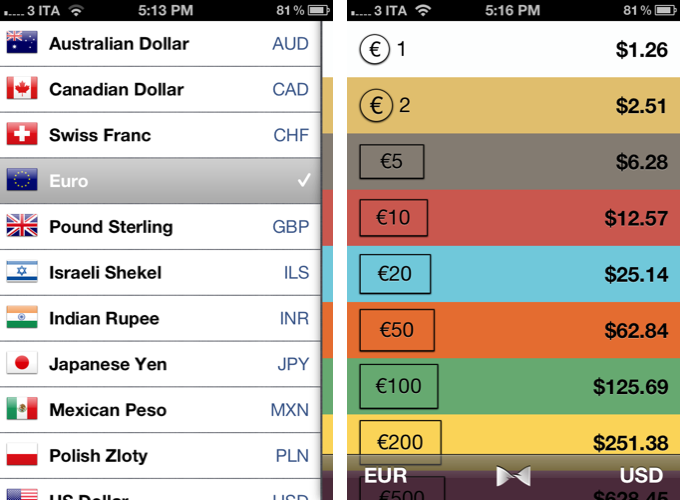
Most currency converters on the App Store feature a number pad for entering values – like a calculator – and a menu to choose currencies to compare. Denominations is different: instead of letting you enter your own numbers, it comes with a predefined set of amounts to compare. You can set two currencies, and quickly switch between them with the tap of a button. Denominations’ focus is on the idea of understanding conversions in another currency without having to think too much.

I don’t think Denominations can replace currency converters like Currencies – after all, I still need to convert the amounts I want – but I believe it has some neat possible usage scenarios worth considering. For instance, as a tourist I might just want to know “how many pounds are 10 Euros”, instead of doing my own manual conversion at the coffee shop. Or I might need to know that, approximately, my dinner will cost around 50 Euros, which Denominations says are worth 62 dollars today (rates are updated server-side every 15 minutes). Quick, at-a-glance information that doesn’t require me to think and manually enter numbers.

Denominations’ design is concise, with a flat color scheme that’s reminiscent of the simplicity of Clear, again signifying a trend in recent App Store releases to focus on information rather than ornamental menus. Developer Vegh is already working on adding more currencies, bug fixes, and tweaks for an upcoming version.

Denominations is available at $1.99 on the App Store.


Review: Magellan Virtual Analog iPad Synthesizer

In my post about the current state of music-making and discovery on the iPad, I concluded with a roundup of the best, most sophisticated software to professionally create music on the iPad. As I did with shuffler.fm and discovery, I would today like to add a new app to the list of the best software synths available for the iPad. The app that I found worthy of being added is the newest product by music software company Yonac Inc, called Magellan.

Yonac made a name for itself by producing an extensive amount of music-related apps since early 2010. One of their most elaborate and popular efforts has been the Shredder guitar synth to create analog and digital synth leads or pads by playing guitar into the iPad through an interface like the IK Multimedia iRig or the Apogee JAM. The company was also right there when the iPad got unveiled. They developed and promoted one of the very first synth software for the iPad, the Yonac miniSynth.

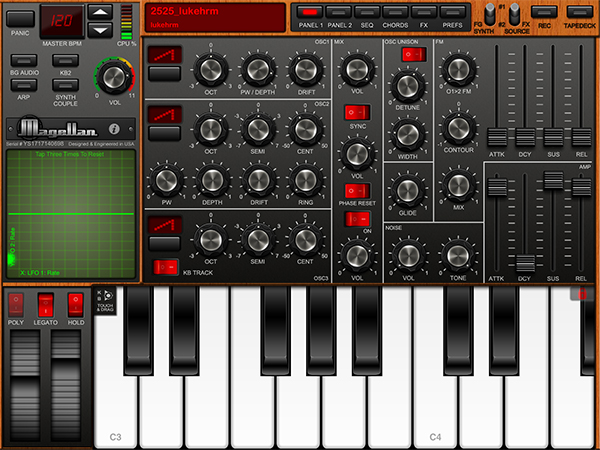
Magellan is their new masterpiece. It’s a fully fleshed-out virtual analog synth with a lot of power. Let me sum up its basic feature set: two synthesizer engines running at the same time, each of them equipped with three oscillators for basic sound generation, frequency modulation, a step sequencer, and two filters plus eight effects. The app has got an easy to understand interface and produces an immense variety of sounds in very high audio quality. This review not only judges the quality and usability of Magellan, I will also give so detailed instructions and tricks so that you immediately can start making sophisticated music tracks with the app right after you’ve downloaded it. So, if you are curious, stay a while and let me explain you how Magellan works and why it may become a strong competitor to other high-end iPad synths like the KORG iMS-20 or the Sunrizer.

Read more


Buzz Contacts 2.0 Refines Interface, Improves Navigation

Buzz

Buzz

Savvy Apps’ Buzz Contacts is one of the finest iPhone apps to quickly access contacts from the Address Book and organize them into groups. Back in February I wrote a review of the first version of the app, and I liked what Ken Yarmosh and his team built:

Buzz is focused on groups. From a Facebook-like panel on the left, you can create as many groups as you want (such as “Friends”, “Family”, or “Work”) and assign contacts to them. Switching between groups is easy, as you just have to open the panel again and tap. Each group can have multiple pages of contacts, and each shortcut in the group’s grid view can be assigned a default action — be it call, message, or email. From the group’s management window, accessible by hitting the Groups icon in the upper right corner, you can reorder contacts, and organize pages if a group has more than four shortcuts.

The group actions of Buzz are something I found myself using on a daily basis. By tapping on the lower section of a group’s page, in fact, you get shortcuts for group messaging and emailing that will automatically use all the email addresses / phone numbers stored in your Address Book to send emails or texts to multiple recipients at once. This is particularly handy for teams, groups of friends, or family members. It’s been a huge time saver for me, as I would have to manually re-insert each contact every time I want to start a new group message or email.

Buzz Contacts 2.0, released today as a free update for existing customers, is a fantastic step forward in terms of design polish, navigation, integration with other services and apps, and overall speed of the app – an essential aspect of a utility that aims at making it easier and quicker to access your contacts.

In version 2.0, Buzz Contacts received a new icon and support for themes. Like Agenda, Savvy Apps’ other popular calendar app for iOS, users can now choose between different takes on the app’s color scheme and, interestingly, they can do so by either opening the Settings or swiping left/right on the top bar to change colors instantly. I prefer the app’s standard black theme, but I found the swipe implementation to change themes particularly well done.

Where Buzz Contacts 2.0 really excels, though, is the in functionality it adds to group management and navigation. Retaining the same Facebook-inspired panel interface of version 1.0, Buzz 2.0 adds Frequent and Outgoing sections at the top of the sidebar; in my usage, I found the Frequent “smart group” to be a great way to have the app monitor my most-contacted people for me, offering a series of shortcuts for emails, calls, or messages that I access on a daily basis. It’s reminiscent of the functionality Dialvetica offered, and it’s perfectly integrated with the other features offered by Buzz.

Buzz

Buzz

Such features include a double-tap action to bring up options for single contacts, which in version 2.0 got support for scheduling through Agenda or Due (so you won’t forget to contact your coworkers or friends anymore), possibility to send contact details via email or message, and integration with Box, Camera+, and Dropbox to easily add attachments to emails. This is a welcome addition to my workflow, as I rely on a Dropbox shared folder to store files for our team, and now I can easily forward them via email to a single contact (or everyone within a Buzz group) so I can add comments in the message. Or, more simply, I can attach photos from the Camera Roll or Camera+ and send them to my closest friends without leaving the app or composing a message manually.

Buzz Contacts 2.0 adds a reworked dialer that’s now easier to access and that works with phone numbers, names, and initials. Whether you prefer to dial a contact by name or number, Buzz will display results from your Address Book in real time, highlighting in green the numeric or alphabetic matches as you type. You can then double-tap on a contact to bring up the action menu, add it to a group from the dialer (a new option in 2.0), or initiate a new phone call (there’s a setting to avoid confirmation for phone calls).

To improve navigation, Buzz 2.0 deepens its reliance on swipes to create an actionable environment that’s equally powerful and intuitive. You can swipe horizontally between multiple pages of a group, and swipe to the right to open the group in a simpler list view. An additional swipe to the right will go back to the slide-out panel, which is now more responsive and better highlights the active view. In this new version, you can also swipe vertically between groups and the dialer – an option that single-handedly reinvented my usage of Buzz as it’s dramatically faster than going back to the sidebar for every kind of section switching.

Buzz Contacts 2.0 is full-featured and easy to use. Whereas an app like Launch Center Pro can work as a quick contact launcher, Buzz Contacts is a powerful contact manager and hub that in this version has been greatly improved with faster navigation and integration with other apps and services. Buzz Contacts remains the best solution for group-based contact management in my opinion, and thanks to a better dialer and support for swipes, it can now aspire to replace Apple’s Phone app for other users as well.

Buzz Contacts 2.0 is available at $0.99 for a limited time.