


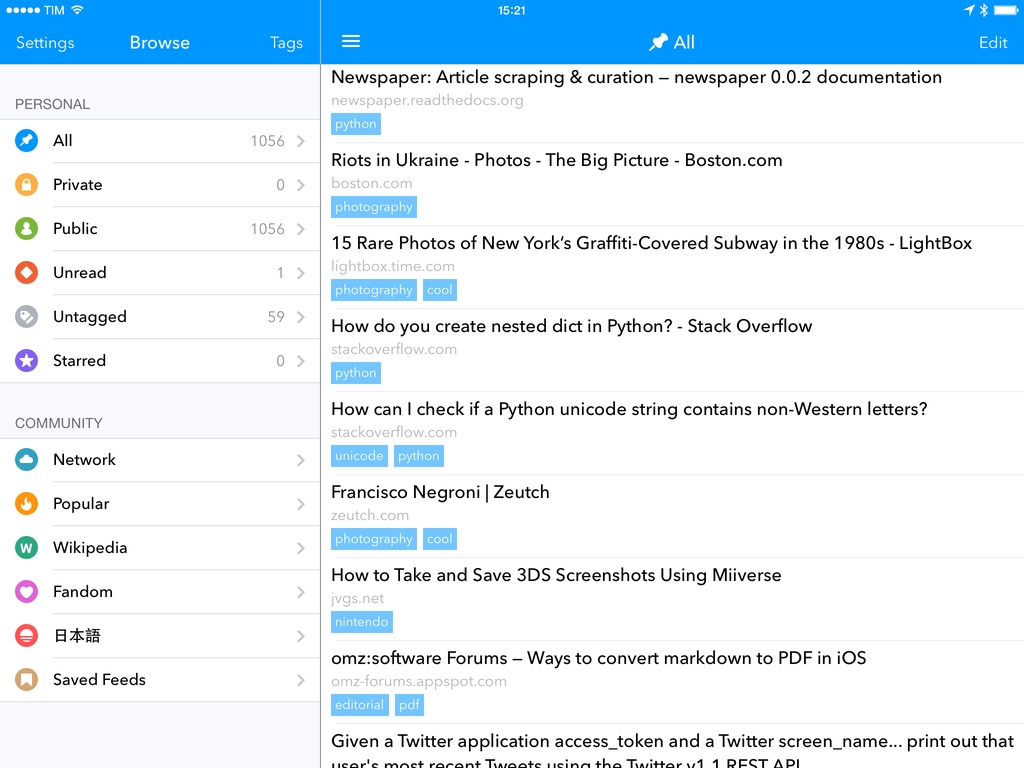
Pushpin, a full-featured Pinboard client that used to be my personal favorite before iOS 7, has today been updated to version 3.0, which brings a new design, a split pane interface on the iPad, and several other features. On the iPhone, I now prefer Pinswift, but Pushpin remains the best Pinboard experience for the iPad, which is where I spend most of my time bookmarking links and discovering new ones every day.
How The “Lost” Mac Intro Video Was Found→
On January 24, 2005, Majo posted the video on his site for the Mac’s 21st birthday. The traffic was overwhelming. To watch, you had to download the 20MB file, and majo’s site soon crashed. We were SlashDotted, kottke.orged, and etc. He begged for mirror sites, and a bunch of other people helped out. I wrote a blog post about the video. I watched the comments come in from around the world as people woke up and discovered the “lost” video (that I didn’t realize had been lost). The comments show how excited people were to discover the video, and how eager they were to help by mirroring it. It was a pretty cool day.
Like many other “lost videos”, there’s a good story behind Jobs’ Macintosh intro (via Daring Fireball).
See also: how the original Macintosh demo was actually put together, by Andy Hertzfeld.
Apple’s “Mac Icon Standard” Font→
Nice surprise in Apple’s 30 Years of Mac website: a font including all the icons for every Mac model from the original Macintosh up to the latest modern Macs. For those interested, the Unicode code points used by Apple. These are beautiful line drawings and a good easter egg.
Macminicolo Launches Mac Pro Colocation Service→
Macminicolo, the first Mac mini colocation service that has been hosting Mac mini servers for over 9 years, has today announced a Mac Pro colocation service, called MacProColo. The service will allow users to send their new Mac Pros to take advantage of the benefits of a data center to have powerful, dedicated hosting with all the benefits of OS X and the Mac Pro’s advanced technologies.
From the company’s blog post:
We tested the Mac Pro quite a bit in the data center. It performs incredible and there is no issue with heat. The Pro does pull quite a bit more power though. (And in a data center, power is one of the biggest expenses.)
For most people, the Mac mini will easily do the job and will also be less expensive for purchase and for colocation. In my opinion, I think most people will want the Mac Pro on their desk and the Mac mini in the data center.
Speaking to MacRumors’ Jordan Golson, Macminicolo’s Brian Stucki noted that the fan of the new Mac Pro makes it easy to get air through the machine, and he added that heat dissipation won’t be an issue in most data centers.
We’ve been running MacStories on Macminicolo for over a year now, and I couldn’t be more satisfied with the service’s uptime and the company’s support. We’ve changed a few hosting providers over the years, and while setting up a dedicated Mac server for our needs required some time, it was absolutely worth it. We won’t need a Mac Pro upgrade (at least not for the time being), but I can personally vouch for Macminicolo and I’m looking forward to reading about other websites switching to MacProColo.
Details about pricing are available here.
iFixit Tears Down The Original Macintosh→
iFixit:
Join us as we live the time-traveler’s dream—the deep, lucid, Orwellian vision of hope, fear, and nostalgia that is 1984. Just in time for its 30th anniversary, we laid hands on an ‘84 original: the Macintosh 128K. And, you guessed it—we’re tearing it down like it’s the Berlin Wall.
They give it a repairability score of 7/10. Don’t miss the face-to-face photo of Old vs New in Step 7.
Also worth checking out: Macworld’s unboxing of the Macintosh (via John Siracusa).
Apple Celebrates 30 Years of Mac
To celebrate 30 years since the introduction of the original Macintosh (January 24, 1984), Apple has launched a special webpage and released a commemorative video focused on the impact that the Mac had on modern technology.
Thirty years ago, Apple introduced the Macintosh with the promise to put the creative power of technology in everyone’s hands. It launched a generation of innovators who continue to change the world. This 30‑year timeline celebrates some of those pioneers and the profound impact they’ve made.
In the video, Apple shows musicians, designers, photographers, teachers, scientists, and other users who, with the Mac, have been able to be more creative, more productive, and more satisfied with computers thanks to the Mac’s constant evolution and refinement. In an interview with Macworld published yesterday, Apple’s Phil Schiller and Craig Federighi shared their thoughts on rumors of “convergence” of iOS and OS X and stated how, because of its nature and design, the Mac “keeps going forever”.
Apple’s special 30 Years site features beautiful photography and special icons for old Macintosh models displayed in a scrollable timeline at the bottom. Each Mac model has an associated story of how it was used – for instance, Apple talked to Moby, the Miller brothers (creators of Myst), and educators, among others, about the role that the Mac had in their lives.
Apple’s mini-site focuses on people and their stories rather than computer specs. In the timeline, the only product-only preview photos are the original Macintosh (where there are photos of Jobs and part of the original Macintosh team) from 1984 and the latest Mac Pro, displayed in 2014 (even though it was technically released in 2013). Apple is also allowing readers to answer questions to a poll about their first Mac, with results displayed in each model’s page under a “What people did with it” section. Unsurprisingly, Apple chose to celebrate human creativity instead of advancements in technology, which has been a common theme in the company’s campaigns lately. The 30 Years site is exceptionally well done.
As reported by 9to5Mac, Apple is also celebrating 30 Years of Mac with special window displays at its retail stores. As part of Apple’s press tour for the Mac’s anniversary, ABC’s David Muir interviewed Tim Cook, Craig Federighi, and Bud Tribble; the full interview will air tonight, and a first excerpt is available here.
My First Mac
After my friends and I graduated from high school in July 2007, we decided to take a vacation to Spain and go see our favorite bands in Benicàssim, at an annual music festival. That was the year when Arctic Monkeys were already pretty popular thanks to 2006’s record-smashing debut album and Favourite Worst Nightmare (but they were still shy on stage), and just a month after the iPhone went on sale in the United States.
Celebrate The Mac→
Jonathan Zufi:
To celebrate Mac’s 30th birthday, I’ve created this micro site for all the world to enjoy. In 2009, I started taking photos of every Apple product ever made since 1976. Then I turned them into a really big photo site. I hope you enjoy this trip down memory lane, and I hope that the Macintosh’s anniversary brings your happy memories of your own experience with Apple.
Beautiful photos. Jonathan is also the author of ICONIC, a fantastic photo book about Apple products. Make sure to check out the PowerBooks page and then look down at your new MacBook’s trackpad.
Apple Executives On The Mac At 30→
Macworld’s Jason Snell has an interview with Apple executives Phil Schiller, Craig Federighi, and Bud Tribble about the 30 years of the Mac (Tribble was part of the original Macintosh team). It’s a great interview, and this part about convergence of OS X and iOS stood out to me:
The reason OS X has a different interface than iOS isn’t because one came after the other or because this one’s old and this one’s new,” Federighi said. Instead, it’s because using a mouse and keyboard just isn’t the same as tapping with your finger. “This device,” Federighi said, pointing at a MacBook Air screen, “has been honed over 30 years to be optimal” for keyboards and mice. Schiller and Federighi both made clear that Apple believes that competitors who try to attach a touchscreen to a PC or a clamshell keyboard onto a tablet are barking up the wrong tree.
“It’s obvious and easy enough to slap a touchscreen on a piece of hardware, but is that a good experience?” Federighi said. “We believe, no.
Later in the article, Snell included other quotes by Federighi and Schiller about how each device in Apple’s lineup fills a specific role. The message is clear, but I’m sure that it still won’t convince analysts to better understand the company they’re covering.