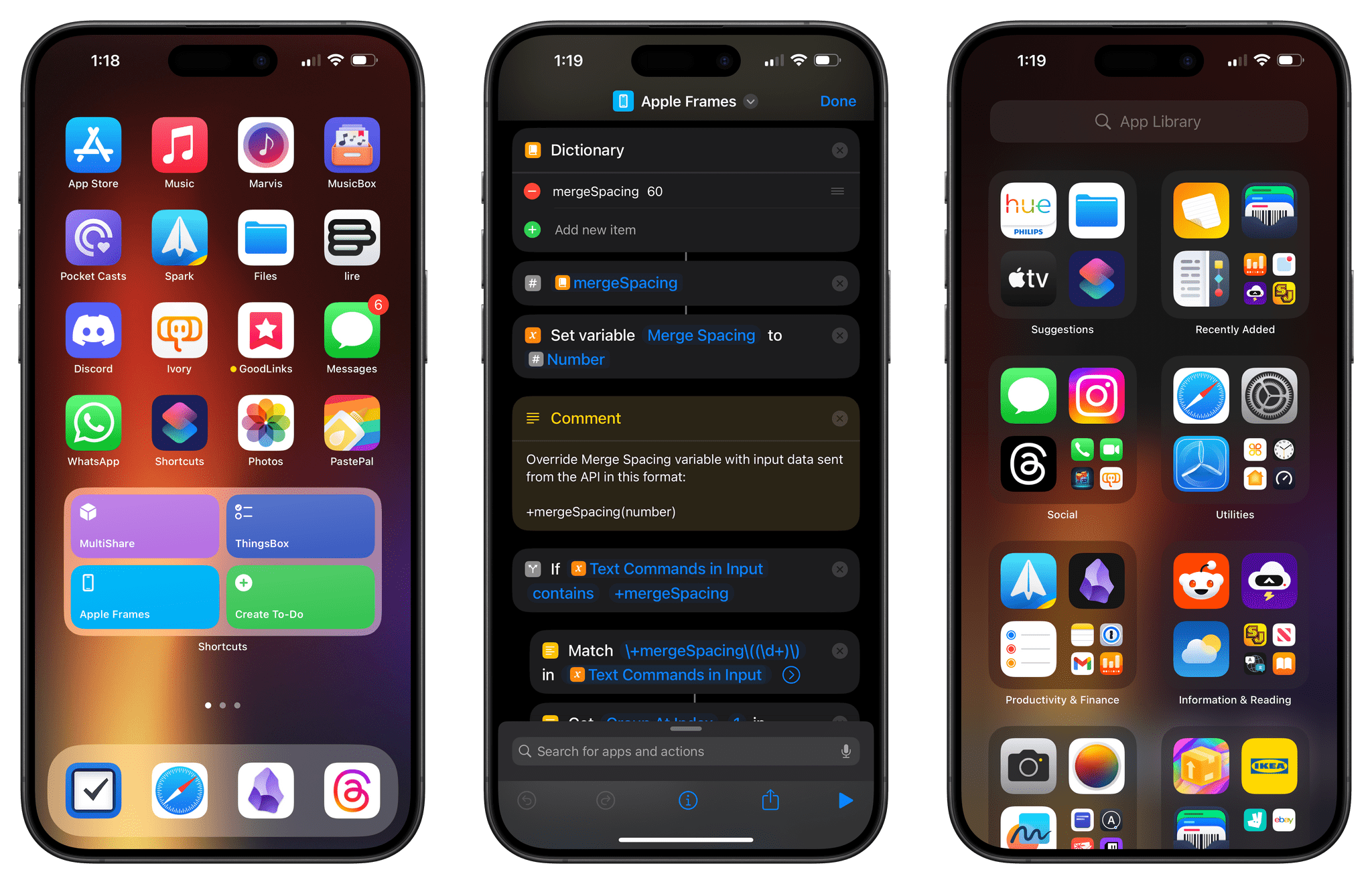
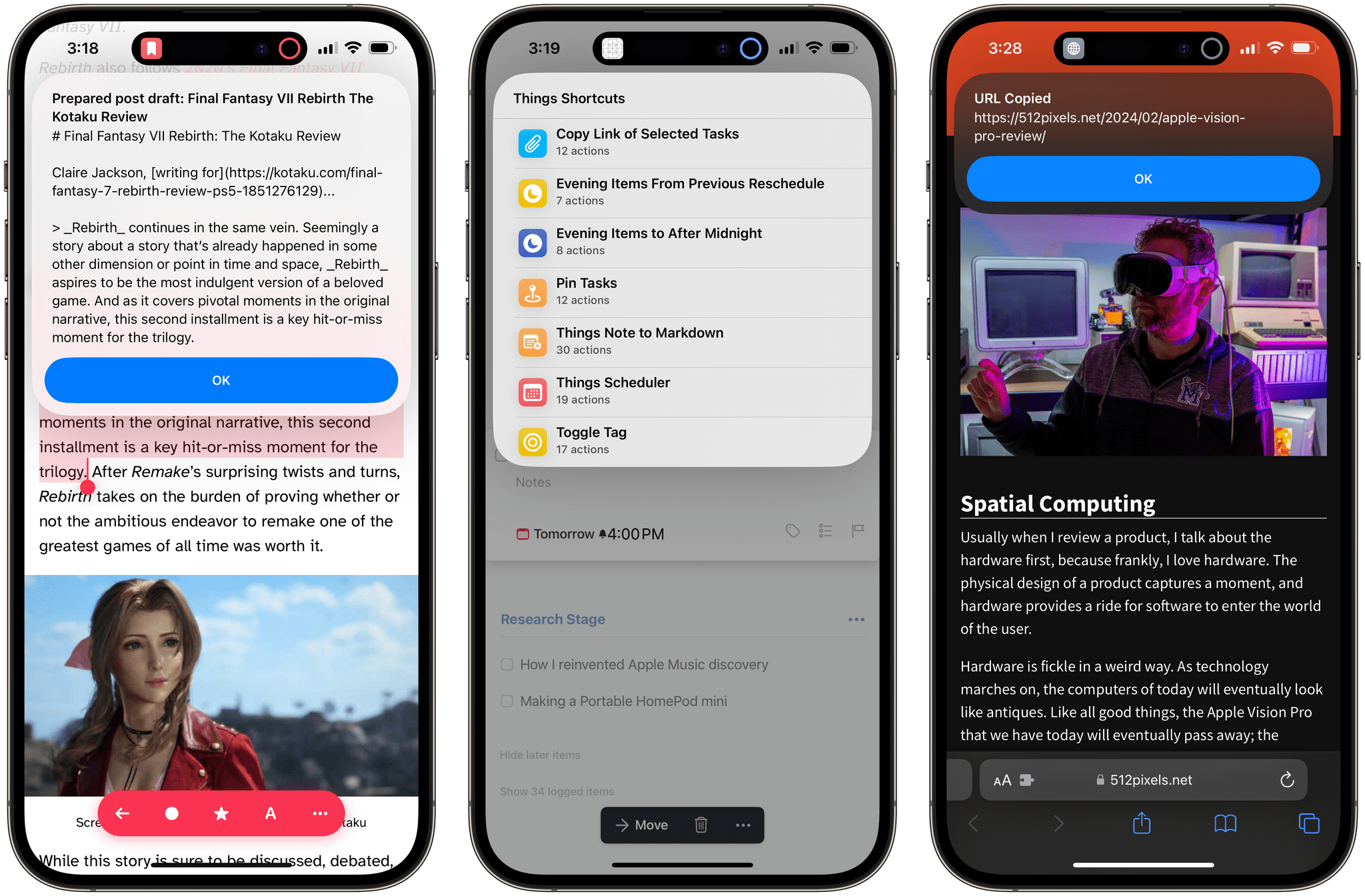
Update, March 28, 2024: I recently realized that the original version of ThingsBox was failing to properly save URLs shared from the YouTube app for iOS and iPadOS. (Fun fact: this happens because YouTube passes URLs to the share sheet not as URLs, but as plain text. Sigh.) I’ve shared an updated version of ThingsBox...
Read more
The 2023 MacStories Selects Awards
Using Custom Fonts in GoodLinks
I’m trying out GoodLinks again as my read-later app (as I mentioned on AppStories, I want to find “the Things of read-later apps”, and this may be it), and while I was reading some articles the other day, I realized I wanted to try another reading font. Specifically, I wanted to check out an option...
How ChatGPT Changed Tech Forever→
I thoroughly enjoyed this story from a couple weeks ago by David Pierce, writing for The Verge about OpenAI’s ChatGPT turning one and how it created a revolution in the tech industry that no one saw coming:
We definitely seem to like being able to more quickly write business emails, and we like being able to ask Excel to “make this into a bar graph” instead of hunting through menus. We like being able to code just by telling ChatGPT what we want our app to do. But do we want SEO-optimized, AI-generated news stories to take over publications we used to love? Do we want AI bots that act like real-life characters and become anthropomorphized companions in our lives? Should we think of AI more as a tool or a collaborator? If an AI tool can be trained to create the exact song / movie / image / story I want right now, is that art or is that dystopia? Even as we start to answer those questions, AI tech seems to always stay one step and one cultural revolution ahead.
At the same time, there have been lawsuits accusing AI companies of stealing artists’ work, to which multiple US judges have said, essentially: our existing copyright laws just don’t know what to do with AI at all. Lawmakers have wrung their hands about AI safety, and President Joe Biden signed a fairly generic executive order that instructed agencies to create safety standards and companies to do good and not evil. There’s a case to be made that the AI revolution was built on immoral and / or illegal grounds, and yet the creators of these models and companies continue to confidently go ahead with their plans, while saying it’s both impossible and anti-progress to stop them or slow them down.
This all gets really heady really fast, I know. And the truth is, nobody knows where all this will be even 12 months from now, especially not the people making the loudest predictions. All you have to do is look at recent hype cycles — the blockchain, the metaverse, and many others — for evidence that things don’t usually turn out the way we think. But there’s so much momentum behind the AI revolution, and so many companies deeply invested in its future, that it’s hard to imagine GPTs going the way of NFTs.
I recommend reading the whole piece on The Verge. I quoted these paragraphs because they get right to the heart of the conflict that I also feel whenever I think about ChatGPT and similar tools. On the one hand, they were (largely? Partially?) built with data sets stolen from artists and creators (including this very website); on the other, the practical benefits of, say, using ChatGPT to help me proof-read my articles are undeniable.
I’ve been thinking about these issues a lot, perhaps because I make a living out of, well, creating content for the Internet. Is there a way to enjoy the power of LLMs without feeling weird and conflicted about how they were made in the first place? Will it even matter years from now? I don’t know the answer, but I’m hoping Apple will have one.
What If?: Exploring Alternative Apple Timelines
An Update On My XREAL Air Setup with the iPad Pro
It was only a few weeks ago that I wrote about the RedMagic USB-C adapter – arguably, the best USB-C dongle I’ve ever seen in terms of compact size and support for USB-C fast charging and video out in the same package. As I explained, I wanted to find the smallest possible adapter to charge...
Improving the Copy and Paste Prompts on iOS→
I couldn’t agree more with all the suggestions proposed by Matt Birchler, who envisions a more flexible permission flow for clipboard access on iOS that is entirely in line with Apple’s current privacy prompts for other personal data.
Apple could even hide the “always allow…” option until the user had allowed an app to see the clipboard like 5 times in a row. That would avoid giving full access to apps that you don’t want to give it to, and it even helps keep the number of apps with this always access down. After saying “allow paste” in Parcel 100+ times in the past few years and never hitting no, it might be safe to let me just say “always allow” at this point, but maybe an app where I paste once in a blue moon doesn’t need it.
They could go the other way as well: if you deny an app a few times in a row, there could be a new option the next time that asks if you want to block this app from the clipboard forever.
And as they’ve done recently with location, photos, and calendar access, it could make sense to occasionally show an alert that tells the user that this app has access to your clipboard and how often it’s used that access in the last X days.
I strongly disliked the redesigned clipboard prompts in the first version of iOS 16 (a perfect example of user experience dictated by security engineers rather than designers at Apple), and I was relieved when the company improved the system with per-app clipboard settings in 16.1. Still, these clipboard prompts feel antiquated, user-hostile, and not intelligent at all. For starters, they should be consistent – like Matt suggests – with Apple’s other privacy prompts. Second, they should learn from user habits in terms of granting access or reminding people to review their apps with clipboard access.
Third, I can’t believe it’s still not possible for third-party developers to make a proper clipboard manager for iOS and iPadOS – a software category that continues to thrive on macOS. I was writing about this stuff 13 (!) years ago, and it’s wild that nothing has changed.
Workflow Co-Founders Want to Bring AI to the Desktop→
When I read earlier this year that Ari Weinstein, one of the co-founders of Workflow before it was acquired by Apple, had left the company, I had a feeling he’d team up soon enough with Conrad Kramer, another Workflow co-founder. I was right. Alex Heath, writing for The Verge, has some initial details on Software Applications Incorporated, the new venture by Weinstein, Kramer, and Kim Beverett, another Apple vet you may remember from the original Siri Shortcuts demo at WWDC 2018:
In their first interview since leaving Apple to start something new, the trio tells me that their focus is on bringing generative AI to the desktop in a way that “pushes operating systems forward.” While they don’t have a product to show off yet, they are prototyping with a variety of large language models, including OpenAI’s GPT and Meta’s Llama 2. The ultimate goal, according to Weinstein, is to recreate “the magic that you felt when you used computers in the ’80s and ’90s.”
“If you turned on an Apple II or an Atari, you’d get this basic console where you could type in basic code as a user and program the computer to do whatever you wanted,” he explains. “Nowadays, it’s sort of the exact opposite. Everybody spends time in very optimized operating systems with pieces of software that are designed to be extremely easy to use but are not flexible.”
An example he gives: “Sometimes you’ve got a browser window open with a schedule on it, and you just want to say, ‘add this to my calendar,’ and somehow, there’s no way to do that… We think that language models and AI give us the ingredients to make a new kind of software that can unlock this fundamental power of computing and make everyday people able to use computers to actually solve their problems.”
They don’t have a product to show yet, but I’ll say this: if there’s anyone out there who can figure out how to turn generative AI into something more than a text prompt or writing assistant for Word and Notion – something that can be truly integrated with your computer, your data, and, well, your workflow, it’s this trio. I absolutely can’t wait to learn more about what they’re working on.
Also worth noting: the company’s website (great domain, too) is a delightfully retro, emulated browser version of Mac OS 8.