Federico Viticci

10766 posts on MacStories since April 2009

Federico is the founder and Editor-in-Chief of MacStories, where he writes about Apple with a focus on apps, developers, iPad, and iOS productivity. He founded MacStories in April 2009 and has been writing about Apple since. Federico is also the co-host of AppStories, a weekly podcast exploring the world of apps, Unwind, a fun exploration of media and more, and NPC: Next Portable Console, a show about portable gaming and the handheld revolution.

Integrating Women Into the Apple Community

Brianna Wu, writing for Macworld last week:

But it’s very hard for me to reconcile this consumer-facing Apple with the development company that put no women on stage this year for either the 2014 Worldwide Developers Conference keynote or the more-technical State of the Union. It’s difficult to connect this Apple I know and trust with the endless sea of white, male faces I saw at Yerba Buena Gardens during this year’s WWDC Bash. Women buy Apple products. We develop on Apple hardware. But we’re still not yet well-represented in Apple’s developer community.

We, as a community, need to keep talking about this and then act on it, because the future needs to be better. Also from Brianna’s article:

Getting women into entrepreneurial positions is also critical. My own company, Giant Spacekat, has quickly risen as a powerful voice for women in game development. Not only am I in a position of industry credibility, I’m able to speak to my experiences, to hire women and advocate for other women. There need to be more Giant Spacekats in the industry.

Permalink

Apple’s Diversity Stats and Message

Tim Cook, writing on Apple’s Diversity webpage in regard to newly-published stats:

Apple is committed to transparency, which is why we are publishing statistics about the race and gender makeup of our company. Let me say up front: As CEO, I’m not satisfied with the numbers on this page. They’re not new to us, and we’ve been working hard for quite some time to improve them. We are making progress, and we’re committed to being as innovative in advancing diversity as we are in developing our products.

A short film is available here. See also: inclusion inspires innovation.

Permalink

Jean-Louis Gassée on App Store Curation

Jean-Louis Gassée, in his open letter to Tim Cook:

Instead of using algorithms to sort and promote the apps that you permit on your shelves, why not assign a small group of adepts to create and shepherd an App Store Guide, with sections such as Productivity, Photography, Education, and so on. Within each section, this team of respected but unnamed (and so “ungiftable”) critics will review the best-in-class apps. Moreover, they’ll offer seasoned opinions on must-have features, UI aesthetics, and tips and tricks. A weekly newsletter will identify notable new titles, respond to counter-opinions, perhaps present a developer profile, footnote the occasional errata and mea culpa…

Good points, and not the first time Gassée has used the Michelin guide as an example of the human curation that could improve the App Store’s recommendations.

Gassée doesn’t mention the upcoming Explore section of the iOS 8 App Store, and I believe that is going to provide an interesting mix of the classic category-based organization with curation through sub-categories and editorial picks for specific “app types”.

Unsurprisingly, Explore is going to replace Near Me in the middle tab of the App Store app for iOS 8: Near Me will be integrated into Explore, and it will likely extend as part of a new system to advertise apps relevant to your location on the Lock screen. Free of the limited scope of Near Me, Explore will enable the App Store team to offer a full-blown index of app categories that are easily accessible from a dedicated view.

It is my understanding that Explore will feature a mix of the curated app collections Apple has been building for the past couple of years and new filters for app types. Starting with the basic list of App Store categories, you’ll be able to drill down into more specific sub-categories with multiple levels of depth, such as “Music > DJs” or “Productivity > Task Management > GTD”.

While Apple may not be considering a full-blown, standalone App Store Guide as a regular publication, iOS 8’s Explore section is showing encouraging signs of new curation efforts that account for the incredible variety of the App Store’s catalogue, but it remains to be seen whether customers will take the time to explore the Explore section.

Permalink

Recommending Music on Spotify with Deep Learning

This summer, I’m interning at Spotify in New York City, where I’m working on content-based music recommendation using convolutional neural networks. In this post, I’ll explain my approach and show some preliminary results.

A fascinating post by Sander Dieleman explaining how he designed a deep neural network to provide music recommendations based on Spotify data. It’s a technical read, but there are Spotify player widgets to listen to songs picked up by the network, which is capable of learning specific pitches, chords, sounds, and other factors such as Chinese voices. Dieleman says that hopefully some of these audio-based recommendations will go into A/B testing soon, with a focus on recommending new music that isn’t generally picked up by traditional recommendation engines. Impressive.

Permalink

Four Years in Apple’s Ecosystem

An interesting and well documented experiment by The Typist: a visualization of four years of purchases on the iTunes Store, and particularly the App Store. I can’t imagine the amount of effort that went into this (sifting through 90 emails, recalculating prices based on past currency conversions, etc.), but I hope I’ll have the patience to do the same someday.

The Typist makes a great point about iOS games:

So what does that mean for games? Of the 34 that I’ve purchased, only 5 games — worth $18 — are currently installed on either of my iOS devices. Of the $111.66 that I’ve spent, $93.71 worth of games are on neither of my devices. Almost 84% of the money I’ve spent on games is now in the cloud.

Does that mean I wouldn’t have bought any or most of them? Not necessarily: That would be like not going to the movies because you pay $12 for 120 minutes that you can’t “reuse”. Most forms of entertainment are ephemeral by nature.

Unlike console games, I can’t remember any old iOS game that I intentionally redownloaded to play it again like I do for, say, Nintendo or Squaresoft classics. Maybe it’s just me, or maybe it’s the nature of mobile games. Also worth considering: old iOS games that don’t work properly on current versions of the OS, that don’t have Retina assets, or that rely on third-party services no longer in existence (the last one is a problem common to console games, too).

Permalink

Pinterest Launches Messaging Feature

In an update released yesterday on the App Store, Pinterest rolled out a messaging feature that allows people to share pins privately and have discussions around them.

Casey Newton has a good overview:

Starting today, the company is rolling out messages on Android, iOS, and the web. Like Facebook’s “chat heads,” recent messages pop up to the left of the feed as bubbles with your friends’ faces. You’ll find the others under the pin icon where notifications pop up. Just click the ‘+’ icon, type in the name of a friend on Pinterest, and you can send a pin or a standalone message. The impressive thing about Pinterest messages is that the pins you send within the app retain all the functionality of a pin you see anywhere else on the site. Anything you can do with a pin on Pinterest’s web site, you can do inside a message: pin it to a board of your own, send it to another friend, or click the ‘heart’ to add it to your list of favorites. You can even drag a pin from the site into a message.

Pinterest is the only social network that I’m genuinely excited about lately. I’ve been using Pinterest a lot in the past few months, and it strikes me as a company that knows what people want and how they really use the service. Everything about it is friendly, comfortable, and practical; the fact that I can talk about Pinterest with my “normal” friends without getting the blank stares I receive for Twitter also helps.

Permalink

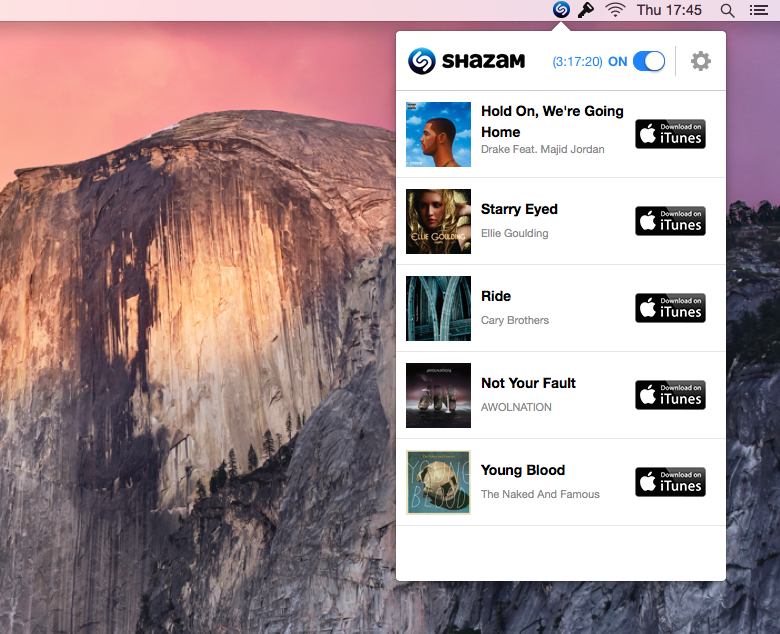
Shazam for Mac: Background Song Recognition in the Menu Bar

I was surprised to hear last week that Shazam, makers of the popular music recognition app that’s going to be integrated with Siri in iOS 8, had launched a desktop app for OS X, available for free on the Mac App Store. I always associated Shazam with the portability and instant-on nature of the iPhone: you hear a song playing, you want to know what it is, you pull out Shazam and let it work its magic. That’s why I’ve never managed to get used to Shazam on the iPad and why I seldom use all the features that the company has tacked onto the app over the years: fundamentally, I see Shazam as the music recognition app for iPhone, and that’s it.

Read more