
Question: I have seen you have covered how to create a PDF for each link selected in the Club MacStories archive and save it into Dropbox. I was wondering if there is a way to create a similar workflow except to add a Todoist task that would attach the PDF as a note. I don’t...
 Sharing Multiple Files at Once from DEVONthink
Among the various shortcomings of iOS compared to the Mac, one that I frequently mention on MacStories and Relay FM is the inability to share multiple files at once with extensions and document providers. Apple’s own iOS apps, such as Mail and iCloud Drive, can’t move multiple documents at once between apps; iOS itself...
Canvas, Episode 31: Note-Taking with Apple Pencil→
This week Fraser and Federico take their Apple Pencils in hand and share some notes on taking notes with the iPad Pro.
We’ve covered some excellent Pencil-based note-taking apps for iPad on this week’s Canvas, and also explained why the Pencil is a must-have accessory for iPad Pro owners. You can listen here.
Sponsored by:
- SaneBox: Clean up your inbox in minutes. Sign up for a two-week free trial and a $20 credit.
Connected, Episode 133: The Italian Word for Spoon→
Apple has a new ad, Casey has an iMac, Ticci watches TV and everyone has workflows.
On today’s Connected, we covered a lot of the automations we’ve created with Workflow, as well as some custom workflows I’ve built for MacStories. You can listen here.
Sponsored by:
- Pingdom: Start monitoring your websites and servers today. Use offer CONNECTED to get 20% off.
- Incapsula: Secure and accelerate your website. Connected listeners get one month free.
- Squarespace: Make your next move. Enter offer code WORLD at checkout to get 10% off your first purchase.
Member Requests
Question: I love building workflows and feel very comfortable in using Workflow and integrating it with other iOS apps via URL schemes. To me the next obvious place to grow is via web APIs. I’ve had minimal success with a couple but I was wondering if you could recommend some web API that is to...
Q&A
Question: Have you guys created a way to store workflows that you no longer use, but don’t want to delete forever? Do you just create a dummy Workflow account to store everything? (Micah Owens)
I’ve been archiving workflows I don’t use on a regular basis as files in Dropbox. Besides the ability to share...
Convert Labeled Trello Cards to Tasks, Slack Messages, and More with Zapier
Here at MacStories, we use Trello a lot. Editorial management for the Club runs entirely on Trello, where we have a board with separate sections, each filled with cards representing content we need to produce for our newsletters. We have shared boards to handle podcast topics, sponsorships sales, the website’s editorial calendar, and more....
Remaster, Episode 30: Nintendo Switch Review→
Our review of the Nintendo Switch, and The Legend of Zelda: Breath of the Wild (with no story spoilers).
On this week’s Remaster, we share our first impressions of the Nintendo Switch after a week of play, and I spend 30 minutes going through my notes on Breath of the Wild. This is a good one. You can listen here.
Sponsored by:
- Blue Apron: A better way to cook. Get three meals free with your first purchase, and free shipping.
- Squarespace: Make your next move. Enter offer code INSERTCOIN at checkout to get 10% off your first purchase.
iPad Diaries: Optimizing Apple Notes
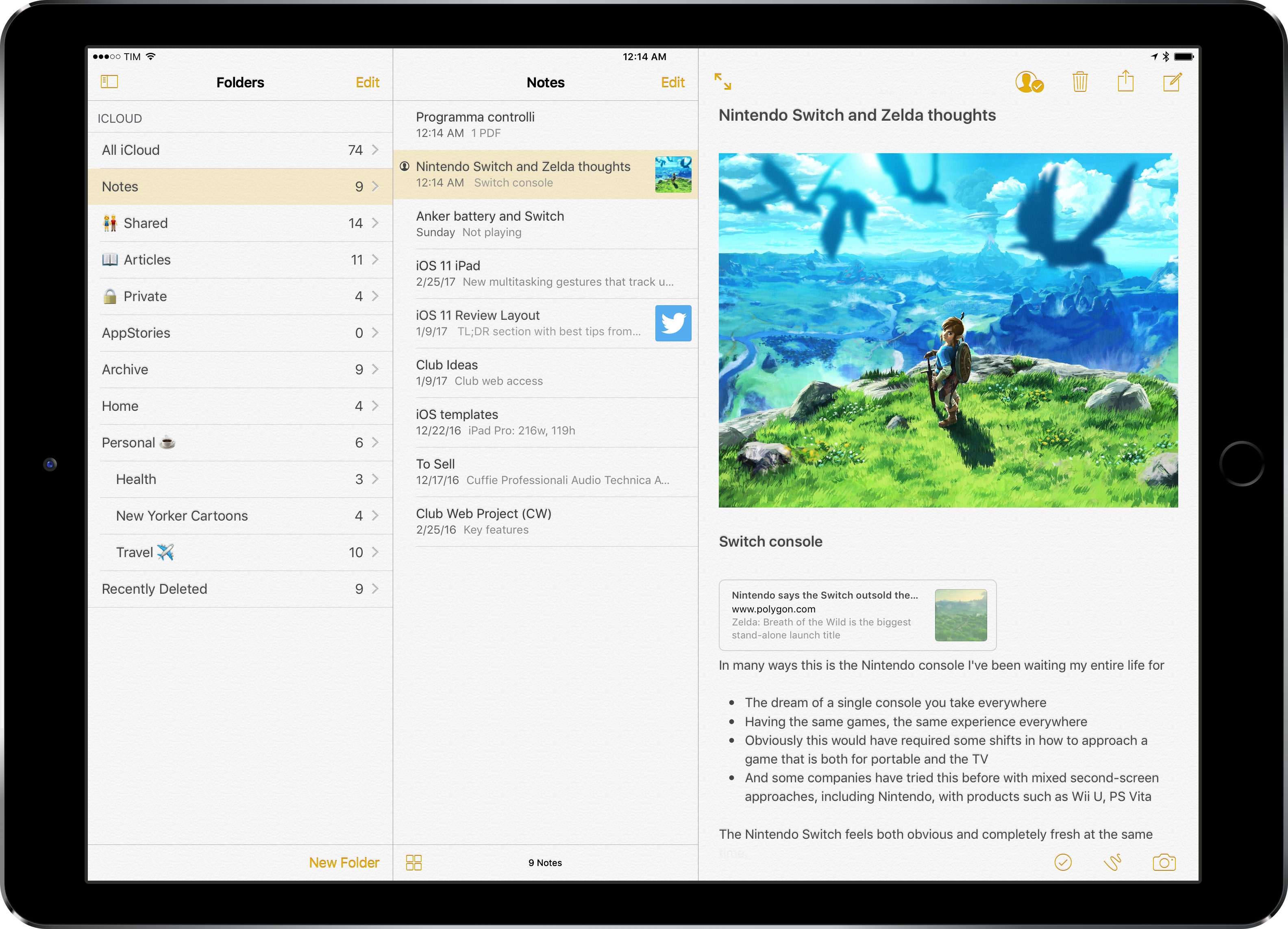
iPad Diaries is a regular series about using the iPad as a primary computer. You can find more installments here and subscribe to the dedicated RSS feed.
I’ve been using Apple Notes every day since its relaunch with iOS 9 in 2015.
Apple’s refreshed note-taking app landed with impeccable timing: it supported the then-new iPad Split View in the first beta of the OS released in June, and Apple deftly positioned Notes as a nimble, multi-purpose tool that many saw as a much-needed escape from Evernote’s bloated confusion. I almost couldn’t believe that I was switching to Apple Notes – for years, it had been derided as the epitome of démodé skeuomorphism – but the app felt refreshing and capable.
Notes in 2017 isn’t too different from its iOS 9 debut. Apple added integration with the Pencil in late 2015, private notes with iOS 9.3, and they brought sharing and collaboration features in iOS 10, but the app’s core experience is still based on the foundation laid two years ago. Unlike, say, Apple Music or Apple News, Notes has remained familiar and unassuming, which gives it an aura of trustworthiness and efficiency I don’t perceive in other built-in Apple apps (except for Safari).
I keep some of my most important documents in Notes – from bank statements to health records – and anything I want to save for later tends to be captured with Notes’ extension. Apple Notes is my brain’s temporary storage unit – the place where I archive little bits of everything before I even have time to think about them, process them, and act on them. Some of the content I save in Notes is eventually transformed into DEVONthink archives or Trello cards; other notes live in the app and they’re continuously edited to reflect what’s on my mind. I rely on Apple Notes and it’s one of my most used Apple apps (again, along with Safari).1
Apple Notes, however, is not a great pro iPad app. Notes falters where other Apple software falls short: it’s entrenched in iPhone paradigms at the expense of more advanced controls and customization options for iPad users. While Apple showed some promising steps towards “power-user features” with the three-pane layout added in iOS 10, I’ve long wished for a deeper degree of personalization in Notes for iOS. And given Apple’s reluctance to tweak Notes’ structure and functionality, I’ve come up with my own workarounds.