

Quick Capture for Obsidian I’ve been keeping an eye on this Obsidian companion utility for a while now, and I decided to take it for a spin earlier this week. I think it has a lot of potential, with a couple of confusing aspects I’d like the developer to work on. The idea behind...
Choosing Optimism About iOS 19→
I loved this post by David Smith on his decision to remain optimistic about Apple’s rumored iOS 19 redesign despite, well, you know, everything:
Optimism isn’t enthusiasm. Enthusiasm is a feeling, optimism is a choice. I have much less of the enthusiastic feelings these days about my relationship to Apple and its technologies (discussed here on Under the Radar 312), but I can still choose to optimistically look for the positives in any situation. Something I’ve learned as I’ve aged is that pessimism feels better in the moment, but then slowly rots you over time. Whereas optimism feels foolish in the moment, but sustains you over time.
I’ve always disliked the word “enthusiast” (talk about a throwback), and I’ve been frequently criticized for choosing the more optimistic approach in covering Apple over the years. But David is right: pessimism feels better in the short term (and performs better if you’re good at writing headlines or designing YouTube thumbnails), but is not a good long-term investment. (Of course, when the optimism is also gone for good…well, that’s a different kind of problem.)
But back to David’s thoughts on the iOS 19 redesign. He lists this potential reason to be optimistic about having to redesign his apps:
It would provide a point of differentiation for my app against other apps who wouldn’t adopt the new design language right away (either large companies which have their own design system or laggards who wouldn’t prioritize it).
He’s correct: the last time Apple rolled out a major redesign of iOS, they launched a dedicated section on the App Store which, on day one, featured indie apps updated for iOS 7 such as OmniFocus, Twitterrific, Reeder 2, Pocket Casts 4, and Perfect Weather. It lasted for months. Twelve years later1, I doubt that bigger companies will be as slow as they were in 2013 to adopt Apple’s new design language, but more agile indie developers will undoubtedly have an advantage here.
He also writes:
Something I regularly remind myself as I look at new Apple announcements is that I never have the whole picture of what is to come for the platform, but Apple does. They know if things like foldable iPhones or HomeKit terminals are on the horizon and how a new design would fit in best with them. If you pay attention and try to read between the lines they often will provide the clues necessary to “skate where the puck is going” and be ready when new, exciting things get announced subsequently.
This is the key point for me going into this summer’s review season. Just like when Apple introduced size classes in iOS 8 at WWDC 2014 and launched Slide Over and Split View multitasking for the iPad (alongside the first iPad Pro) the next year, I have to imagine that changes in this year’s design language will pave the way for an iPhone that unfolds into a mini tablet, a convertible Mac laptop, App Intents on a dedicated screen, or more. So while I’m not enthusiastic about Apple’s performance in AI or developer relations, I choose to be optimistic about the idea that this year’s redesign may launch us into an exciting season of new hardware and apps for the next decade.
- Think about it this way: when iOS 7 was released, the App Store was only five years old. ↩
 Shortcuts Utility Apps Revisited
 John
JohnThis week, Federico and John explore a collection of Shortcuts helper utilities that extend functionality beyond the built-in system actions, sharing how these apps address gaps in Apple’s Shortcuts implementation across the iPhone, iPad, and Mac.
On AppStories+, John interviews Federico about his recent story that concludes web applications often provide superior experiences to native apps on iPad, examining how this trend reflects broader challenges in the iPad ecosystem.
](https://cdn.macstories.net/banneras-1629219199428.png)
We deliver AppStories+ to subscribers with bonus content, ad-free, and at a high bitrate early every week.
To learn more about an AppStories+ subscription, visit our Plans page, or read the AppStories+ FAQ.
AppStories Episode 427 - Shortcuts Utility Apps Revisited
0:00
32:26
32:26
This episode is sponsored by:
- Incogni – Take your personal data back with Incogni! Use code APPSTORIES with this link and get 60% off an annual plan.
 ReaderTask: A Shortcut to Turn Readwise Reader Articles into Todoist Tasks
You may have noticed that I’ve been trying to be more consistent about sharing interesting articles found around the web on MacStories lately. Besides feeling energized by new topics we’re covering and some upcoming changes in my workflow, I’m doing this as part of a broader effort to continue making the MacStories homepage a frequent...
The iPad’s “Sweet” Solution

In working with my iPad Pro over the past few months, I’ve realized something that might have seemed absurd just a few years ago: some of the best apps I’m using – the ones with truly desktop-class layouts and experiences – aren’t native iPad apps.
They’re web apps.
Before I continue and share some examples, let me clarify that this is not a story about the superiority of one way of building software over another. I’ll leave that argument to developers and technically inclined folks who know much more about programming and software stacks than I do.
Rather, the point I’m trying to make is that, due to a combination of cost-saving measures by tech companies, Apple’s App Store policies over the years, and the steady rise of a generation of young coders who are increasingly turning to the web to share their projects, some of the best, most efficient workflows I can access on iPadOS are available via web apps in a browser or a PWA.
Access Extra Content and Perks
Founded in 2015, Club MacStories has delivered exclusive content every week for nearly a decade.
What started with weekly and monthly email newsletters has blossomed into a family of memberships designed for every MacStories fan.
Club MacStories: Weekly and monthly newsletters via email and the web that are brimming with apps, tips, automation workflows, longform writing, early access to the MacStories Unwind podcast, periodic giveaways, and more;
Club MacStories+: Everything that Club MacStories offers, plus an active Discord community, advanced search and custom RSS features for exploring the Club’s entire back catalog, bonus columns, and dozens of app discounts;
Club Premier: All of the above and AppStories+, an extended version of our flagship podcast that’s delivered early, ad-free, and in high-bitrate audio.
On Apple Offering an Abstraction Layer for AI on Its Platforms
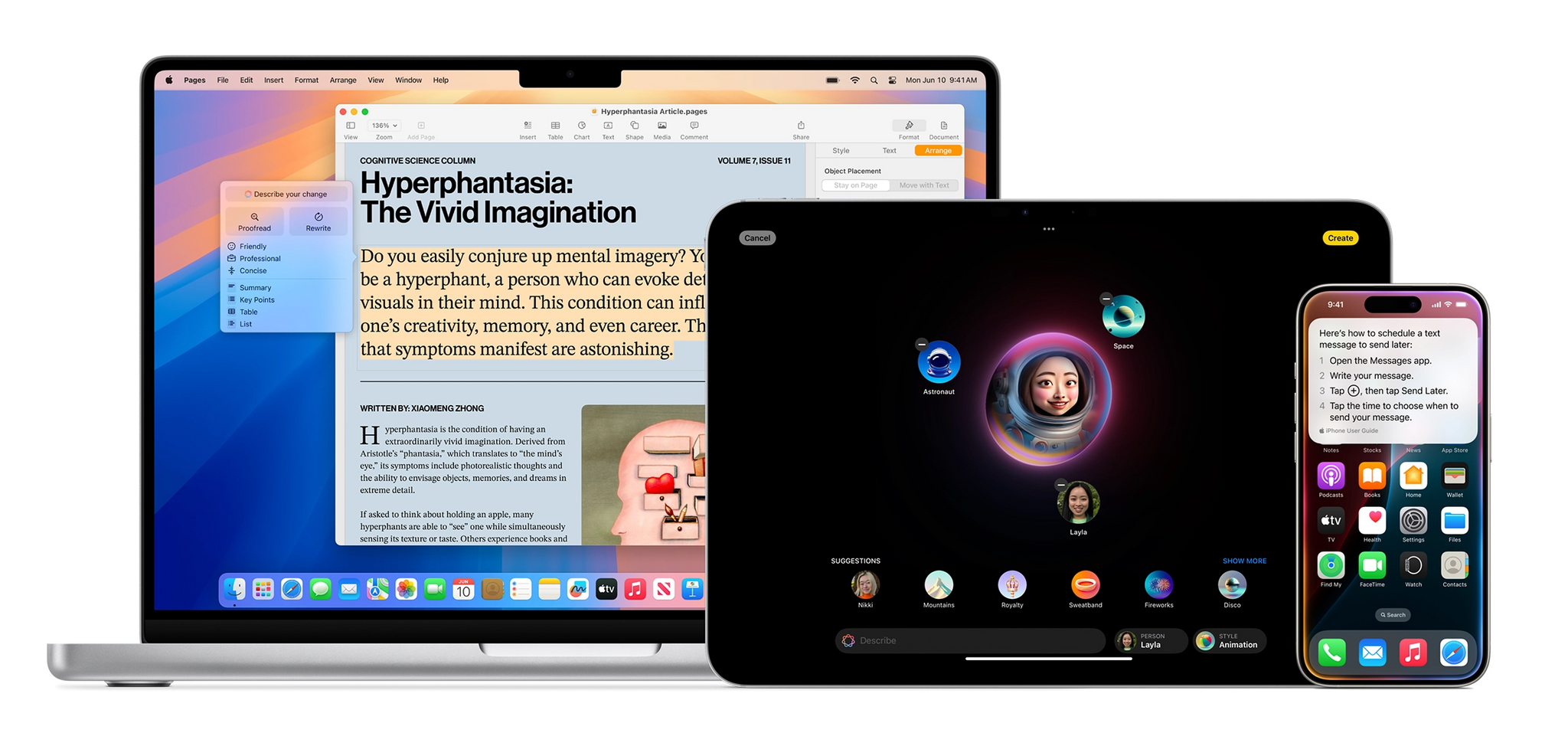
I’ve been thinking about Apple’s position in AI a lot this week, and I keep coming back to this idea: if Apple is making the best consumer-grade computers for AI right now, but Apple Intelligence is failing third-party developers with a lack of AI-related APIs, should the company try something else to make it easier for developers to integrate AI into their apps?
Gus Mueller, creator of Acorn and Retrobatch, has been pondering similar thoughts:
A week or so ago I was grousing to some friends that Apple needs to open up things on the Mac so other LLMs can step in where Siri is failing. In theory we (developers) could do this today, but I would love to see a blessed system where Apple provided APIs to other LLM providers.
Are there security concerns? Yes, of course there are, there always will be. But I would like the choice.
The crux of the issue in my mind is this: Apple has a lot of good ideas, but they don’t have a monopoly on them. I would like some other folks to come in and try their ideas out. I would like things to advance at the pace of the industry, and not Apple’s. Maybe with a blessed system in place, Apple could watch and see how people use LLMs and other generative models (instead of giving us Genmoji that look like something Fisher-Price would make). And maybe open up the existing Apple-only models to developers. There are locally installed image processing models that I would love to take advantage of in my apps.
The idea is a fascinating one: if Apple Intelligence cannot compete with the likes of ChatGPT or Claude for the foreseeable future, but third-party developers are creating apps based on those APIs, is there a scenario in which Apple may regain control of the burgeoning AI app ecosystem by offering their own native bridge to those APIs?
Access Extra Content and Perks
Founded in 2015, Club MacStories has delivered exclusive content every week for nearly a decade.
What started with weekly and monthly email newsletters has blossomed into a family of memberships designed for every MacStories fan.
Club MacStories: Weekly and monthly newsletters via email and the web that are brimming with apps, tips, automation workflows, longform writing, early access to the MacStories Unwind podcast, periodic giveaways, and more;
Club MacStories+: Everything that Club MacStories offers, plus an active Discord community, advanced search and custom RSS features for exploring the Club’s entire back catalog, bonus columns, and dozens of app discounts;
Club Premier: All of the above and AppStories+, an extended version of our flagship podcast that’s delivered early, ad-free, and in high-bitrate audio.
The M3 Ultra Mac Studio for Local LLMs→
Speaking of the new Mac Studio and Apple making the best computers for AI: this is a terrific overview by Max Weinbach about the new M3 Ultra chip and its real-world performance with various on-device LLMs:
The Mac I’ve been using for the past few days is the Mac Studio with M3 Ultra SoC, 32-core CPU, 80-core GPU, 256GB Unified Memory (192GB usable for VRAM), and 4TB SSD. It’s the fastest computer I have. It is faster in my workflows for even AI than my gaming PC (which will be used for comparisons below; it has an Intel i9 13900K, RTX 5090, 64GB of DDR5, and a 2TB NVMe SSD).
It’s a very technical read, but the comparison between the M3 Ultra and a vanilla (non-optimized) RTX 5090 is mind-blogging to me. According to Weinbach, it all comes down to Apple’s MLX framework:
I’ll keep it brief; the LLM performance is essentially as good as you’ll get for the majority of models. You’ll be able to run better models faster with larger context windows on a Mac Studio or any Mac with Unified Memory than essentially any PC on the market. This is simply the inherent benefit of not only Apple Silicon but Apple’s MLX framework (the reason we can efficiently run the models without preloading KV Cache into memory, as well as generate tokens faster as context windows grow).
In case you’re not familiar, MLX is Apple’s open-source framework that – I’m simplifying – optimizes training and serving models on Apple Silicon’s unified memory architecture. It is a wonderful project with over 1,600 community models available for download.
As Weinbach concludes:
I see one of the best combos any developer can do as: M3 Ultra Mac Studio with an Nvidia 8xH100 rented rack. Hopper and Blackwell are outstanding for servers, M3 Ultra is outstanding for your desk. Different machines for a different use, while it’s fun to compare these for sport, that’s not the reality.
There really is no competition for an AI workstation today. The reality is, the only option is a Mac Studio.
Don’t miss the benchmarks in the story.
Is Apple Shipping the Best AI Computers?→
For all the criticism (mine included) surrounding Apple’s delay of various Apple Intelligence features, I found this different perspective by Ben Thompson fascinating and worth considering:
What that means in practical terms is that Apple just shipped the best consumer-grade AI computer ever. A Mac Studio with an M3 Ultra chip and 512GB RAM can run a 4-bit quantized version of DeepSeek R1 — a state-of-the-art open-source reasoning model — right on your desktop. It’s not perfect — quantization reduces precision, and the memory bandwidth is a bottleneck that limits performance — but this is something you simply can’t do with a standalone Nvidia chip, pro or consumer. The former can, of course, be interconnected, giving you superior performance, but that costs hundreds of thousands of dollars all-in; the only real alternative for home use would be a server CPU and gobs of RAM, but that’s even slower, and you have to put it together yourself. Apple didn’t, of course, explicitly design the M3 Ultra for R1; the architectural decisions undergirding this chip were surely made years ago. In fact, if you want to include the critical decision to pursue a unified memory architecture, then your timeline has to extend back to the late 2000s, whenever the key architectural decisions were made for Apple’s first A4 chip, which debuted in the original iPad in 2010. Regardless, the fact of the matter is that you can make a strong case that Apple is the best consumer hardware company in AI, and this week affirmed that reality.
Anecdotally speaking, based on the people who cover AI that I follow these days, it seems there are largely two buckets of folks who are into local, on-device models: those who have set up pricey NVIDIA rigs at home for their CUDA cores (the vast minority); and – the undeniable majority – those who run a spectrum of local models on their Macs of different shapes and configurations (usually, MacBook Pros). If you have to run high-end, performance-intensive local models for academic or scientific workflows on a desktop, the M3 Ultra Mac Studio sounds like an absolute winner.
However, I’d point out that – again, as far as local, on-device models are concerned – Apple is not shipping the best possible hardware on smartphones.
While the entire iPhone 16 lineup is stuck on 8 GB of RAM (and we know how memory-hungry these models can be), Android phones with at least 12 GB or 16 GB of RAM are becoming pretty much the norm now, especially in flagship territory. Even better in Android land, what are being advertised as “gaming phones” with a whopping 24 GB of RAM (such as the ASUS ROG Phone 9 Pro or the RedMagic 10 Pro) may actually make for compelling pocket computers to run smaller, distilled versions of DeepSeek, LLama, or Mistral with better performance than current iPhones.
Interestingly, I keep going back to this quote from Mark Gurman’s latest report on Apple’s AI challenges:
There are also concerns internally that fixing Siri will require having more powerful AI models run on Apple’s devices. That could strain the hardware, meaning Apple either has to reduce its set of features or make the models run more slowly on current or older devices. It would also require upping the hardware capabilities of future products to make the features run at full strength.
Given Apple’s struggles, their preference for a hybrid on-device/server-based AI system, and the market’s evolution on Android, I don’t think Apple can afford to ship 8 GB on iPhones for much longer if they’re serious about AI and positioning their hardware as the best consumer-grade AI computers.
Our Self-Imposed Tech Deadlines
This week, Federico and John share their self-imposed tech deadlines for the hardware and software they use.
On AppStories+, Federico and John follow up their tech deadlines with the hardware they expect to add to their setups in 2025.
We deliver AppStories+ to subscribers with bonus content, ad-free, and at a high bitrate early every week.
To learn more about an AppStories+ subscription, visit our Plans page, or read the AppStories+ FAQ.
AppStories Episode 426 - Our Self-Imposed Tech Deadlines
0:00
35:24
35:24
This episode is sponsored by:
- Memberful – Easy-to-Use Reliable Membership Software