Ryan is an editor for MacStories and co-hosts the [Adapt](https://www.relay.fm/adapt) podcast on Relay FM. He most commonly works and plays on his iPad Pro and bears no regrets about moving on from the Mac. He and his wife live in New York City.
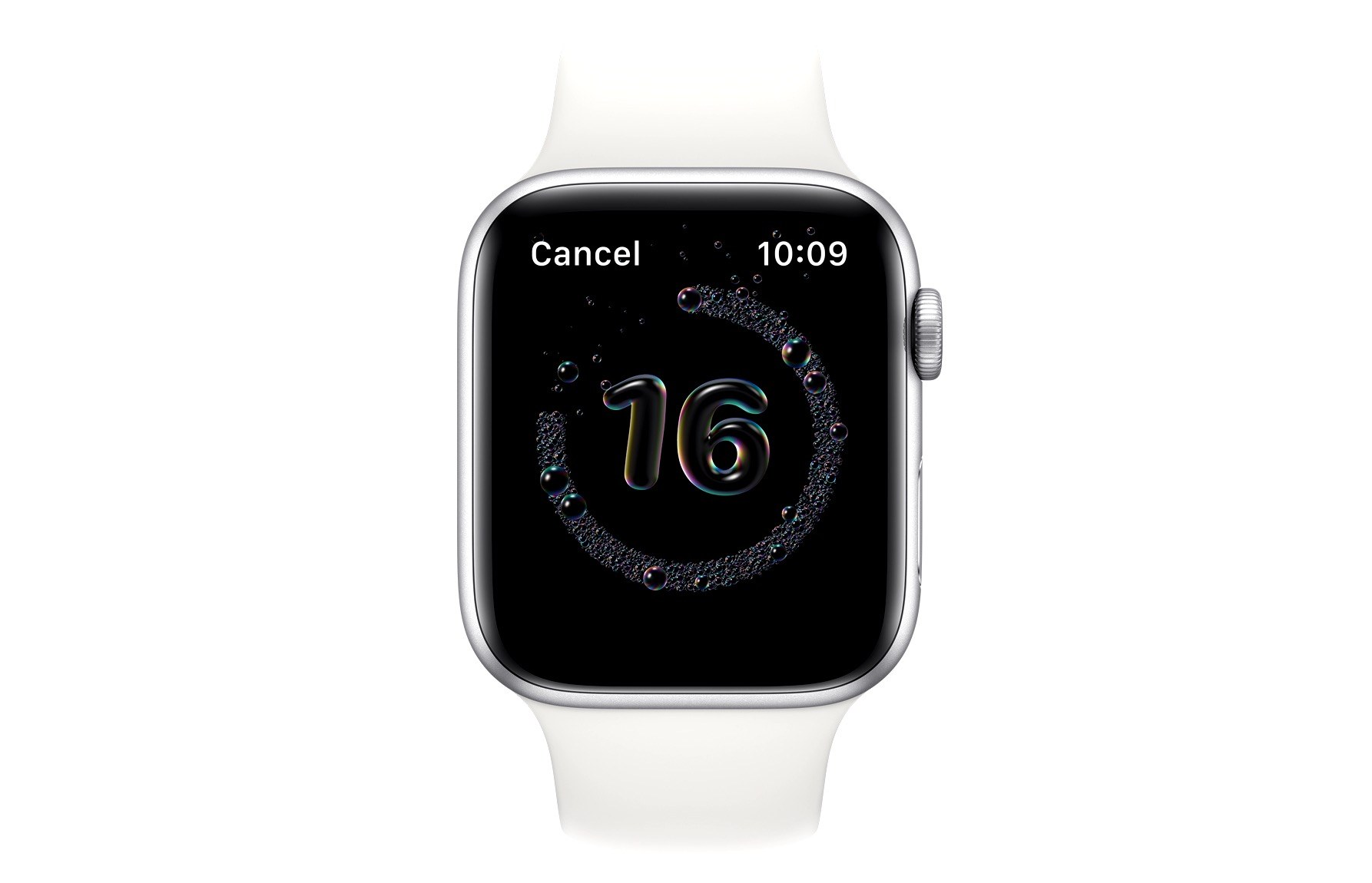
The feature, which is built directly into the forthcoming version of watchOS, is designed to work like fitness tracking in a number of ways. For starters, if the user opts into it, it’s designed to automatically trigger when handwashing is detected, starting a countdown timer of 20 seconds. The accelerometer is the key piece of hardware here, waiting for the specific handwashing pattern — which apparently adopts a number of different methods, depending on who’s actually doing the scrubbing.
The system uses machine learning models to tackle different methods, but the system gets an additional nudge from the Watch’s microphone. Along with motion, the app listens for the sound of running water. Even that’s not enough, though — after all, eco sinks have become increasingly popular, meaning that there’s often less water sound to be listening for. The sound of squishing soap takes care of that last bit. It’s got a unique enough audio signature so as to confirm that handwashing is taking place.
Interestingly, the piece notes that this feature has been in the works for years, it isn’t simply a reaction to the current pandemic. I haven’t tried the feature yet, but I’m anxious to see if it works as advertised. If it’s unreliable, I’ll surely leave it turned off, but if it works well it could be a valuable aid to preventing the contraction of COVID-19. At the very least, I’m always happy to see Apple explore new areas of health.
It’s Saturday, WWDC has come to a close, and my head is still spinning thinking about all of the things announced this week. I’ve been playing with betas, listening to a lot of podcasts, reading tweets and articles, mulling over the news of the conference, and I’m ready to start considering the real-life impact I...
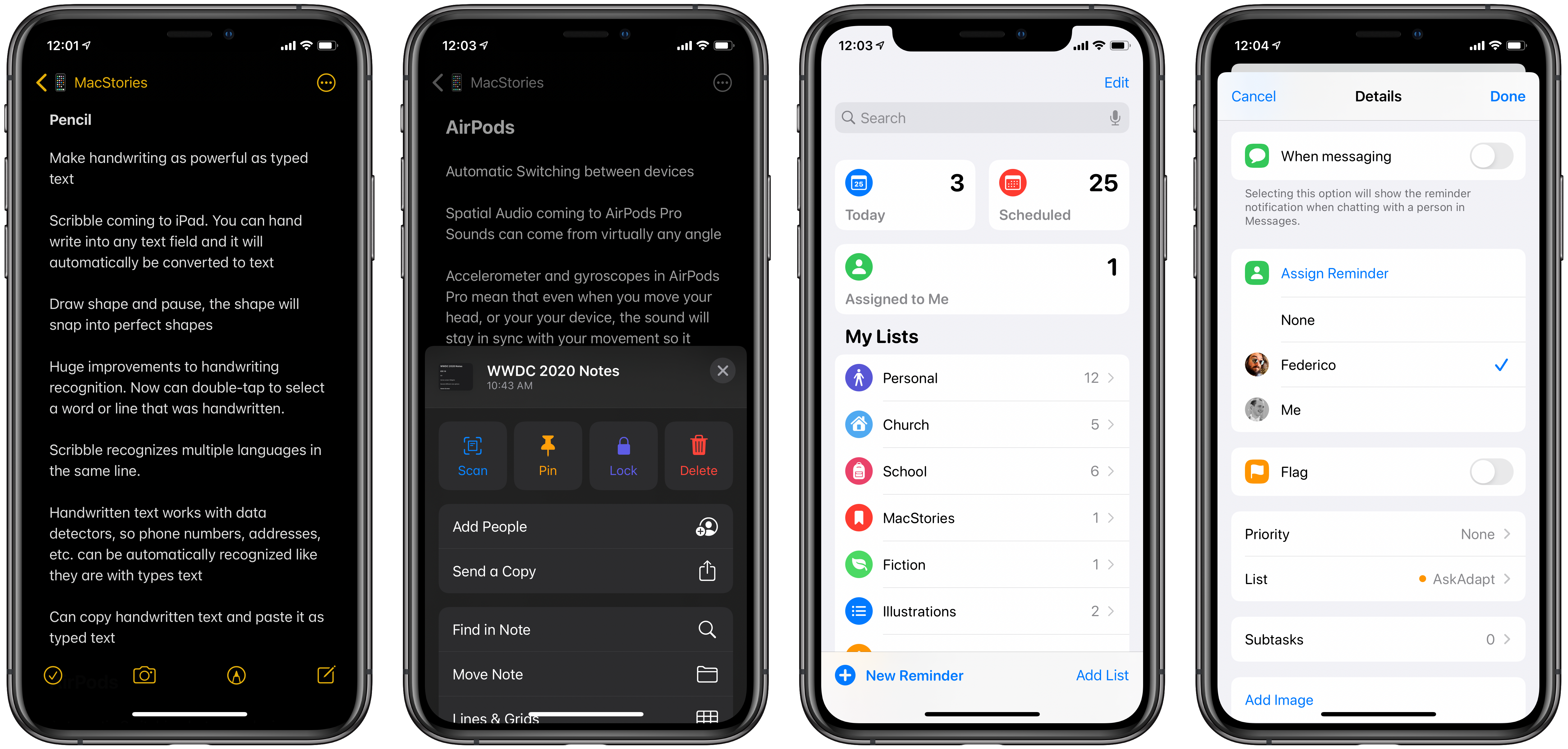
Apple Notes and Reminders are two of my most-used apps, and each has received significant updates in iOS and iPadOS 14. Though neither app’s improvements have been held up as tentpole features of this fall’s releases, Apple has nonetheless given noteworthy attention to making the user experience for each app better in a variety of key ways. You won’t find fundamental evolutions in how either app works, but these updates prove the power of iteration. From visual tweaks that make everything look and feel more modern, to quality of life enhancements, and more substantive new features, the list of total changes is surprisingly rich.
After a few days of use, here’s everything new I’ve discovered in Notes and Reminders.
WWDC week is always full of big and small announcements about Apple’s core software platforms. Monday’s keynote only has time for sharing a limited number of details, however, so as the week goes on many new discoveries are made as developers and writers delve into the first beta OS releases themselves. As a result, we always have a roundup of new things to share midway through the week. So today, on top of everything detailed in our overviews of iOS and iPadOS 14, watchOS 7, macOS Big Sur, and tvOS 14, here’s an assortment of extra goodies that will be arriving on your devices this fall.
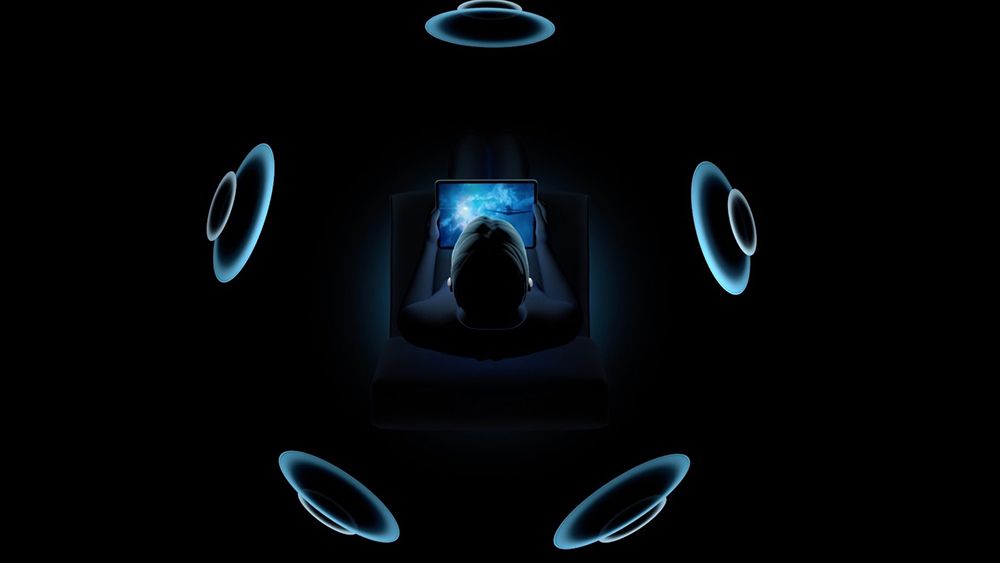
Apple’s audio products – especially AirPods and AirPods Pro – are becoming major players in the company’s product ecosystem, and as a result it’s no surprise that new features for these products were announced at WWDC. Easily my favorite audio announcement was automatic switching between devices, but there’s a lot of other great audio news too: spatial audio on AirPods Pro, third-party music services on HomePod, audio sharing on tvOS, headphone accommodations, and more.
Apple announced a lot of new software improvements during yesterday’s WWDC keynote, but time was short and one major platform didn’t receive its own segment: tvOS 14. Apple announced new tvOS features as part of its discussion of the home, but fortunately that doesn’t mean the latest Apple TV software release is light on improvements. In addition to features like HomeKit integration, new controller support, and improved Picture in Picture, tvOS 14 will offer a variety of other important updates when it launches this fall.
“We hope to build a lot of great products that bring customers a lot of joy every year,” he says. “But in the fullness of time, in the scope of hundreds of years from now, I think the place where I hope people can look back and talk about the places where Apple made a huge contribution to humanity is in helping people see the way of taking advantage of this great technology without the false tradeoff of giving up their privacy to do it.”
Grothaus highlights several new privacy features throughout his piece, all of which will arrive this fall in Apple’s new batch of software releases. One especially interesting feature is called Approximate Location:
With this option, an app will never know the precise spot you’re at. Instead, it will learn the general area, which is often enough to provide the same level of service without intruding on your privacy to the same degree. To achieve the “approximate location” feature, Apple divided the entire planet into regions roughly 10 square miles in size. Each region has its own name and boundaries, and the area of the region is not based on a radius from the user–it’s fixed. That means that an app can’t extrapolate your precise location from approximate location data, because you aren’t necessarily at the center point of that approximate location boundary.
In a packed, fast-moving keynote, it was noteworthy that Apple dedicated an entire segment of the presentation to privacy. The company ships new privacy features annually, and considering its stated focus on future centuries, it shows no signs of letting up any time soon.
Today Apple detailed the next major versions of its two most popular computing platforms: iOS and iPadOS 14. While the list of new features in these releases may not be as long as in some years, each update nonetheless has a lot to offer. From Home screen enhancements to tons of app upgrades spanning nearly every system app, plus the new Translate app and Siri improvements, Apple Pencil handwriting features, emoji search (finally!) and more, the iPhone and iPad are being refined this year in a variety of ways.
Here’s our in-depth overview of all the most important updates.
Mere days away from Apple’s WWDC 2020 keynote, and full details about the future of software platforms like iOS, iPadOS, macOS, and more, I can’t help but revisit my hopes for iPad enhancements. In February I shared my concept for how Apple could revamp iPad multitasking using context menus, an idea that became even more...