

 Federico
Beta users have uncovered the prompt-based instructions for several Apple Intelligence features, which are stored in plain text in the upcoming version of macOS. (Link) [[John]] Apple’s fee response to the DMA is getting more and more confusing. Benjamin Mayo at 9to5Mac has a good overview of how the fees work if a developer...
 What Happened to the Middle?
Not long ago, Federico and I did an AppStories episode about email apps. One of the problems we identified with the category is that there’s a gap between email apps designed for everyday consumer use and enterprise-based solutions. Power users and small teams that fit somewhere between those ends of the spectrum are stuck making...
The Latest from Magic Rays of Light, Comfort Zone, and MacStories Unwind
Enjoy the latest episodes from MacStories’ family of podcasts:






Sigmund and Devon preview Apple Intelligence, highlight new Apple Original heist flick The Instigators, discuss improvements to Continuity Camera in the tvOS 18 beta, and recap Land of Women.
Chris is absent for mysterious reasons, Niléane finds clever ways to watch the Olympics, and Matt explores his podcast app feelings.
This week, Federico returns to discuss the animal kingdom and share our E-ink device hot takes, along with a movie pick.
The Latest from AppStories and Ruminate
Enjoy the latest episodes from MacStories’ family of podcasts:
This week, I am joined by Jonathan to preview watchOS 11, which is one of the most feature packed OSes being updated this fall.
On AppStories+, John reports on how his travel tech setup fared.
- Setapp – the place to get apps. Use the code appstories20 at checkout for 20% off.
- MusicHarbor – New Music From Your Favorite Artists and Record Labels.
This week, Robb is this snackplier this week, and I had a sour patch kids situation, and we both discuss Samsung’s renaming of a train station.
GoodLinks 2.0: The Automation-Focused Read-Later App I’ve Always Wanted
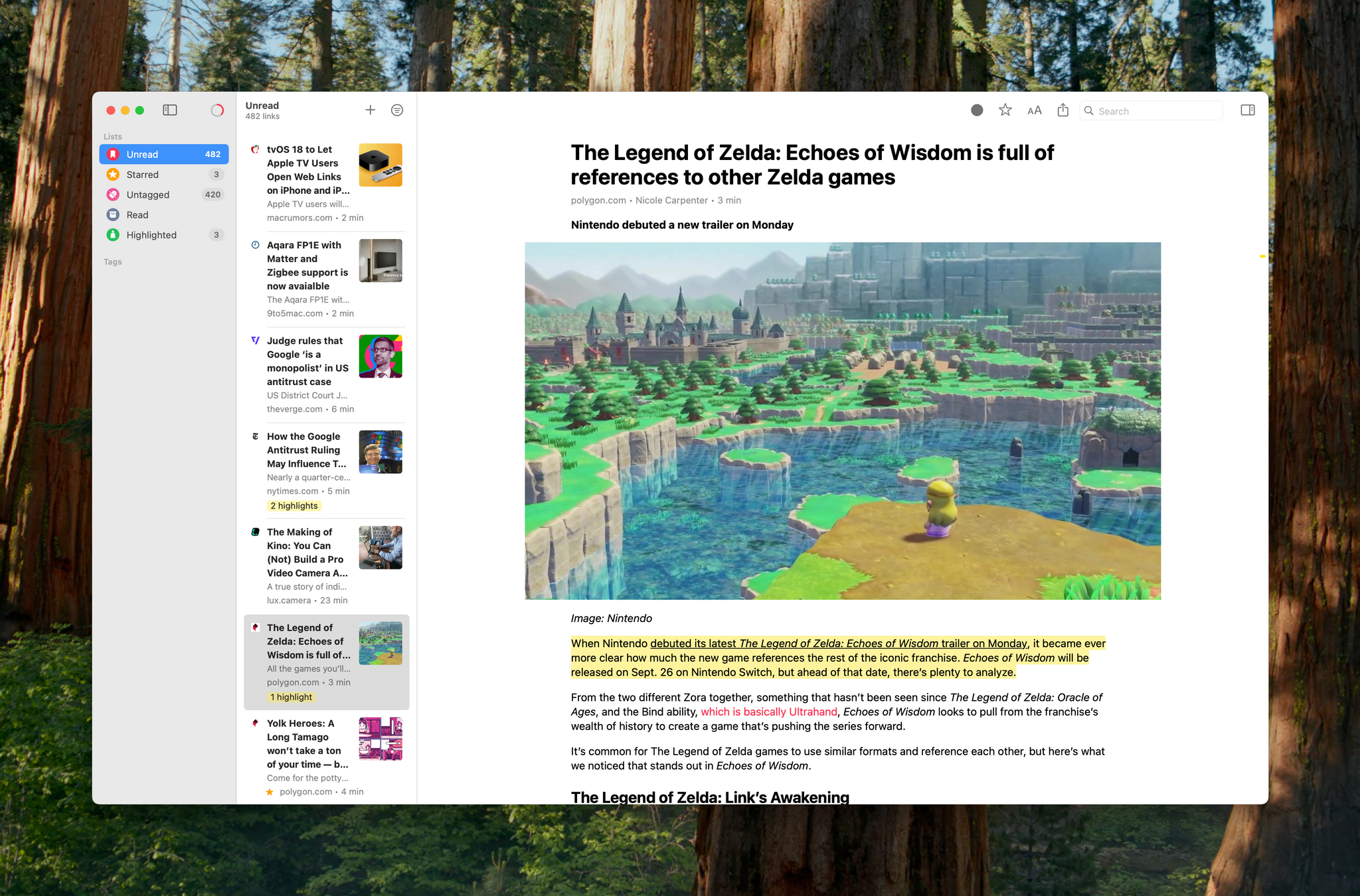
One of my greatest frustrations with read-later apps is how hard most make it to get your data out on your terms. Few allow you to export links using Shortcuts or some other system, and even fewer offer to do the same with highlights – until now. With version 2.0, GoodLinks adds highlighting and note-taking combined with excellent Shortcuts support, giving users full access and flexibility to incorporate saved URLs, highlights, and notes into their workflows however they want.
Thanks to Obsidian’s deep catalog of plugins from third-party developers, it’s been possible to import highlights from read-later apps like Readwise Reader and Amazon’s Kindle app for some time. Those are good solutions when I’m working in Obsidian, but both I and our readers use lots of different apps. That’s why I was so glad to see GoodLinks (available for the iPhone, iPad, and Mac) get this major 2.0 revision that transforms it from a place to save links and articles to a more well-rounded research tool, thanks to highlighting and notes.
Google’s Antitrust Loss, Why Apple Doesn’t Just Build a Search Engine, and What Comes Next

Yesterday, Federal District Judge Amit Mehta issued a ruling in the U.S. Justice Department’s antitrust case against Google in favor of the government. Judge Mehta didn’t mince words:
Google is a monopolist, and it has acted as one to maintain its monopoly. It has violated Section 2 of the Sherman Act.
The Judge further explained his ruling:
Specifically, the court holds that (1) there are relevant product markets for general search services and general search text ads; (2) Google has monopoly power in those markets; (3) Google’s distribution agreements are exclusive and have anticompetitive effects; and (4) Google has not offered valid procompetitive justifications for those agreements. Importantly, the court also finds that Google has exercised its monopoly power by charging supracompetitive prices for general search text ads. That conduct has allowed Google to earn monopoly profits.
It’s a long opinion, coming in at nearly 300 pages, but the upshot of why Judge Mehta ruled the way he did is summed up nicely near the beginning of the tome:
But Google also has a major, largely unseen advantage over its rivals: default distribution. Most users access a general search engine through a browser (like Apple’s Safari) or a search widget that comes preloaded on a mobile device. Those search access points are preset with a “default” search engine. The default is extremely valuable real estate. Because many users simply stick to searching with the default, Google receives billions of queries every day through those access points. Google derives extraordinary volumes of user data from such searches. It then uses that information to improve search quality. Google so values such data that, absent a user-initiated change, it stores 18 months-worth of a user’s search history and activity.
If you’re interested in how web search works and the business deals that drive it, the opinion is a great primer. Plus, although the details already dribbled out over the course of the 10-week trial, there are lots of interesting bits of information buried in there for anyone interested in Apple’s search deal with Google.
 watchOS 11 Preview
Interesting Links
[[John]] Some ChatGPT Plus subscribers already have access to OpenAI’s new, more emotive voices. Jess Weatherbed collected users’ demos in an article on The Verge. (Link) iFixit recently answered the question of whether blowing on a game cartridge’s contacts actually works to make them playable, teaching gamers how to properly clean their carts along the...
App Debuts
[[John]] Genius Sign Genius Sign is a companion app to Genius Scan, an app that I’ve covered before. The purpose of the utility is to sign, date, and annotate PDFs, but it’s not meant to be a PDF editor. Instead, it’s designed to simplify and speed up the process of signing documents, such as a...