John Voorhees

5812 posts on MacStories since November 2015

John is MacStories' Managing Editor, has been writing about Apple and apps since joining the team in 2015, and today, runs the site alongside Federico. John also co-hosts four MacStories podcasts: AppStories, which covers the world of apps, MacStories Unwind, which explores the fun differences between American and Italian culture and recommends media to listeners, Ruminate, a show about the weird web and unusual snacks, and NPC: Next Portable Console, a show about the games we take with us.

This Week's Sponsor:

Crickets

The first alarm app for families.


Apple’s Bionic Advantage→

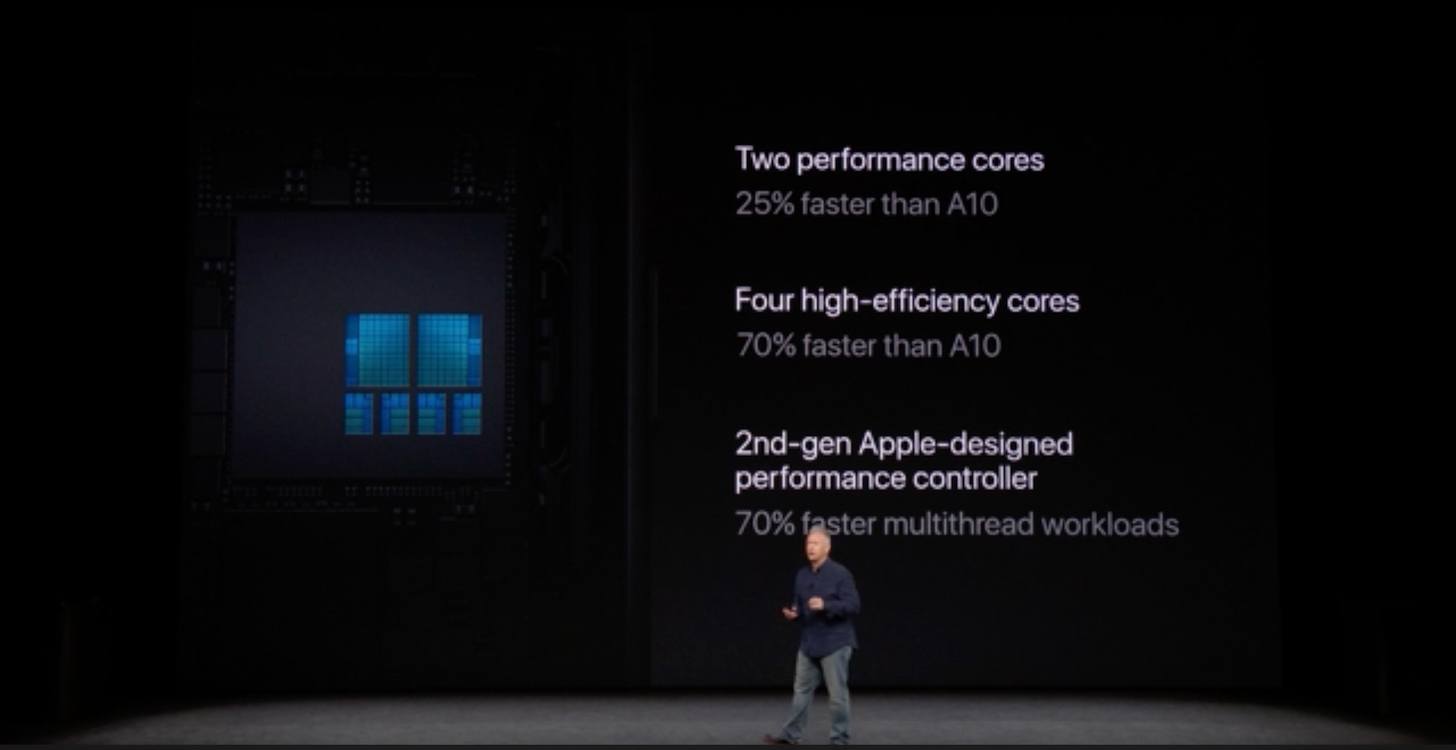
Mashable interviewed Apple’s Senior Vice President of Worldwide Marketing Phil Schiller and Senior Vice President of Hardware Technologies Johny Srouji about Apple new A11 Bionic CPU, which powers the iPhone 8, 8 Plus, and X.

“This is something we started 10 years ago, designing our own silicon because that’s the best way to truly customize something that’s uniquely optimized for Apple hardware and software,” said Srouji.

For Apple, silicon development is an intrinsic part of the iPhone creation process. “It’s not just something you drop in or build around,” said Schiller.

It’s a strategy that has paid off for Apple by giving it more control over the full hardware/software stack and enabling the company to squeeze more performance and energy efficiency out of the tiny chips that power iOS devices. At the same time though, it’s an approach that requires Apple to make big bets far in the future:

Srouji told me that when Apple architects silicon, they start by looking three years out, which means the A11 Bionic was under development when Apple was shipping the iPhone 6 and its A8 chip. Back then we weren’t even talking about AI and machine learning at a mobile level and, yet, Srouji said, “The neural engine embed, it’s a bet we made three years ahead.”

Apple’s tight control over hardware and the software that runs on it isn’t new. It’s one of the cornerstones of the company’s success. What’s remarkable though, is the microscopic level to which Apple has taken the approach. As author Lance Ulanoff points out, the images of chips that Phil Schiller displayed onscreen during the September 12th keynote to illustrate new and improved iPhone technologies weren’t different chips. They were different areas on the same chip – one with leaked Geekbench scores that put it on par with the silicon inside the 2017 13-inch MacBook Pro. That’s extraordinary and likely to be a key advantage that Apple will have over competitors for years to come.
Permalink

PCalc’s Delightfully Insane About Screen

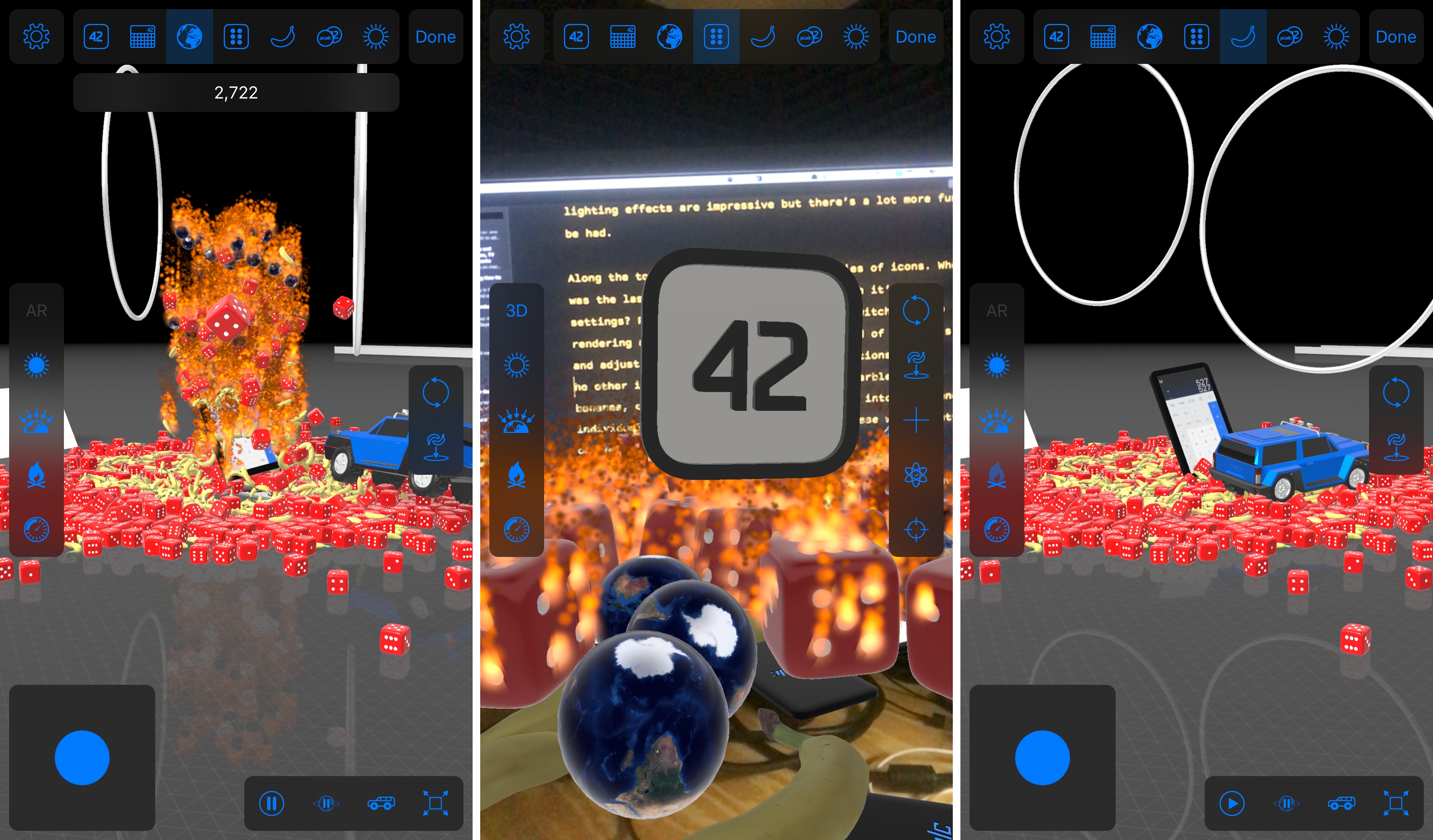
As apps updated for iOS 11 begin to trickle out onto the App Store, it’s fitting that the first of what will be many reviews on MacStories in the coming days features ARKit, which from all indications is a big hit with developers. Even more fitting though, is that the app reviewed is PCalc by James Thomson. PCalc is an excellent calculator app that was one of Federico’s ‘Must Have’ apps of 2016. It’s available on iOS devices, the Apple Watch, and even the Apple TV. Still, you wouldn’t expect it to incorporate 3D animation or augmented reality, but that is exactly what the latest version of PCalc has tucked away in its settings.

Read more


Album

Sassy Sloths The best sort of sloths are the sassy sort. These are decidedly hipster sloths chilling with a glass of wine, sporting handlebar mustaches, and dressed as snowflakes, among other things. I’m not going to try to make sense of it for you. Instead, try them for yourself and let your friends figure...


Q&A

Question: What is a good way to archive iMessage conversations on the Mac? I’ve been using Messages to scroll back in time to download the message. Then, I go to File->Print and Save as PDF. This works, but is there an easier way to download the history of the conversation? I’ve gone back all the...


Club MacStories Turns Two

I was a Club MacStories member before I joined the MacStories team as a writer, and it’s been fun to watch the Club grow and then become part of building it. The first issue of MacStories Weekly that I worked on was Issue 20 in February of last year. I was amazed that Federico and Graham Spencer had almost single-handedly produced those first nineteen issues of Weekly, several issues of the Monthly Log, and fifty issues of MacStories Weekly Classic. It’s a lot of work, but it’s also a labor of love – if it weren’t, we couldn’t do it. We produce the newsletter and other content for the Club because we love apps, the people who make them, and sharing them with our readers.

We’re fortunate at MacStories to have some of the very best readers around. Without you, MacStories wouldn’t be possible. Club MacStories gives us an outlet to share even more about apps than we could otherwise.

We’re also lucky to have the best team of writers around. In the past year, although Graham left the team, we added Ryan Christoffel, Jake Underwood, and Stephen Hackett to the newsletter as regular contributors, which has kept the MacStories Weekly and Monthly Log fresh and relevant to a broader audience.

Last year at this time, we celebrated Club MacStories’ first anniversary. After producing another 60 newsletters for a total of 120 since the Club’s inception, we wanted to do something special for members. When we asked our friends in the developer community to help us celebrate by offering special deals to Club MacStories members, the response was immediate and overwhelming, for which we’re very grateful.

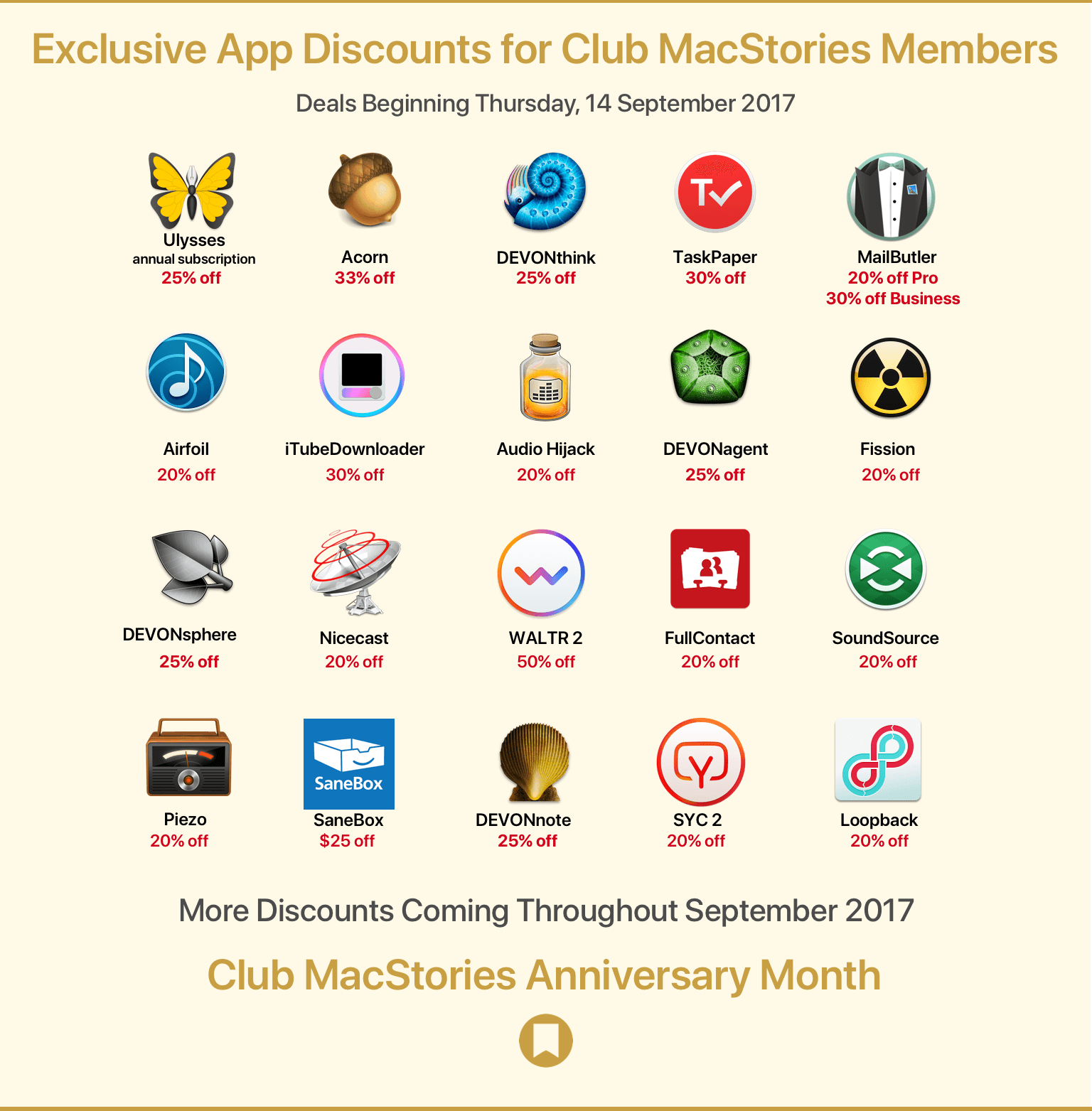
We’ve assembled a great list of discounts this year that we’ll announce in two waves. The first wave, launching today, includes:

As Club members, you can access these deals from a special webpage that we’ve set up just for you. The second wave of discounts will be announced next Thursday (September 21), and there will be additional surprises and deals announced in the next three issues of MacStories Weekly as well.

But there’s even more coming during Club MacStories anniversary month, including a free edition of the eBook version of Federico’s iOS 11 review, the ‘Making Of’ his iOS 11 review, and other special surprises. So be sure to keep an eye out for them beginning next week.

Thanks again to our Club members. We appreciate the hard-earned money you spend to be part of our growing community, and we enjoy making the newsletters for you every week. If you’re an annual member and your subscription is expiring, we hope you’ll join us for year three. We’ve got big plans for the Club and would love for you to be part of them.


AppStories, Episode 22 – Apps With a Human Touch→

On this week’s episode of AppStories, we discuss what’s left now that Federico is finished writing the text of his iOS 11 review, preview some of the upcoming coverage on MacStories and the upcoming second anniversary of Club MacStories, and consider the importance of little human touches that make apps by indie developers a delight to use.

Sponsored by:

  • Omni - Celebrating 25 years of human-centered productivity!
  • Twist - Our mission is to make team communication calmer, more organized, and more productive.
AppStories+ Deeper into the world of apps

AppStories Episode 22 - Apps with a Human Touch

0:00
43:56

↓

AppStories+ Deeper into the world of apps

Permalink

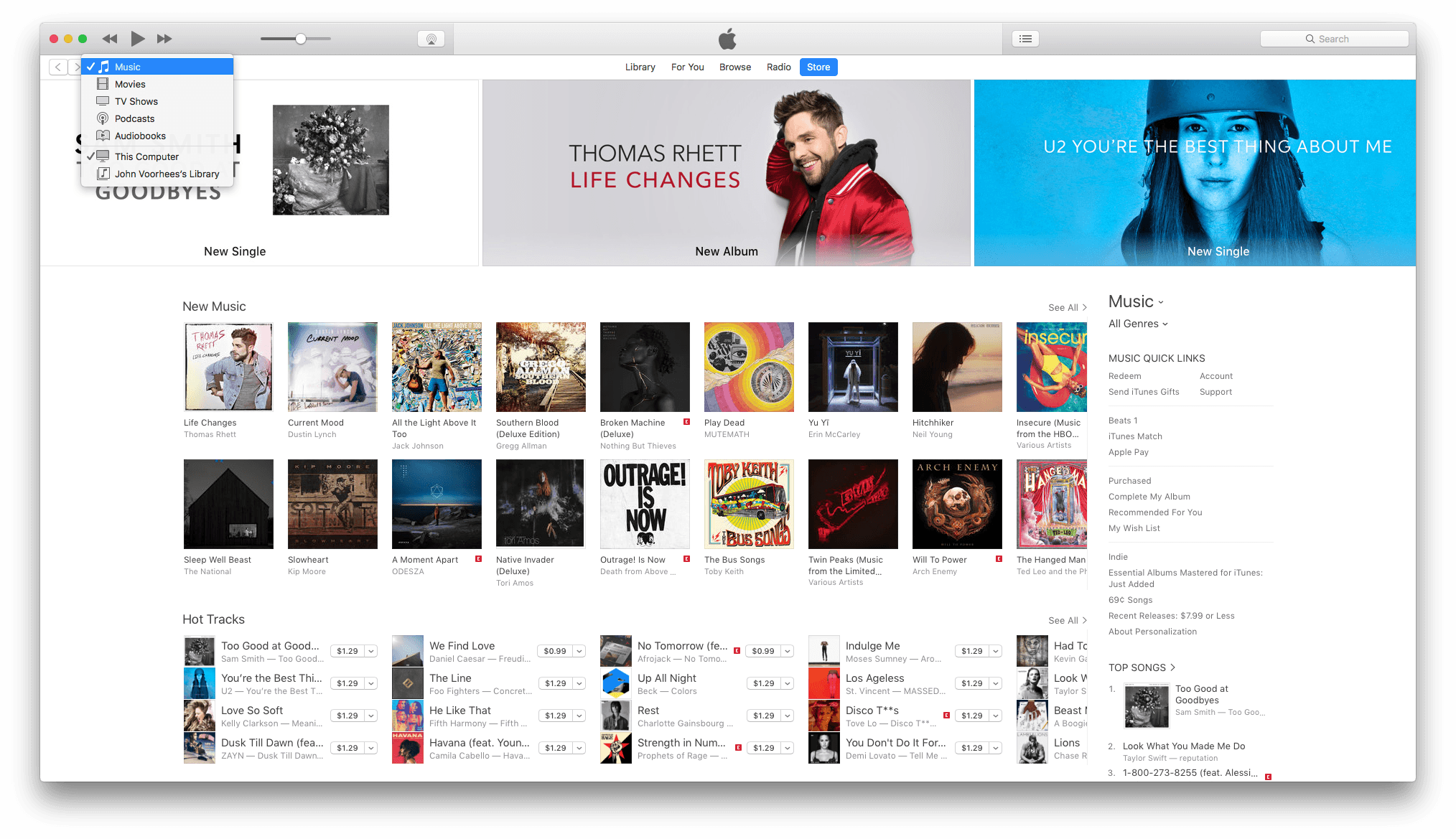
iTunes Removes the App Store and More to Focus on Music, Movies, TV Shows, Podcasts, and Audiobooks

Apple has updated iTunes on macOS to eliminate ringtones, iTunes U, and perhaps most surprising of all, iOS apps. According to Apple’s support page:

Apps for iPhone, iPad, and iPod touch are now exclusively available in the new App Store for iOS.

iTunes 12.7 now includes music, movies, TV Shows, Podcasts, and Audiobooks only. Apple’s support page links to instructions on how to download each type of content that has been eliminated.

Although there were prior indications that Apple was streamlining iTunes, such as when it announced that iTunes U content was being eliminated from the app, the removal of downloaded iOS apps and the App Store itself is surprising. iTunes is now focused on just two types of media audio and video.

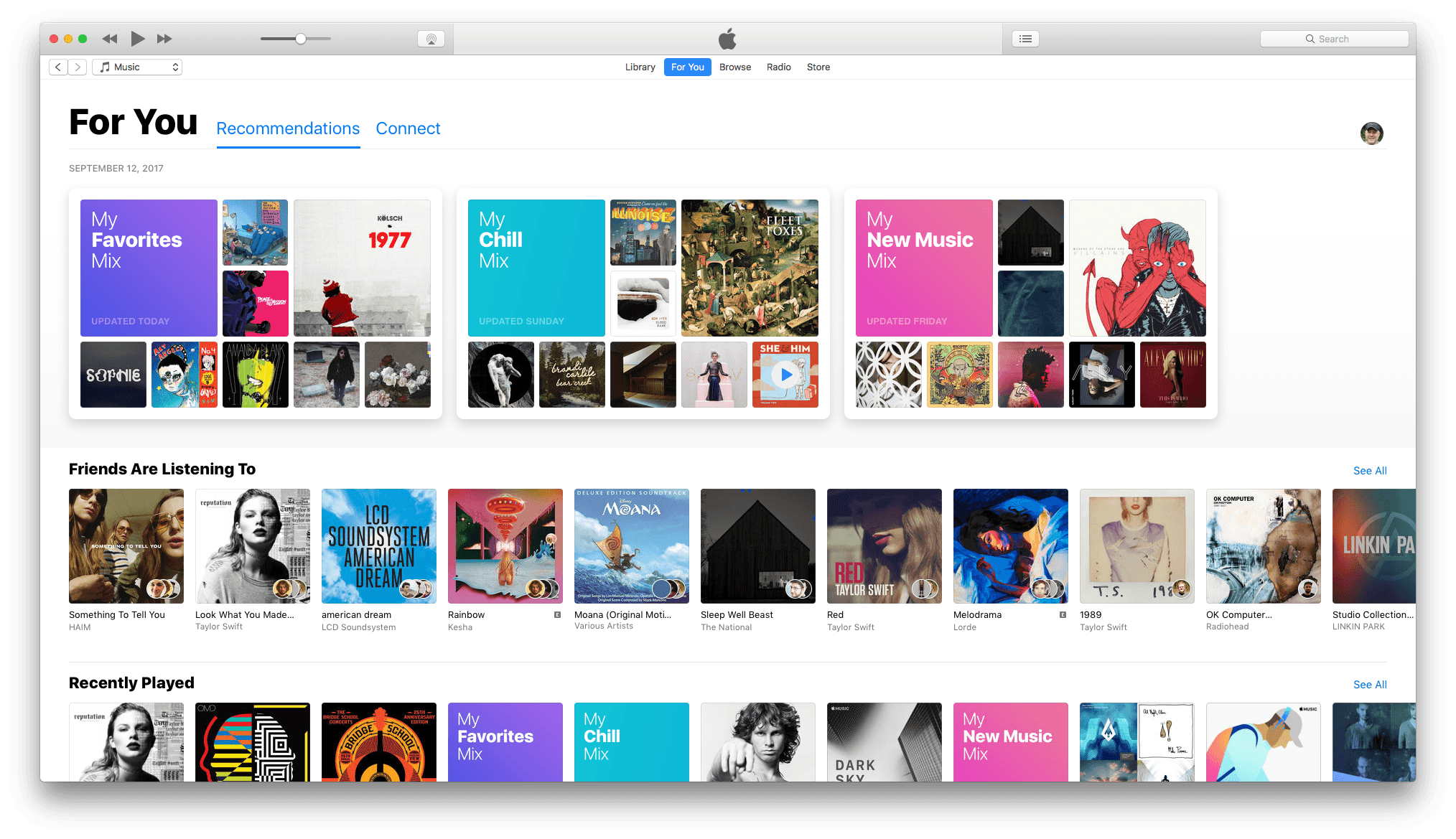
The update to iTunes also adds the Friends feature first seen in the iOS 11 beta. Apple Music subscribers can set up a profile and follow friends to see the music and playlists they are listening to. I’ve been using the Friends feature all summer and it’s been a great way to find and try new music.


AT&T and Verizon Announce Apple Watch Wireless Plan Pricing→

The Street reports that AT&T and Verizon will charge $10 per month to add an LTE-enabled Apple Watch to an existing US data plan. Of the two carriers, Verizon’s offer is a little more generous because the first three months of service are free. According to The Street, Sprint and T-Mobile will also carry the Series 3 Watch in the US, but have not disclosed pricing yet.

You can also follow all of our Apple event coverage through our September 12 hub, or subscribe to the dedicated September 12 RSS feed.

Permalink

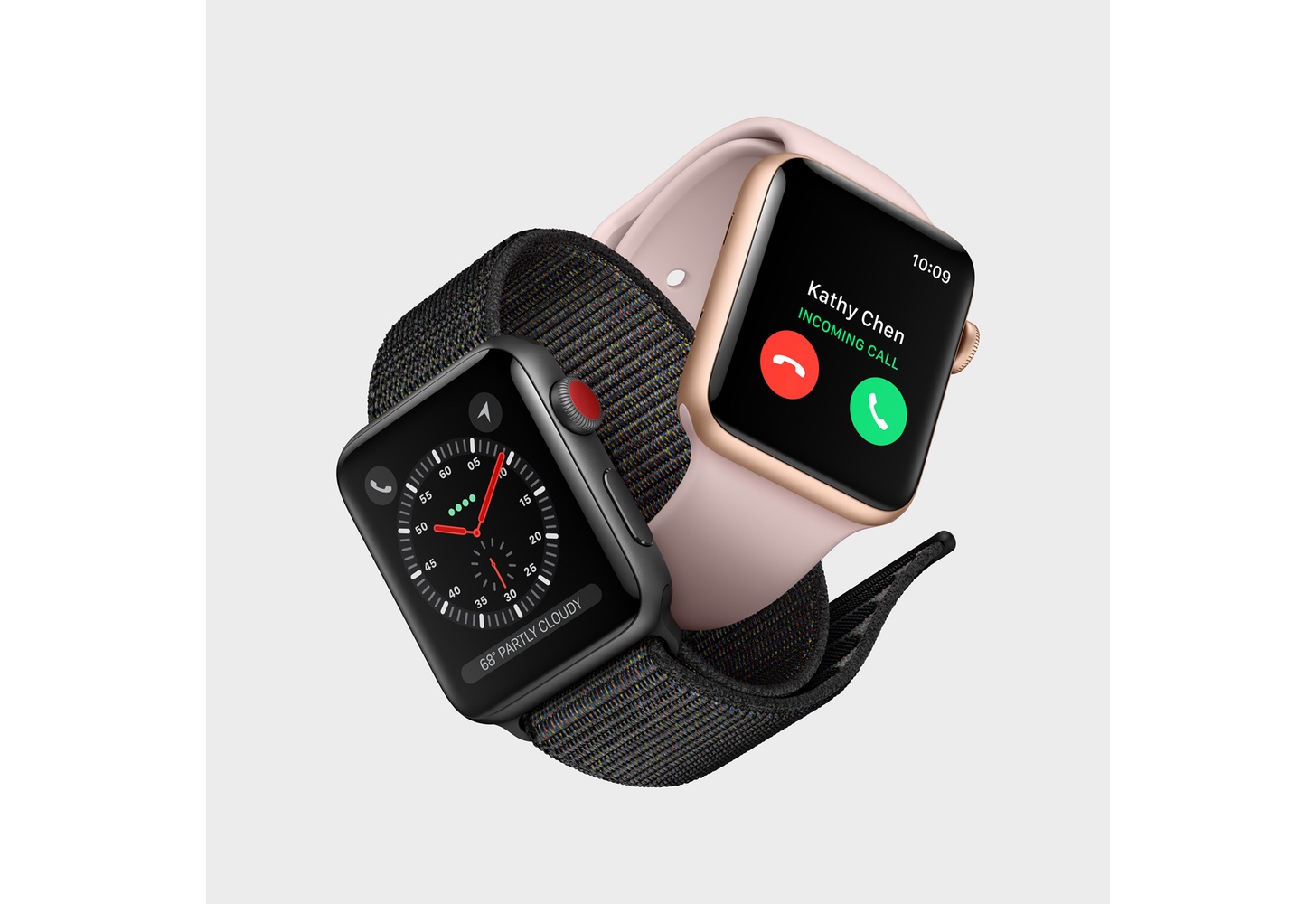
Apple Watch Series 3: Our Complete Overview

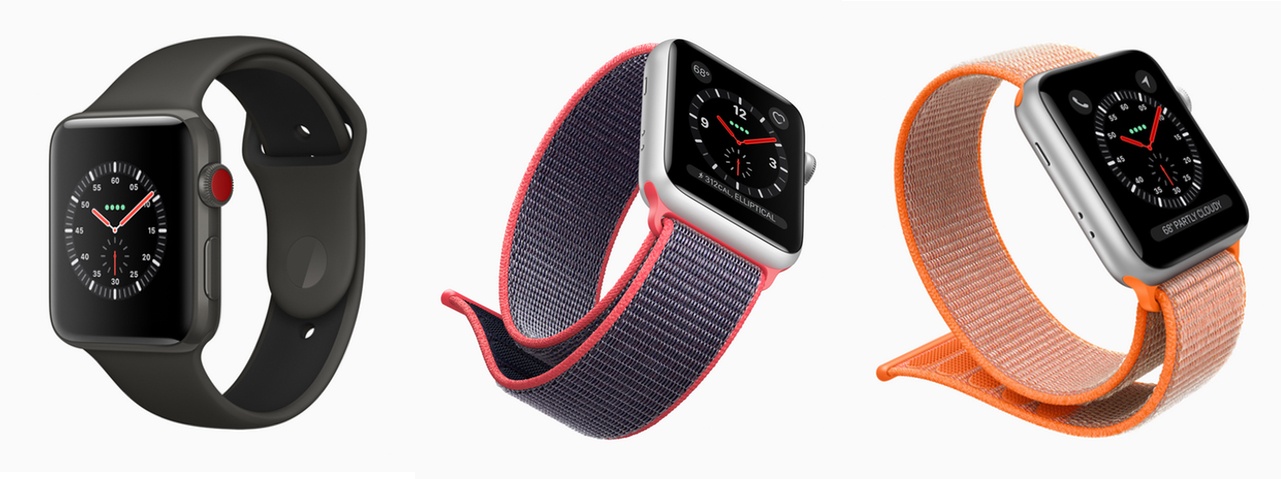
Today at a press event held at the Steve Jobs Theater in Apple’s Cupertino headquarters, the company unveiled the Apple Watch Series 3. The latest iteration of Apple Watch adds a new option to its lineup. Now the Apple Watch is available with an optional LTE radio that provides a network connection when out of range of its paired iPhone. The Series 3 is distinguished from its non-LTE siblings by a bright red dot on its Digital Crown. The Series 3 also features a new barometric altimeter that measures relative elevation, which Apple touted as perfect for skiers and snowboarders.

Read more