

 Federico
As first reported by Semafor, Google’s Sissie Hsiao is stepping down as head of the Gemini app and will be replaced by Josh Woodward, who led Google Labs and developed NotebookLM. Given how beloved NotebookLM is these days, this seems like a good change for the company. (Link) Ace is a new “computer autopilot”...
 Simple Scan
I’ve been on a simple utility kick lately. I’ve always loved apps that fulfill a specific computing need without the distraction or complexity of a lot of features I don’t need and won’t use. Today, I thought I’d check in with Simple Scan, the iPhone and iPad app from Greg Pierce of Agile Tortoise, which...
App Debuts
Streets The popular Street View browser for iPhone, iPad, and Apple Watch was updated with a new way to explore panoramic images from the past. With the new Timeline feature in Streets, you can now view historical Street View panoramas, letting you see how neighborhoods, landmarks, and cities have evolved. I’ve had a lot...
AI Adds a New Dimension to DEVONthink 4
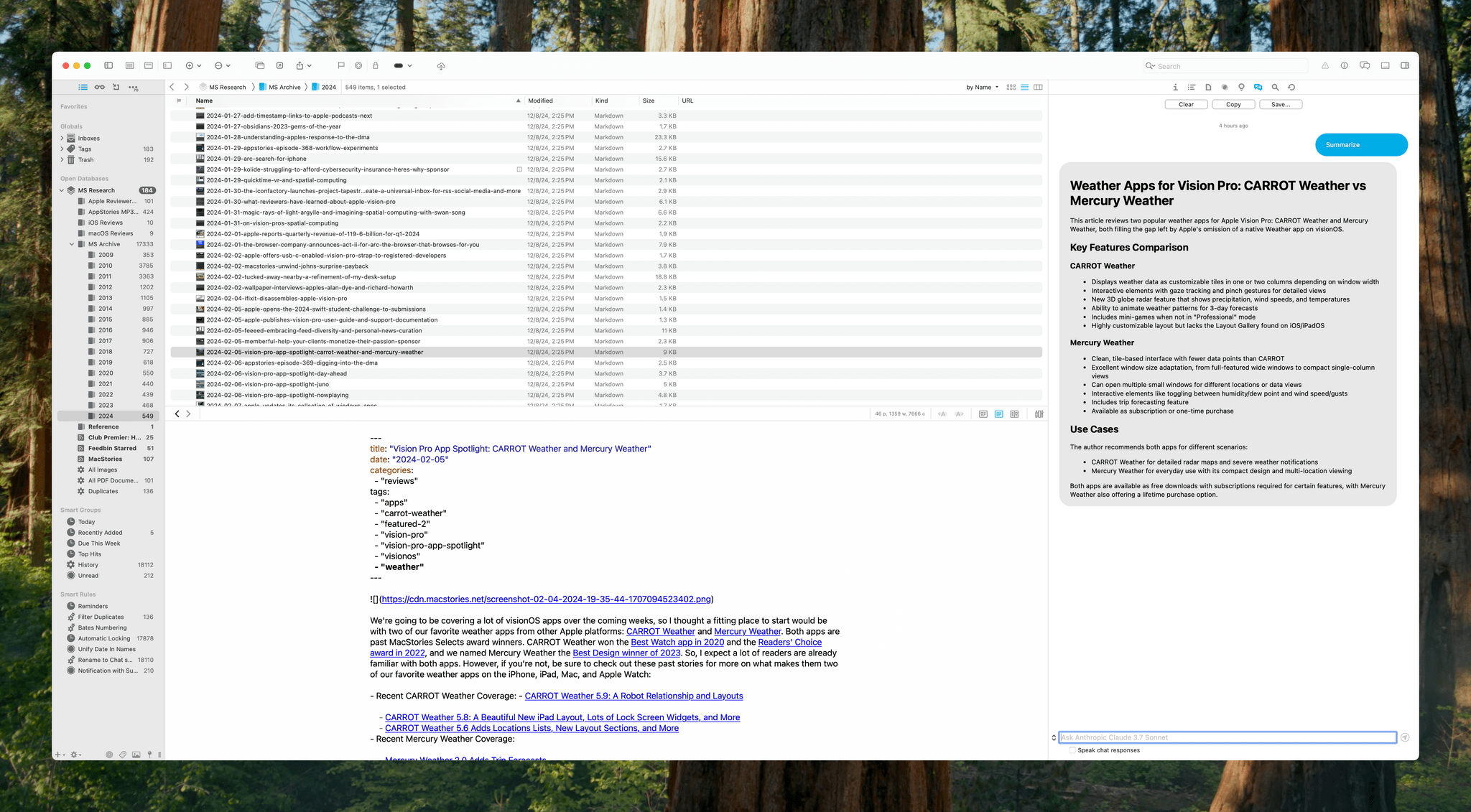
DEVONthink is a difficult app to review because its flexibility means it can serve a wide variety of purposes. I’ve been using it for the past few weeks as an archive and research companion that houses thousands of plain text files, but the app is capable of effectively replacing your Mac’s file system, storing and cataloging all sorts of files. With lightning-fast search, tagging, and a plethora of other organization methods, DEVONthink 3 has a well-earned reputation as a premier tool for researchers working with lots of files. However, DEVONthink’s capabilities are so varied that it can also serve as a text editor, an RSS reader, a read-later app, and a lot more.
Today, DEVONtechnologies is releasing a public beta of DEVONthink 4, a big update with a focus on AI, but with other new features and refinements to existing capabilities, too. Which of these features matters most to you will depend in large measure on how you use the app. I’m going to focus on the new AI tools because those are the additions that have had the greatest impact on the way I use DEVONthink, but it’s worth keeping in mind that the app offers many other tools that may suit your needs better.
Access Extra Content and Perks
Founded in 2015, Club MacStories has delivered exclusive content every week for nearly a decade.
What started with weekly and monthly email newsletters has blossomed into a family of memberships designed for every MacStories fan.
Club MacStories: Weekly and monthly newsletters via email and the web that are brimming with apps, tips, automation workflows, longform writing, early access to the MacStories Unwind podcast, periodic giveaways, and more;
Club MacStories+: Everything that Club MacStories offers, plus an active Discord community, advanced search and custom RSS features for exploring the Club’s entire back catalog, bonus columns, and dozens of app discounts;
Club Premier: All of the above and AppStories+, an extended version of our flagship podcast that’s delivered early, ad-free, and in high-bitrate audio.
Podcast Rewind: Automation, Nintendo Today and Virtual Game Cards, Fanta, and Games
Enjoy the latest episodes from MacStories’ family of podcasts:
AppStories






This week, Federico and I take listeners on a tour of the wide variety of automations they’ve been working on so far this year, including shortcuts, Claude projects, and Zapier zaps.
This episode is sponsored by:
- BetterTouchTool – Get ready for BTT Mobile. Visit the BetterTouchTool community to learn more.
- Notion – Try the powerful, easy-to-use Notion AI today.
NPC: Next Portable Console
This week, Brendon, Federico and I analyze the latest Nintendo Direct and what it reveals about the Switch 2’s rumored June launch. Then, we dissect the many questions that Nintendo’s upcoming Virtual Game Cards system raises, explores the features of the Nintendo Today app, and debate the reported three-phase launch strategy for the next console. In the latest handheld news, we also cover an EmuDeck update, AYA NEO’s confounding mini PC, and an intriguing foldable from Huawei that’s perfect for DS emulation.
NPC XL
This week, Brendon and I share our first impressions of the 8BitDo Ultimate Controller 2, Brendon has additional thoughts about the Ayn Odin 2 Portal as a streaming device and details his living room docking setup, and I take the Mechanism gaming pillow plunge.

Ruminate
Robb brings a huge bag of snacks while I considers signature drinks, then we discus a gaming and stationery collab, followed by some Switch 2 hopes and dreams.
Access Extra Content and Perks
Founded in 2015, Club MacStories has delivered exclusive content every week for nearly a decade.
What started with weekly and monthly email newsletters has blossomed into a family of memberships designed for every MacStories fan.
Club MacStories: Weekly and monthly newsletters via email and the web that are brimming with apps, tips, automation workflows, longform writing, early access to the MacStories Unwind podcast, periodic giveaways, and more;
Club MacStories+: Everything that Club MacStories offers, plus an active Discord community, advanced search and custom RSS features for exploring the Club’s entire back catalog, bonus columns, and dozens of app discounts;
Club Premier: All of the above and AppStories+, an extended version of our flagship podcast that’s delivered early, ad-free, and in high-bitrate audio.
Twenty Thousand Hertz Explores Apple’s Accessibility History
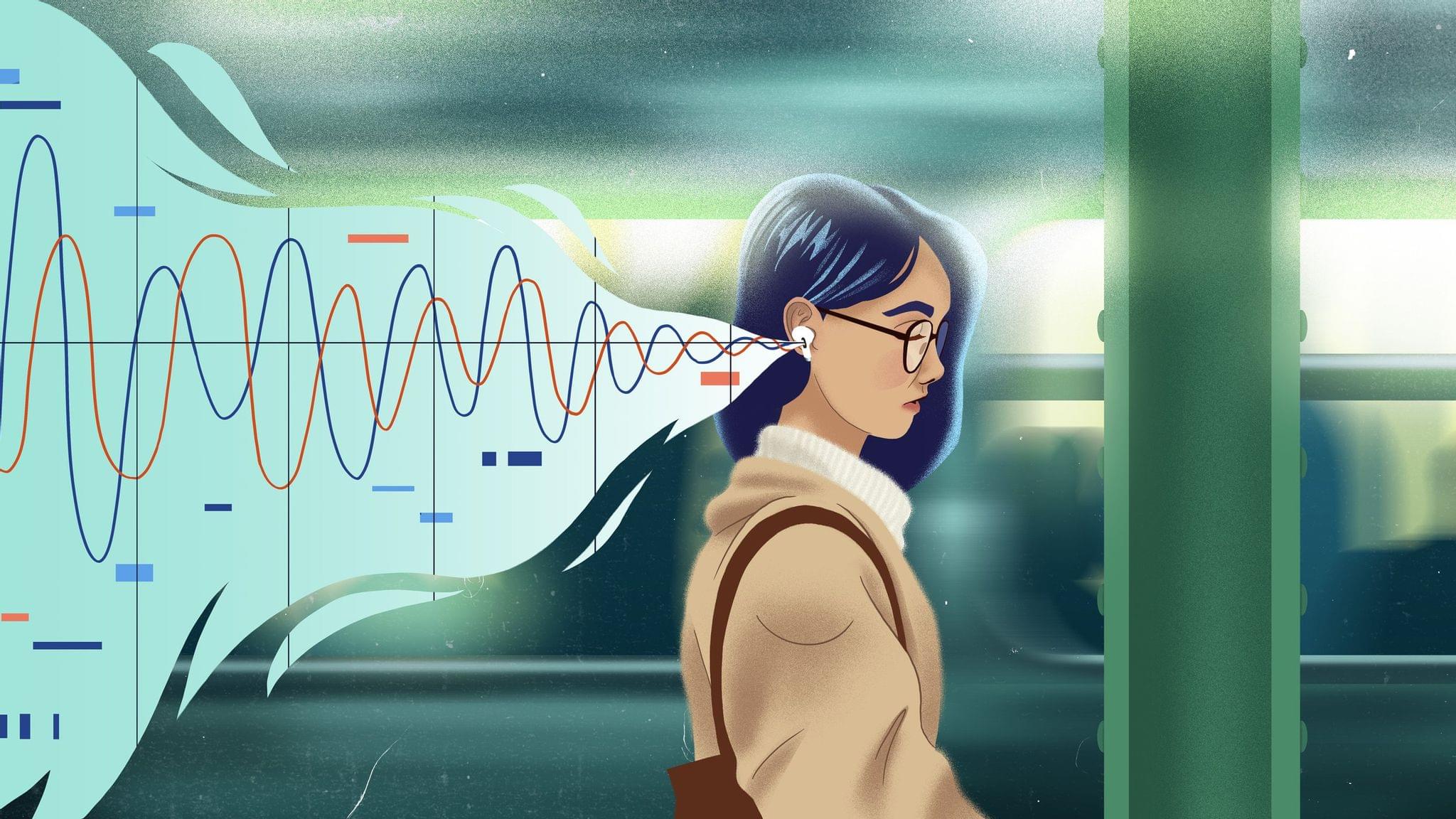
The Twenty Thousand Hertz podcast’s latest episode celebrates the 40th anniversary of Apple’s accessibility efforts. Through a series of interviews with Apple’s Sarah Herrlinger, Ron Huang, Deidre Caldbeck, and Erick Treski, host Dallas Taylor explores the history of accessibility features in Apple products. It’s an excellent oral history that weaves historical insights and present-day technological advancements in a fascinating way.
Beyond the tech of it all, though, what really comes through is the importance of the accessibly work that goes into Apple’s hardware and the impact it has on so many lives:
[Dallas Taylor, Show Host:] For years now, I’ve been talking about how hearable technology was eventually gonna combine headphones, earplugs, hearing aids, virtual assistants, and more into one earbud-like device that we can theoretically leave in all day. This is the kind of technology that I’m most passionate about because it goes so far beyond just convenience or entertainment. It’s the stuff that literally changes people’s lives and helps people connect with each other through sound.
[Deidre Caldbeck, Apple’s senior director of product marketing for Apple Watch and Health] For me, when I started to work on Apple Watch and then soon after Health, to be able to hear some of these stories we’ve been sharing today, I just felt very fortunate that this was my actual job. This is my profession, that I get to work with these brilliant people that come up with these features that anyone can use and anyone has the potential of having their lives changed.
[Dallas Taylor, Show Host:] Now, designing for accessibility comes with a lot of challenges, but when you approach those challenges with empathy and creativity, the result is often a better product for everyone.
[Sara Herrlinger, Apple’s senior director of global accessibility policy and initiatives:]: We’re all unique in the world, and accessibility features may be life hacks to one person and they may be necessities to another, but we’re always just trying to make sure that we have features that work for everyone.
You can listen to the full episode on Apple Podcasts, Spotify, and the Twenty Thousand Hertz website.
Access Extra Content and Perks
Founded in 2015, Club MacStories has delivered exclusive content every week for nearly a decade.
What started with weekly and monthly email newsletters has blossomed into a family of memberships designed for every MacStories fan.
Club MacStories: Weekly and monthly newsletters via email and the web that are brimming with apps, tips, automation workflows, longform writing, early access to the MacStories Unwind podcast, periodic giveaways, and more;
Club MacStories+: Everything that Club MacStories offers, plus an active Discord community, advanced search and custom RSS features for exploring the Club’s entire back catalog, bonus columns, and dozens of app discounts;
Club Premier: All of the above and AppStories+, an extended version of our flagship podcast that’s delivered early, ad-free, and in high-bitrate audio.
Apple Updates Its OSes with Mail Parity Across Platforms, Recipes in News, Apple Intelligence on visionOS, and More
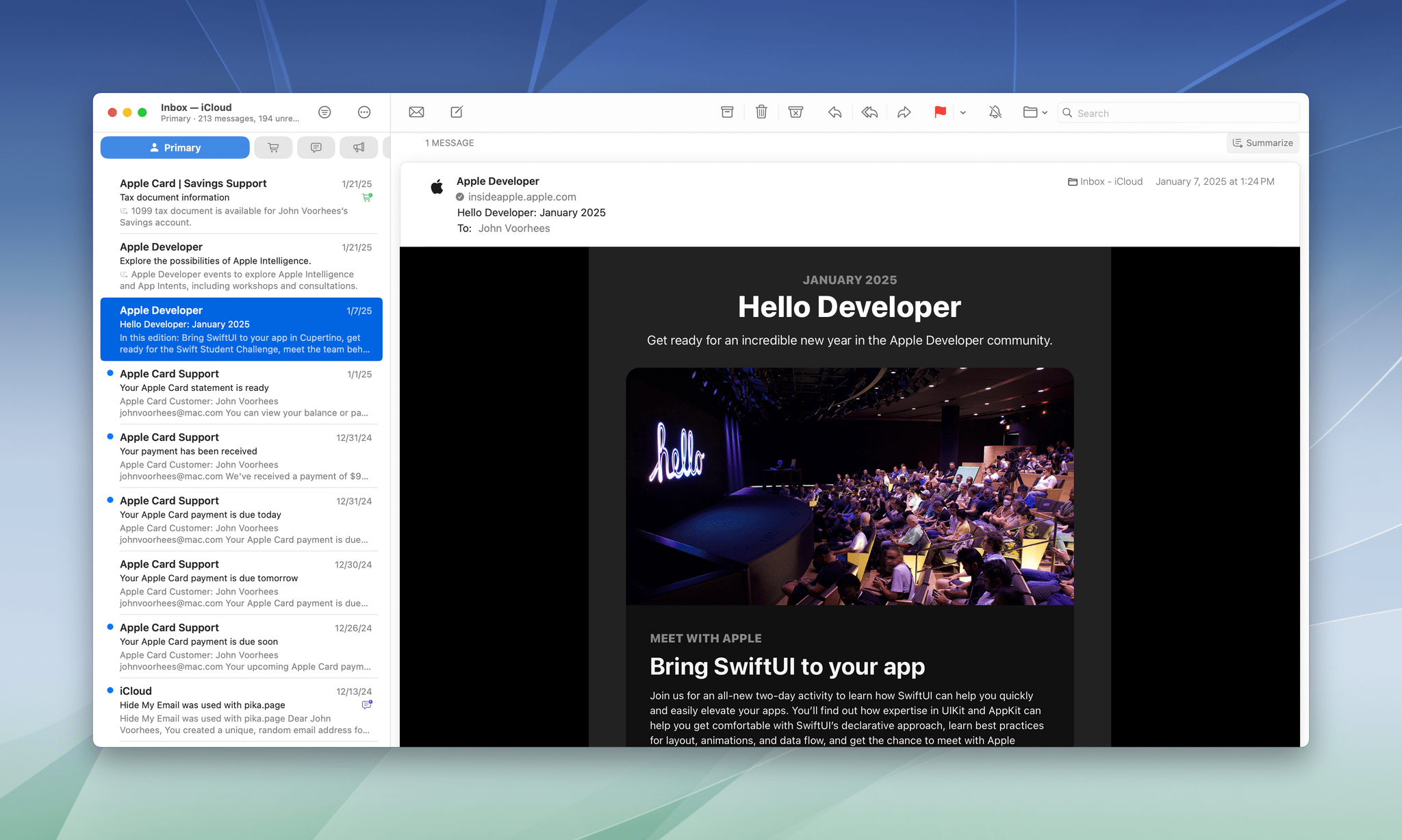
Today, Apple released iOS 18.4, iPadOS 18.4, macOS 15.4, visionOS 2.4, tvOS 18.4, and watchOS 11.4. These releases represent an eclectic mix of new and updated features along with smaller changes scattered across each of the OSes.
One of the biggest changes is that the automatic message categorization feature added to iOS’ Mail app in December is now available on the iPad and Mac, although the Categories view can be switched back to List view if you prefer the old style. The updates to Mail on the Mac and iPad also include a digest view that combines multiple messages from one sender into a unified thread as well as sender contact photos.
Priority notifications have arrived on iOS, iPadOS, and macOS, too. The feature is designed to surface important alerts. In my experience, the feature works fairly well but has a more expansive definition of what a priority message is than I do.
Access Extra Content and Perks
Founded in 2015, Club MacStories has delivered exclusive content every week for nearly a decade.
What started with weekly and monthly email newsletters has blossomed into a family of memberships designed for every MacStories fan.
Club MacStories: Weekly and monthly newsletters via email and the web that are brimming with apps, tips, automation workflows, longform writing, early access to the MacStories Unwind podcast, periodic giveaways, and more;
Club MacStories+: Everything that Club MacStories offers, plus an active Discord community, advanced search and custom RSS features for exploring the Club’s entire back catalog, bonus columns, and dozens of app discounts;
Club Premier: All of the above and AppStories+, an extended version of our flagship podcast that’s delivered early, ad-free, and in high-bitrate audio.
Approaching AI with a Critical Optimist’s Eye
On Friday, Allison Morrow published a story for CNN Business suggesting that Apple’s delay of AI features doesn’t matter because AI isn’t good enough for the sort of consumer products we’re accustomed to from the company. In Morrow’s parlance, Apple isn’t failing AI; AI is failing AI. She argues that Wall Street’s desire for an...
 Pick 3: Automations
This week, Federico and John take listeners on a tour of the wide variety of automations they’ve been working on so far this year, including shortcuts, Claude projects, and Zapier zaps.
On AppStories+, Federico and John dig a little deeper into some of the more complex automations that they’ve been working on in 2025.
](https://cdn.macstories.net/banneras-1629219199428.png)
We deliver AppStories+ to subscribers with bonus content, ad-free, and at a high bitrate early every week.
To learn more about an AppStories+ subscription, visit our Plans page, or read the AppStories+ FAQ.
This episode is sponsored by:
- BetterTouchTool – Get ready for BTT Mobile. Visit the BetterTouchTool community to learn more.
- Notion – Try the powerful, easy-to-use Notion AI today.