John Voorhees

5415 posts on MacStories since November 2015

John is MacStories' Managing Editor, has been writing about Apple and apps since joining the team in 2015, and today, runs the site alongside Federico. John also co-hosts four MacStories podcasts: AppStories, which covers the world of apps, MacStories Unwind, which explores the fun differences between American and Italian culture and recommends media to listeners, Ruminate, a show about the weird web and unusual snacks, and NPC: Next Portable Console, a show about the games we take with us.

Six 8BitDo Controllers Add Support for Apple Hardware

Source: 8BitDo

Source: 8BitDo

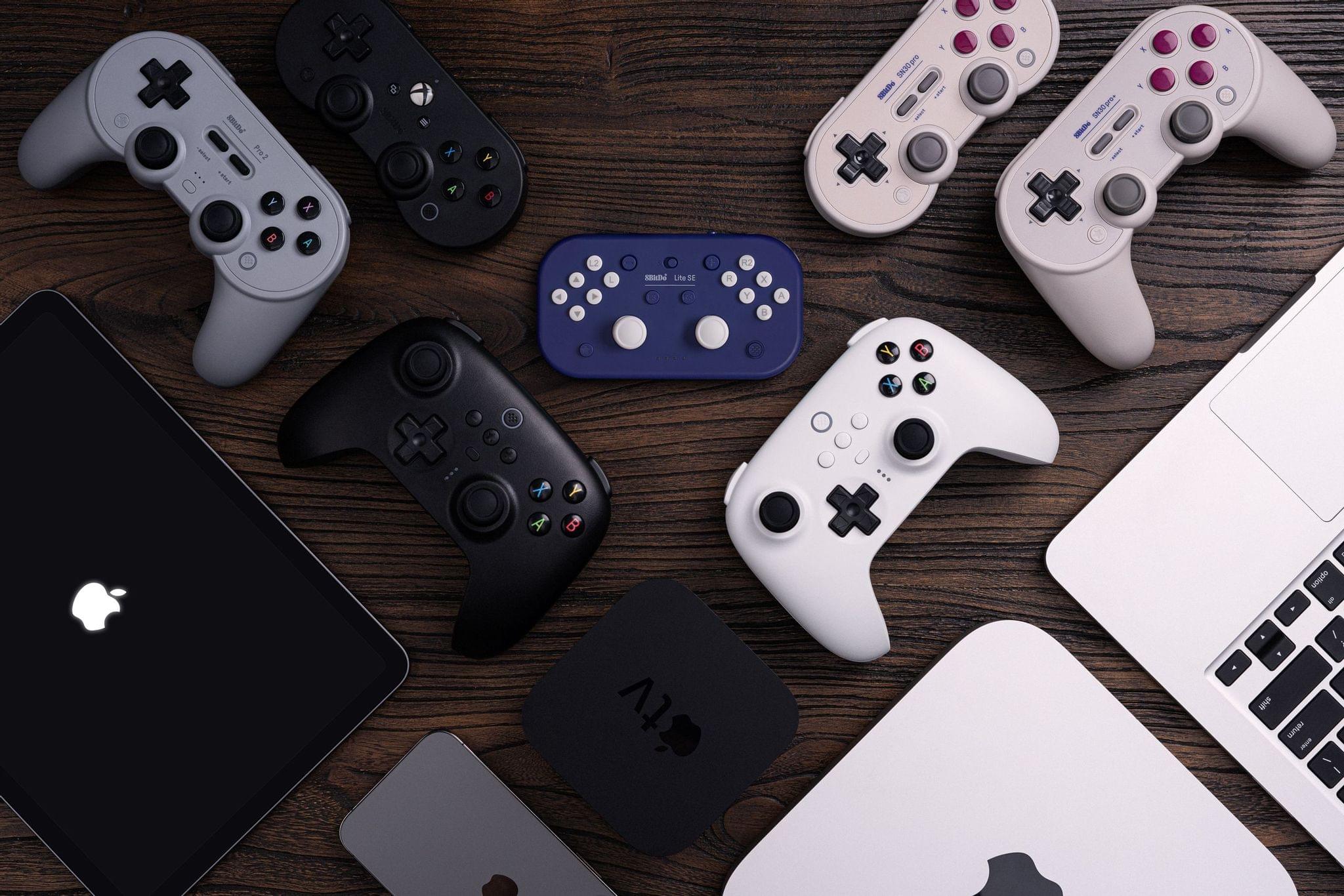
8BitDo, a popular maker of game controllers, announced today that six of its products now officially support Apple hardware:

  • 8BitDo Ultimate Controller 2.4g
  • 8BitDo Pro 2
  • 8BitDo SN30 Pro +
  • 8BitDo Pro
  • 8BitDo SN30 Pro for Android
  • 8Bitdo Lite SE

The controller firmware update, which can be applied using the company’s Upgrade Tool, will allow gamers to use 8BitDo’s supported controllers wirelessly with any iOS, iPadOS, macOS, or tvOS game that has adopted Apple’s game controller APIs. Playing wired is also supported on iPads and Macs with USB-C ports.

According to 8BitDo, up to four controllers can be connected at once for games with multiplayer support, but rumble and motion control are not supported “for the moment,” suggesting that a future update may support those features. Links to detailed directions and illustrations of how to connect 8BitDo’s controllers are available by hovering over the images of the controllers on the company’s dedicated Apple device webpage.

I have a bunch of the controllers for which Apple device support was announced, and I can’t wait to try them. A couple of the controllers I have already have some basic support for Apple devices, thanks to compatibility with Sony and Microsoft controllers. However, the firmware update should extend the functionality of the controllers to the full set of features that Apple now supports.


Microsoft and Netflix Aim to Challenge Apple in Mobile Gaming

Two pieces of mobile gaming news caught my eye this morning.

The first was an interview that Phil Spencer, CEO of Microsoft Gaming, gave to the Financial Times. The annual Game Developer Conference began today, and Spencer wants developers to know that Microsoft intends to publish games on mobile devices:

We want to be in a position to offer Xbox and content from both us and our third-party partners across any screen where somebody would want to play.

He continued:

Today, we can’t do that on mobile devices but we want to build towards a world that we think will be coming where those devices are opened up.

Spencer is banking that the EU’s Digital Markets Act will force Apple and Google to open up their devices early next year. Microsoft is having troubles of its own with US, UK, and EU regulators over its proposed acquisition of Activision Blizzard. Part of Spencer’s strategy to win regulators over appears to be the prospect of bringing competition to mobile gaming with its own store and a native Game Pass app that isn’t relegated to streaming via a browser, which is the case for it and services like NVIDIA’s GeForce Now under current App Store rules.

The second piece of news comes from Netflix, which says it has 40 mobile games coming to iOS in 2023, which will join the 55 already available. Working within the constraints of the App Store’s guidelines, Netflix’s games are released as separate App Store downloads that Netflix subscribers can download and play at no additional cost. I’ve been impressed with the quality of the games released by Netflix, which include titles like TMNT: Shredder’s Revenge, Kentucky Route Zero,Reigns: Three Kingdoms, Oxenfree, and Lucky Luna.

However, perhaps even bigger than the news of Netflix’s growing catalog is that the first two Monument Valley games are coming to the company’s mobile game catalog in 2024. That’s a big deal because both games are currently part of an Apple Arcade subscription, as well as being available as separate App Store purchases. It’s not clear whether the games will remain part of Arcade after they’re published by Netflix, but even if they are, it will provide another avenue to play the games at no additional cost, which will dilute the value of an Arcade subscription.

Microsoft and Netflix are already competing with Apple in mobile gaming to a degree, but their hands are tied by App Store guidelines. Microsoft has settled on streaming games, which is clunky and constrained, while Netflix has launched dozens of individual games without a good way to organize and market them under their brand.

What Microsoft and Netflix have done so far demonstrates that a little competition is a good thing. Developers have more avenues for publishing their games, and consumers have more choices. The Digital Markets Act has the potential to be the catalyst that opens the door to competition even wider, which I expect will create all sorts of new opportunities for developers and consumers alike.


Revisiting RSS

AppStories+ Deeper into the world of apps

AppStories Episode 321 - Revisiting RSS

0:00
51:09

AppStories+ Deeper into the world of apps

This week, Federico and John revisit RSS to talk about how syncing services and apps have changed and share how their use of RSS has evolved.

Read more


iPad Frustrations

Here are the highlights from the Club MacStories Discord this week:

The frustration with the iPad as a primary computing device is growing, which is evident from the lively discussion of its shortcomings by Club members this week. Want to join the Club MacStories+ Discord?Upgrade toClub MacStories+ or Club Premier, then visit theAccount page....


Interesting Links

Copilot, which debuted in GitHub, has graduated to Microsoft 365, bringing AI functionality to apps like Word, Excel, and Powerpoint. (Link) Warp, a new take on terminal apps, has added AI integration that assists users with error messages and building scripts. (Link) Silicon Valley Bank collapsed under the weight of a confluence of events, which...


App Debuts

Detail Duo Detail is a video streaming studio for the Mac and iPhone. Detail Duo is a separate iPhone and iPad app for recording video from the front and back cameras of an iPhone or iPad simultaneously. My son Finn, who is an occasional contributor to MacStories, is part of the development team at Detail...


MarkEdit

[[John]] I’m always on the lookout for simple Markdown text editors to supplement my primary writing workflow. Most of my writing takes place in Obsidian, but sometimes I prefer to escape the distraction of my many Obsidian tabs and documents to write something short in a different app. I often use a separate app for...


MacStories Unwind: Ted Lasso, Season 3 Premiere

AppStories+ Deeper into the world of apps
0:00
24:33

AppStories+ Deeper into the world of apps

Sponsored by: Kolide – Ensures only secure devices can access your cloud apps. It’s Zero Trust tailor-made for Okta. Book a demo today.


This week on MacStories Unwind, Federico and John recommend the premiere episode of Ted Lasso, Season 3: Smells Like Mean Spirit

Show Notes

Federico and John’s Pick:


The New York Times Declares that Voice Assistants Have Lost the ‘AI Race’

Brian Chen, Nico Grant, and Karen Weise of The New York Times set out to explain why voice assistants like Siri, Alexa, and Google Assistant seem primitive by comparison to ChatGPT. According to ex-Apple, Amazon, and Google engineers and employees, the difference is grounded in the approach the companies took with their assistants:

The assistants and the chatbots are based on different flavors of A.I. Chatbots are powered by what are known as large language models, which are systems trained to recognize and generate text based on enormous data sets scraped off the web. They can then suggest words to complete a sentence.

In contrast, Siri, Alexa and Google Assistant are essentially what are known as command-and-control systems. These can understand a finite list of questions and requests like “What’s the weather in New York City?” or “Turn on the bedroom lights.” If a user asks the virtual assistant to do something that is not in its code, the bot simply says it can’t help.

In the case of Siri, former Apple engineer John Burkey said the company’s assistant was designed as a monolithic database that took weeks to update with new capabilities. Burkey left Apple in 2016 after less than two years at the company according to his LinkedIn bio. According to other unnamed Apple sources, the company has been testing AI based on large language models in the years since Burkey’s departure:

At Apple’s headquarters last month, the company held its annual A.I. summit, an internal event for employees to learn about its large language model and other A.I. tools, two people who were briefed on the program said. Many engineers, including members of the Siri team, have been testing language-generating concepts every week, the people said.

It’s not surprising that sources have told The New York Times that Apple is researching the latest advances in artificial intelligence. All you have to do is visit the company’s Machine Learning Research website to see that. But to declare a winner in ‘the AI race’ based on the architecture of where voice assistants started compared to today’s chatbots is a bit facile. Voice assistants may be primitive by comparison to chatbots, but it’s far too early to count Apple, Google, or Amazon out or declare the race over, for that matter.

Permalink