Apple has been slowly adding more electric charging station listings to Apple Maps since the release of iOS 10, and today the world’s largest EV charging network, ChargePoint, officially confirmed integration.
The official integration not only means that ChargePoint’s network of charging stations will now be visible as EV Charger badges within Apple Maps, allowing users to tap through to get more info on the station, but users can also initiate charging and complete payment from a link in Apple Maps to the ChargePoint app (Apple Pay included).
Ever since Apple first set out to create its own mapping solution, and found it more difficult than expected, it has aggressively pursued various partnerships to expand the breadth and veracity of its mapping data. Those partnerships have seemed to slow down of late, likely because Maps has less improving to do today than it did shortly following its 2012 launch.
Having spent several years building partnerships to ensure its data won’t lead any drivers astray, Apple has more recently been able to focus on integrating data that’s less important, but still quite useful. A few months ago we saw the company team up with Parkopedia to improve parking data, and now charging stations are a natural next step.
There are lots of interesting tidbits on what Apple is doing, but this part about image processing and GPUs caught my attention:
A bragging point for Apple was the efficiency of its algorithms on graphics processing units, or GPUs, the hardware commonly used in servers to speed processing in deep learning. One slide claimed that Apple’s image recognition algorithm could process twice as many photos per second as Google’s (pdf), or 3,000 images per second versus Google’s 1,500 per second, using roughly one third of the GPUs. The comparison was made against algorithms running on Amazon Web Services, a standard in cloud computing.
While other companies are beginning to rely on specialty chips to speed their AI efforts, like Google’s Tensor Processing Unit and Microsoft’s FPGAs, it’s interesting to note that Apple is relying on standard GPUs. It’s not known, however, whether the company builds its own, custom GPUs to match its custom consumer hardware, or buys from a larger manufacturer like Nvidia, which sells to so many internet companies it has been described as “selling shovels to the machine learning gold rush.”
In my review of iOS 10, I wondered4 how Apple was training its image recognition feature in the Photos app, citing the popular ImageNet database as a possible candidate. We have an answer to that today:
The images Apple uses to train its neural network on how to recognize images also seems to be proprietary, and is nearly twice the size of the standard ImageNet database.
According to Salakhutdinov, Apple will also be more open about their research and they will actively participate in the academic community.
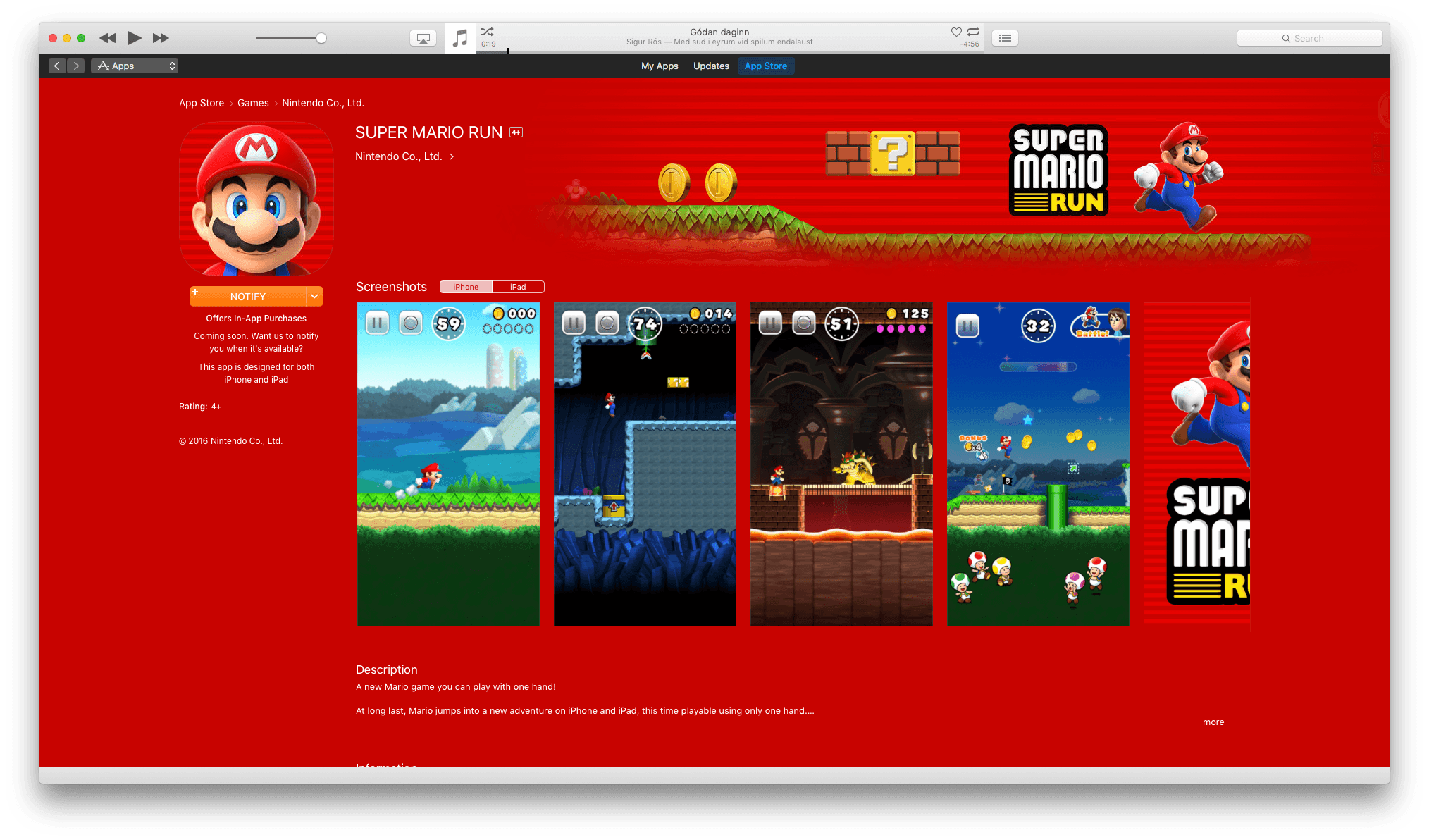
The Super Mario Run marketing blitz has begun. With the launch of Super Mario Run on iOS just one week away, Shigeru Miyamoto was interviewed by The Verge and BuzzFeed News. The creator of Mario spoke at length with both publications about the game, Nintendo’s goals for it, and how it was made.
Miyamoto discussed the thought process behind Super Mario Run’s gameplay with The Verge:
“We felt that by having this simple tap interaction to make Mario jump, we’d be able to make a game that the broadest audience of people could play.”
“Kids are playing on devices that they’re getting from their parents when their parents are upgrading,” Miyamoto said. “We wanted to take an approach of how can we bring Nintendo IP to smart devices and give kids the opportunity to interact with our characters and our games.”
It’s a strategy that makes a lot of sense given the dominance of smartphones and rise of casual gaming.
Nintendo’s goal to make Super Mario Run a one-handed game necessitated designing it for portrait mode, which led to new opportunities for Nintendo’s creative team. Miyamoto told The Verge that:
“Once we did start to focus on the vertical gameplay and one-handed play, we were surprised at how much having that vertical space in a Mario game could add to the verticality of the game itself and how that added a new element of fun to Mario,” Miyamoto explains. “They’re all brand new levels that we created for this game, but because of the vertical orientation, it gave us a lot of new ideas for how to stretch the game vertically. I think it’s been maybe since the Ice Climbers days that we’ve had a game where you’re trying to climb a tower.”
Miyamoto also shared with BuzzFeed News that the inspiration for creating an “endless runner” style Mario game was influenced by fans who do speed runs through Mario and other games. You may have seen videos of speed runs; there is no shortage of them on YouTube. BuzzFeed explains that:
Watching online videos of these gamers’ astounding speed runs and other feats of gaming skill, Nintendo employees noticed that the gamers never let up on the D-Pad. Mario always kept running, and all of the skill came down to the incredible precision of the jumping. What if, the Nintendo braintrust reasoned, all players could have that experience?
In addition, Nintendo executive Reggie Fils-Aimé and Shigeru Miyamoto paid a visit to The Tonight Show Starring Jimmy Fallon last night, demoing Super Mario Run and the Nintendo Switch console that is slated for release in March. If anyone wasn’t sure before, there is no doubt that Jimmy Fallon is a huge Nintendo fan and geek. This video is wonderful:
Yesterday Box launched version 4.0 of its iPhone and iPad app. The update includes a full visual refresh featuring brighter colors and a design that seems to blend better with iOS as a whole.
Douglas Queneua of Campaign US has put together an extensive oral history of Apple’s famous “Get a Mac” ad campaign. Written in two parts, the history is told by actors Justin Long (Mac) and John Hodgman (PC), as well as many of the creative minds that birthed the campaign.
In September 2005, Steve Jobs gave his advertising agency, TBWA\Chiat\Day, an assignment: Come up with a campaign that clearly demonstrates the Mac’s superiority to the PC. There was no deadline.
Seven months, dozens of tense meetings and countless discarded ideas later, the agency produced “Get a Mac.” It would go on to become one of the most succesful and admired ad campaigns in Apple’s history, no small feat when “1984,” “Think Different” and “Silhouette” are the competition. Among those legendary ads, “Get a Mac” stands out as the most overtly comedic and one of the most expansive: The team shot 323 spots over three years just to get the 66 that made it on air.
To mark the 10-year anniversary, Campaign US asked members of the creative team, the crew and the actors to share the untold stories of how the campaign came to life. What follows is their recollections—inconsistencies, errors, biases and all—lightly edited and condensed for clarity.
There are plenty of great stories shared here from a memorable campaign.
One of my favorite tidbits from the article is that Justin Long initially assumed he would be playing the PC role, because up until then he had been playing primarily nerdy parts. “Nerdy parts,” he says, “suited my natural personality.”
The Soulmen updated Ulysses for macOS and iOS with interesting new features today. On macOS, Ulysses added support for Apple’s latest hardware and software features. If you have a new Touch Bar MacBook Pro, you can customize the Touch Bar with Ulysses functionality. In addition, if you have Sierra installed, multiple sheets can be open at one time in tabs, which is something that I’ve found handy as I work on things like the MacStories Weekly newsletter where I tend to jump among multiple documents editing and checking formatting.
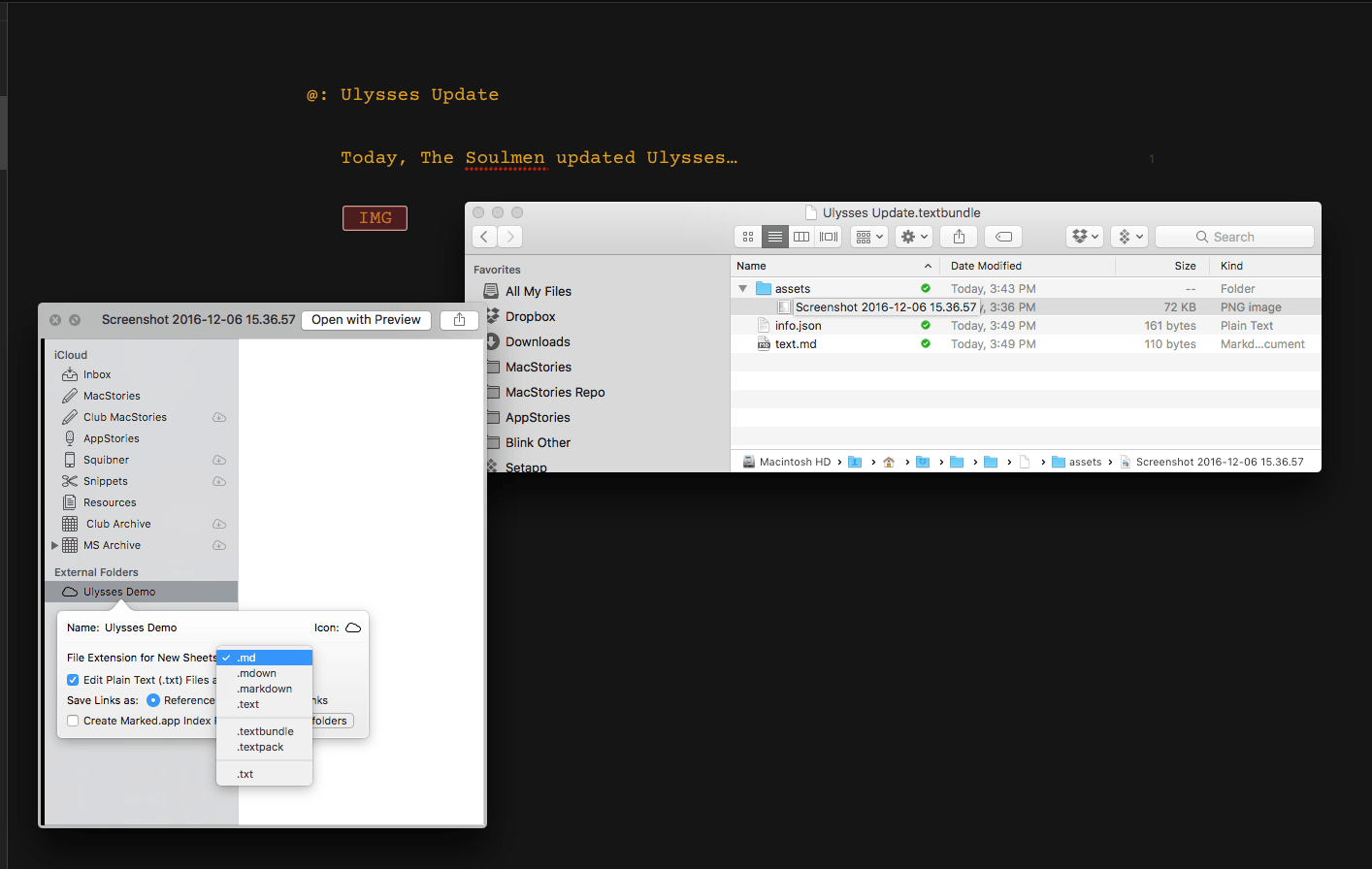
Another addition to Ulysses on the Mac and iOS is TextBundle and TextPack file support. TextBundle is a specification for bundling together Markdown text and referenced images in a way that’s portable and avoids sandboxing issues for apps sold on the Mac and iOS App Stores. TextBundle files work with documents stored in external folders. I had no trouble creating TextBundles on my Mac, but on iOS, where I had less time to test the update, I could create a TextBundle document, but I was unable to add images to it.
On the Mac, right-click an external document and choose edit to save sheets as TextBundles.
The update to Ulysses also added support for importing Evernote ENEX files on the Mac, but I had trouble with it on one of my machines. After you export notes from Evernote as an ENEX file you should be able to drag the ENEX file into a Ulysses group, the sheet list, or onto the Ulysses Dock icon to import the file. That worked for me on one Mac, but not another where it crashed Ulysses. I can’t tell if my situation is an edge case, but in any event, The Soulmen are working on a fix. In the meantime, I suggest testing Evernote importing with a single note before trying to import a more extensive set. Finally, Ulysses already included the ability to set character, word and page goals for your writing, but with the Mac and iOS updates today, you can also set reading time goals.
Reuters reports that Sony’s PlayStation division is working on ten mobile games, six of which will be released next year for iOS and Android. The games, which include Everybody’s Golf, will debut in Japan followed by other Asian countries. The Reuters report doesn’t indicate what plans, if any, Sony has for the games outside Asia.
According to Reuters the other games in the works for mobile release include PaRappa the Rapper and Arc The Lad. Kotaku also reports that Wild Arms is in development for mobile platforms. Kotaku’s coverage includes this preview video of Arc the Lad and Wild Arms from ForwardWorks:
Competition from mobile gaming continues to increase, so its not surprising that console vendors like Sony are following Nintendo’s lead by testing the smartphone waters.
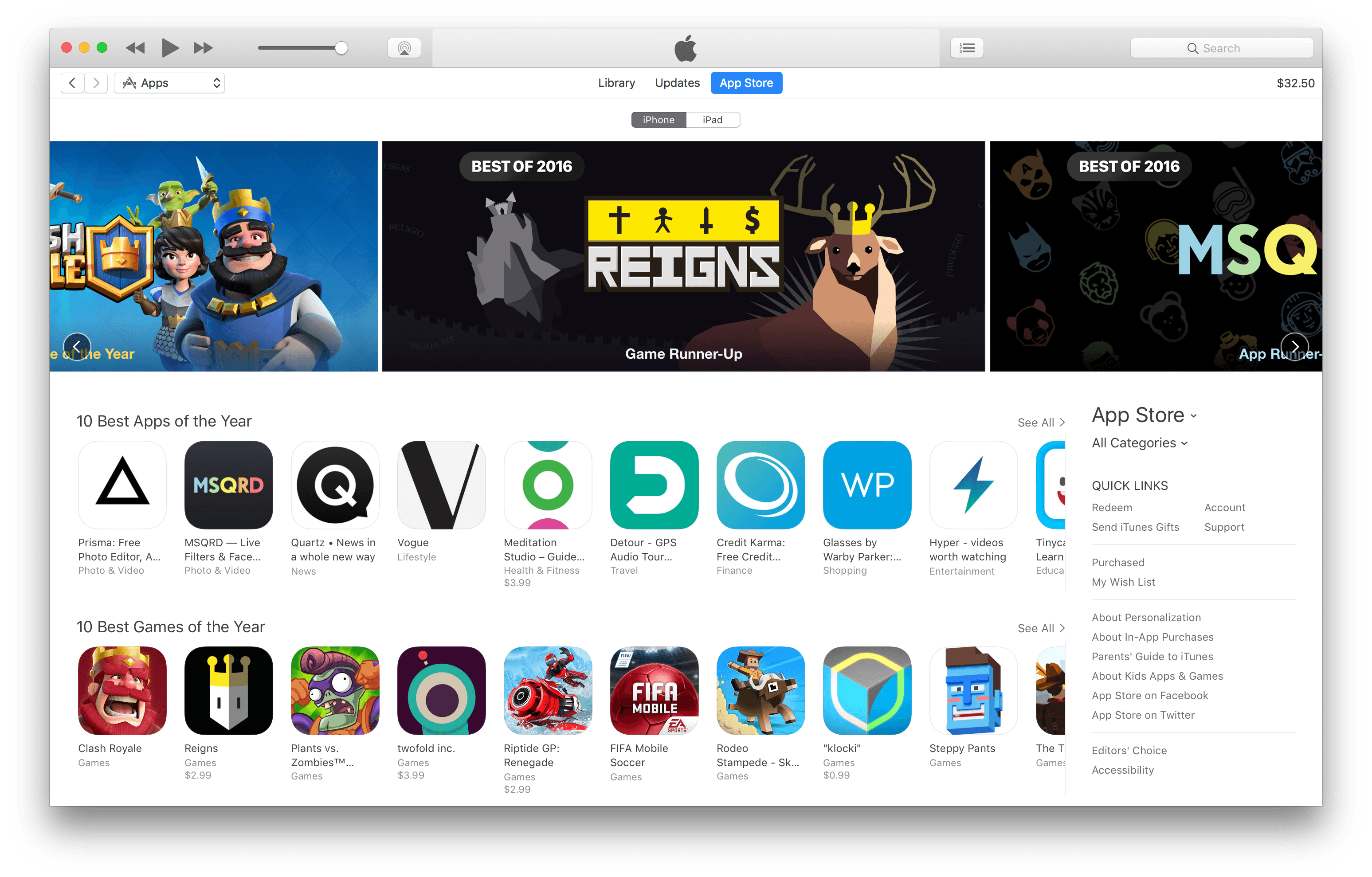
Today, Apple unveiled the 2016 edition of its annual Best of App Store lists for iPhone, iPad, Mac, Apple Watch, and Apple TV. The lists highlight the best apps and games released by third-party developers on each platform during the past year.
In addition, this year Apple published lists of the ‘10 Best Apps of the Year’ and ‘10 Best Games of the Year’ on the iOS App Store and Apple TV App Store, and an extended list of the ‘Best Apps & Games of 2016’ on the Mac App Store.
Like last year, Apple has picked a mix of paid and free apps from developers big and small. Among the notable indie picks are apps from Shiny Frog, Devolver Digital, and Drinkbox Studios. A recap of all the winners and runners-up (from the US App Store) and links to MacStories reviews where applicable is available below.
Federico is back with some new purchases in tow. Stephen published a book. Myke wants more from his Echo. Everyone has wishes for iOS 10.
On this week’s Connected, we checked in with iOS 10 three months after its launch and listed the features we’re liking best so far, as well as those that left us disappointed. You can listen here.