

Gabe Weatherhead has a good collection of tips to get the most out of Pinboard as a reading/discovery service. This is how I use Pinboard as well, but I’ve never thought of using RSS feeds like Gabe does. That’s something I want to try soon.
A Pinboard Reading Library→
Pushpin 2.1 Adds iPad Support and Speed Enhancements
Pushpin already was my favorite Pinboard app on the iPhone: with a great 2.0 update that added a redesigned interface and saved feeds, Pushpin gained a spot on my Home screen as the app I would open to access the full Pinboard experience. From my review:
At $9.99, Pushpin 2.0 is a powerful Pinboard client for users who want to use Pinboard to add bookmarks, manage them, and discover new ones using the service’s (lightweight) social features. Pushpin 2.0 looks great on the Retina display, and new features like Saved Feeds, new tag filtering and suggestions, and improved web browsing strike a good balance between advanced functionality and general usability. Pushpin 2.0 can be used as your only Pinboard client on the iPhone, packing both management and browsing features, and I’m looking forward to an iPad version.
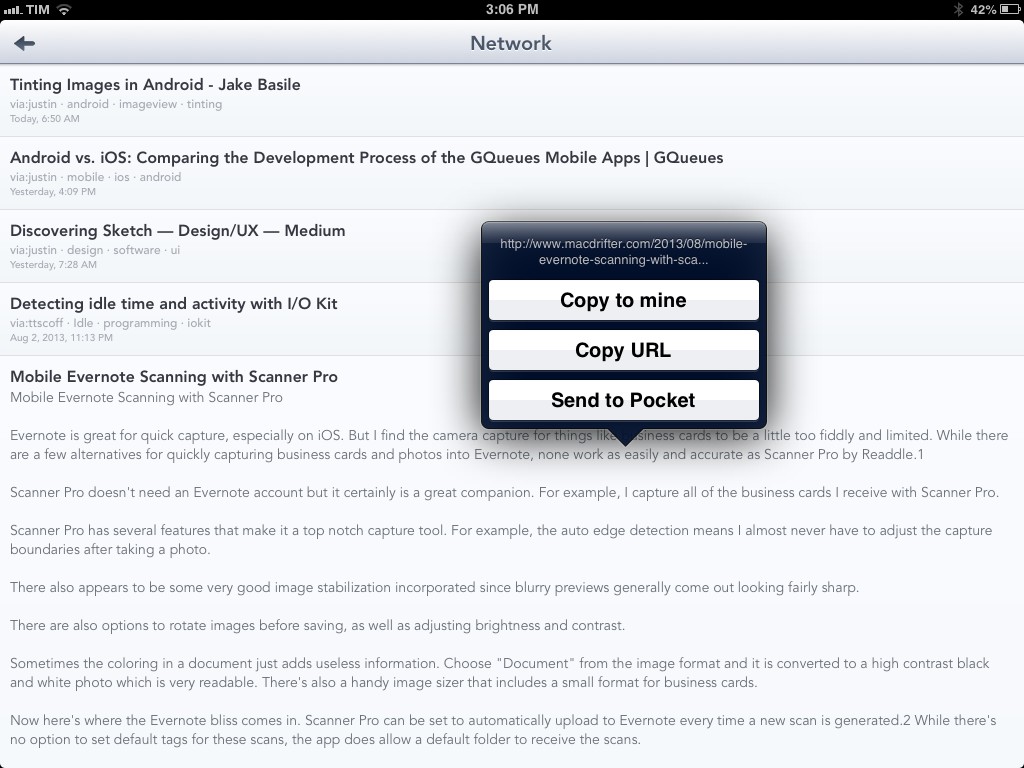
With last night’s 2.1 update, Pushpin is now optimized for the iPad and it looks just as good as the iPhone version. Navigation takes places in a main screen (not a sidebar) where you can find links to your bookmarks, community links, and saved feeds. The iPad version works out of the box with the URL scheme of the iPhone app, and the developer added support for opening links in Dolphin, which is a fine browser with direct Evernote integration (the best of its kind on the App Store).
Pushpin benefits from the increased space of the iPad’s larger screen. For one, it’s much nicer to open links in the app’s built-in web view, and tapping & holding links in the list view opens a popover that doesn’t take over the entire screen; from the popover, you can easily copy a URL, copy a link to your account, or save an item to your read later service of choice.
Alongside speed improvements and bug fixes, saved feeds have been enhanced with support for from: tags: by combining these with regular usernames and tags, you’ll be able to see, for instance, what a specific user has saved from email or Twitter favorites – the app’s changelog on iTunes contains the full list of supported from: tags for your perusal.
Pushpin is a powerful all-in-one Pinboard app, and with an iPad version I can now enjoy the same experience on all my devices (I would like the ability to sync saved feeds, though). You can get Pushpin at $9.99 on the App Store.
App Updates For iOS 7→
Craig Hockenberry:
An overwhelming number of developers were updating apps for iOS 7. Of 575 valid responses, 545 developers indicated that they were working on an update for iOS 7. That’s an adoption rate of 95%!
From what I’ve seen (and heard) so far, it looks like releasing new, paid, separate versions of apps for iOS 7 will be a common trend among developers. I think that, in most cases, it makes sense considering the major rewrite and redesign required by iOS 7 to ensure an app can be technically and visually ready by this Fall.
If we’ll end up with an App Store full of old iOS 6 apps kept for “compatibility mode” or existing customers, I believe properly showcasing iOS 7 apps will be even more necessary in the (already crowded and poorly searchable) App Store.
Rymdkapsel
How do I even begin to explain Rymdkapsel?
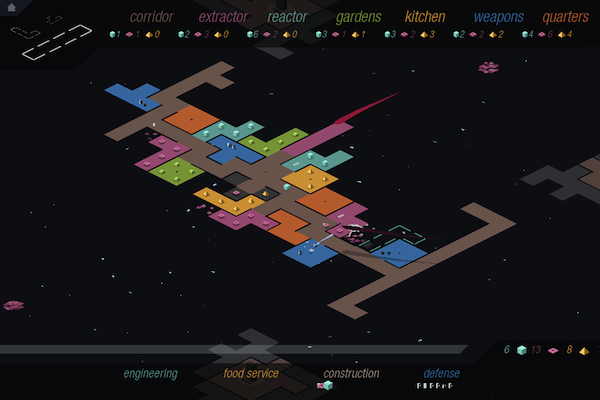
First there’s the tetris pieces, the various rooms you add on to your ship at any given moment. You can assign these pieces to rooms that create materials, or rooms that create sludge which can be used in a kitchen. These pieces intertwine to create the foundation of your ship, complete with weapons rooms, reactors, and quarters where new minions can be spawned. Vast corridors are needed to connect all of these tetris pieces together, making it necessary to create little microcosms of civilization that live in different sections of your ship.
Next there’s the little pixels, the minions and materials that you’ll watch travel around the ship as they man guns and carry materials to their proper destinations. No single minion is managed individually — they’re just dragged between the available resources on your ship. None of them are individually important, but all of them are equally important. There isn’t necessarily strength in numbers. Do you create a lot of minions and a sprawling city, hoping to complete your defenses on time to protect your civilization? Or do you keep your ship small and narrow, relying on a brave few to explore your surroundings? I chose the former.
Then there’s the enemy. As soon as you begin building you’re attacked and forced to defend yourself. As the game progresses enemies become much more numerous and dangerous. Without the proper defenses you could lose a swath of minions, having to dedicate a significant amount of time into growing sludge and working the kitchens so you can generate more little pixels in their quarters. It’s almost pathetic how helpless they are when they’re exposed.
It’s these enemies that control the pace of the game. You don’t have an infinite amount of time to build your ship and build resources. Instead the enemies come in waves and you must carefully keep an eye on a meter that informs you of when an attack is imminent. Your minions must travel the length of the corridors to reach a weapons room, and if they’re not properly protected the enemy will have their way.
A tutorial is given, but I don’t think the it does the game any justice beyond inviting you into the world. You’re walked through the general concepts of the game as events unfold and things happen, but it’s not until you start experimenting with the pieces that you’ll really begin to understand how all of this stuff fits together. And once you do, you begin to realize that Rymdkapsel is very much like and unlike a lot of our favorite games.
It’s Tetris. It’s an RTS strategy. It’s a tower defense game. It’s a race against the clock. It’s endless. It’s all of these things.
I don’t know how to summarize the game and how it makes me feel. An overreaching atmosphere of tranquility masks impending panic. You want to build quickly to meet objectives, but it’s easy to stretch yourself thin. This is evident when you become aware of how important time and distance are. Rooms have limited space and there has to be a balance when deciding how to expand your ship. Don’t forget that you’ll have to find more resources once your extractors are empty; will you have enough materials to continue on? Your minions are all separate pixels doing their own things, such as building rooms or idling, but they’re managed just like a resource would be. There’s all of this complexity and micromangement but it happens at this macro level and the game is actually really simple. The whole thing works so well and once it clicks you cannot put it down.
Rymdkapsel’s own description as a “meditative space strategy” is perfectly apt. It’s so good. Featured by Apple this week, download Rymdkapsel from the App Store for $3.99.
Apple Now Offering Free Downloads in the Apple Store App→
Much like visiting Starbucks and picking up a free song, the Apple Store is now distributing their own freebies. This week it’s an app called Color Zen, which shows up in the Apple Store app alongside the store’s information. If you’re at home, the app just shows up in the list of things that Apple is currently featuring. Mark Gurman from 9to5Mac writes that it’s an incentive to get people to download the app.
We previously reported that Apple Store employees are instructed to install this application on a new iOS Device during Personal Setup (After a purchase). At an internal event in San Francisco last month, Tim Cook revealed that only a small percentage of Apple customers are aware of the app, but Cook wants to use the app as an element of his plan to boost iPhone sales in his stores.
BioShock Infinite Coming To OS X This Month→
Juli Clover:
BioShock Infinite, the third game in the first-person shooter series, is set to be released for the Mac on August 29 through a collaboration between Aspyr Media, developer Irrational Games, and publisher 2K Games.
Infinite is one of my favorite games of 2013 (so far). The game comes with an incredible storyline and solid action-oriented gameplay – but my favorite part remains Columbia, the city in the sky where the game takes place. Just this week, Irrational Games announced a series of DLCs for the game – the first of which, Clash in the Clouds, should be available by launch day with the Mac version. Eurogamer posted an interview with BioShock creator Ken Levine, who explained the motivation behind Clash in the Clouds and the other DLCs that will follow later this year.
BioShock Infinite will be available through Steam, the Mac App Store, and GameAgent, where pre-orders have started today.
365 Days

Today, when I remembered that exactly one year ago I was hospitalized for 22 days for a series of treatments to save my life, I tweeted about it. And then I opened Day One.
In the app’s Calendar view, I changed the year to “2012” and, sure enough, the “August 1, 2012” entry was there, showing photos of my hospital room; my girlfriend sending a selfie from home; and a note that I wrote about the doctors being “nice”. Bits of life. A combination of old thoughts and visual memories that I still have, in some form, in my brain, but that here, in this app – right now – I can hold and directly look at. It is, indeed, far more powerful than memory alone.
It sounds so trivial because we’re used to it. It’s diary app! Of course it lets you browse old entries in a calendar, and of course it’s got search, and of course it accepts photos as attachments, and, okay, the fact that you can see old weather information is neat – but yes, it’s because of the GPS. Common technology terms for yet another app. But does it have a URL scheme? We often lose track of the magic of software.
Sometimes, on days like today, I like to appreciate the simple things of my job. The fact that somebody out there has made an app that lets me cringe at my mistakes and cherish old moments. The fact that in this very moment I can take these old photos, and send them to my parents with a comment that says, “365 days ago…how things change”.
Isn’t that amazing?
Photowerks Enhances Apple’s Photos App with Smart Albums
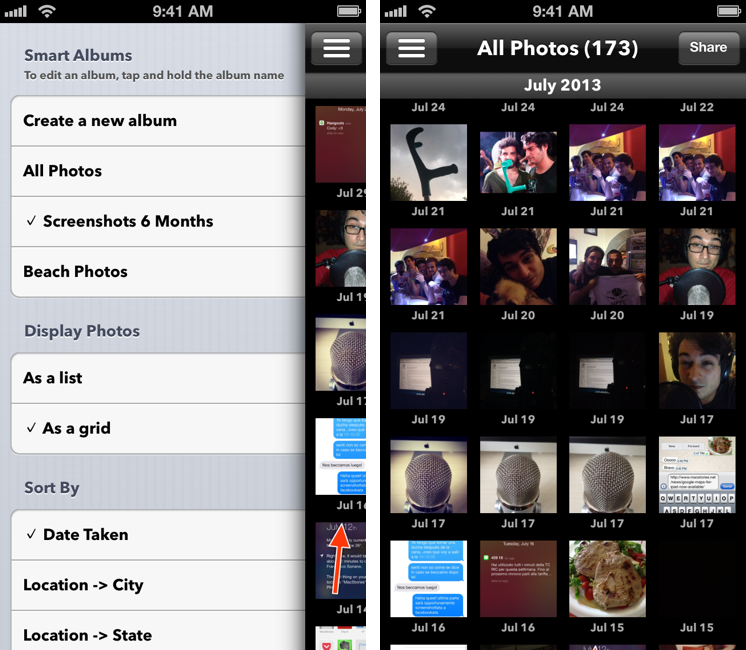
Apple’s Photos app is often criticized for its lack of organizational features that go beyond a list of photos and screenshots, and the company will bring some improvements in this area with iOS 7 and a Photos app capable of organizing items in Moments and Collections. Photowerks, free on the App Store, enhances Apple’s default solution with sorting options and smart albums available today to iOS 6 users.
Photowerks comes with two main features: sorting, which is included in the free download, and Smart Albums, which can be unlocked with a $0.99 In-App Purchase. Once you’ve granted Photowerks permission to access your photos, the free version will allow you to load photos from your Camera Roll, show them as thumbnails on a grid or a list, and sort them (in ascending or descending order) by:
- Date Taken
- Location > City
- Location > State
- Location > Country
- Camera > Make
- Camera > Model
Even without unlocking the IAP, these features prove already handy as, in my opinion, they provide a better view of a stream of photos than what Apple has (or, more appropriately, hasn’t) done with the Photos app. Photos can be viewed in full-screen (where the app will display available information at the bottom), shared to Mail, Facebook, and Twitter, and grouped together to create a new album. Alas, there is no Open In support to send photos to other installed apps, like Evernote and Droplr in my case.
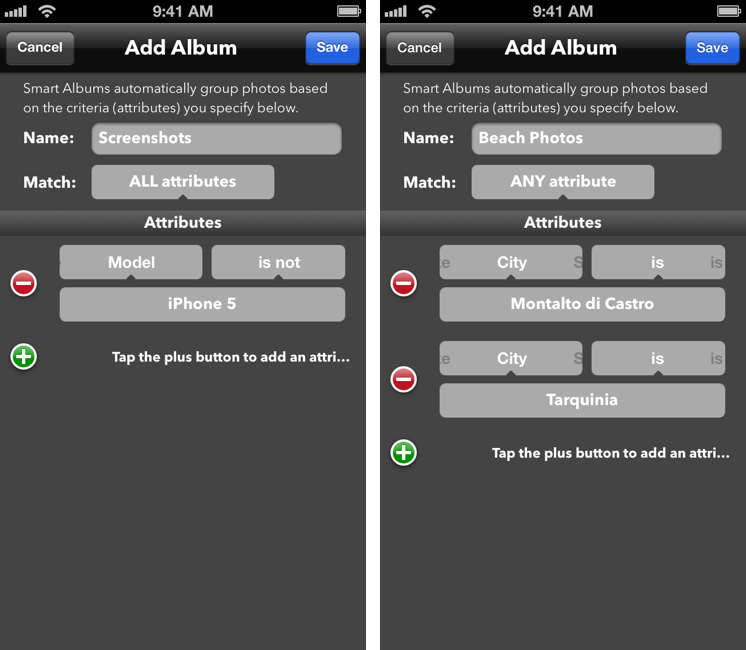
The Smart Albums feature is what really sells Photowerks. As the name suggests, they’re similar to iTunes’ smart playlists in that they let you automatically group photos based on pre-defined criteria that work with the sorting options mentioned above. By using a familiar any/all system for matching rules, Photowerks lets you specify attributes such as “date is after/is not/is/is before” or “model is/is not”; these attributes can be combined to create albums that will be populated with items that match your criteria and that you’ll be able to sort using the same sidebar that you’d use in the IAP-free version of Photowerks. On my iPhone, I have created an album that fetches screenshots taken after June 30 (“date is after June 30, model is not iPhone 5”) and photos taken at the beach (“city is Tarquinia” or “city is Montalto” with Match: Any).
I believe that iOS 7 will reduce the need for Photos.app replacements such as Photowerks, which is why I think the developers should focus on improving the feature that Apple won’t replicate in the short term – smart albums. It would be nice to be able to keep albums in sync across devices (Photowerks is a Universal app) and have access to more attributes for dates (like “past two months” or “this week”), image size, source (like Photo Stream) as well as nested conditions for even smarter filtering. I’m a big fan of the idea of having smart albums based on user-defined criteria, and I hope that the developers will keep on supporting and enhancing Photowerks for iOS 7.
Photowerks is free on the App Store.
Photochop for iPhone Chops and Distorts Your Photos
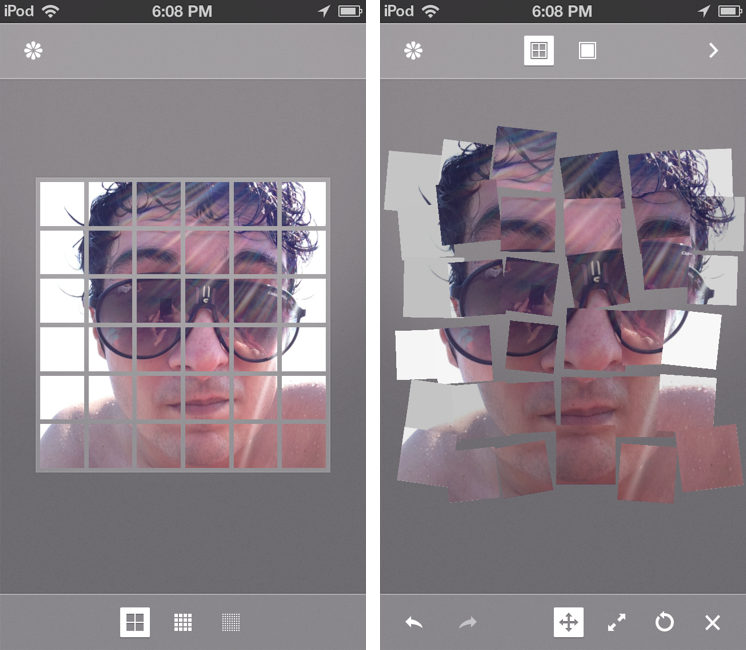
Released last night by Matt Comi of Big Bucket (well known for his work on The Incident), Photochop is an ingenious iPhone app that allows you to break your photos into tiles and distort them to create either artistic or ridiculously funny collages.
I downloaded the app last night, and started playing around with some photos of my friends (they don’t know I’m using their faces to test new apps). The first thing that I noticed is that Photochop, built for iOS 6, uses a clean UI that looks already fine for iOS 7: with clean lines and iconography, translucent bars, and a photo picker button modeled after the new Photos icon of iOS 7, Photochop looks already at home on my iPhone 5 running iOS 7. There are also some distinct choices, though, that give Photochop a unique look.
Photochop lets you work on one photo at a time, and once you’ve picked a photo from your Camera Roll you can choose between three different grid sizes before breaking it up into tiles; to start editing, you simply tap on the grid. The editing screen is fun: there are buttons at the bottom to nudge, scale, rotate, and delete tiles, and controls at the top to switch between tile mode (the “artistic” one) and warp mode. According to the developer, warp mode is meant to make “people’s faces look weird”, and that is a message that I can completely understand because that’s what I’ve been doing in Photochop with my friends’ faces. Once you’re done editing, you can put pictures inside two types of frame (or leave them without a frame) and export them to the Camera Roll, Instagram (with Open In), Twitter, and Facebook.
From a technological standpoint, I’m quite impressed by Photochop’s image distortion and manipulation, which I’m pretty sure has been made possible by Apple’s advancements in APIs offered to developers in recent years (Update: It’s actually a game engine). In using Photochop, you can see how the app will benefit from the new physics engine APIs of iOS 7: right now, the tiles feel “weightless” in how they don’t bounce and slide across the screen, and I wonder if supporting iOS 7 with new effects and physics effects is something that Comi is already working on.
Photochop is a fun little app with some nice technology under the hood. It’s only $0.99 on the App Store.