

Question: I like to view my photos using the ‘All Photos’ album on both the iOS and OS X Photos app because I can view just my photos (I find the way they are displayed in Moments distracting, especially on iOS). However, I’ve recently noticed that some of my photos in ‘All Photos’ are out...
Spotify Launches Two New Radio Shows→
Swedish streaming service Spotify is launching two new radio shows today, both of which feature musicians talking about the kind of music that they like listening to while they’re making their art. The first, AM/PM, will feature artists like electronic music pioneer Jean-Michel Jarre and Terry Hall of ska icons The Specials talking about the music they listen to in the mornings before work, and in the evenings after a day spent creating. The second, Secret Genius, speaks to the songwriters and producers behind major songs, and features the actually-pretty-well-known James Blake, among others.
Looks like Spotify’s “In Residence” radio shows which launched last year were successful enough for Spotify to commission these two new shows. The comparison to the radio shows on Beats 1 is unavoidable, but it’s a good move on Spotify’s part. They may not be for everyone, but those Beats 1 shows are one of the best benefits of the launch of Apple Music. Spotify’s radio shows aren’t live like some of those on Beats 1 are, but I don’t think that makes a great deal of difference to their appeal to listeners.
Speaking of live radio and Beats 1, I’d be very interested to find out how many people listen to Beats 1 live, compared to how many just listen to the recorded radio shows when it is most convenient for them.
Open Casting Call Posted for Apple’s ‘Planet of the Apps’ Reality TV Show→
Earlier this year it was announced that Apple was planning to launch its first original TV series about the “app economy.” Now, Apple has posted an open casting call for the unscripted reality series, which we now know is called Planet of the Apps.
The show is being co-produced with Propagate, a newly launched production company co-owned by Ben Silverman, best known for The Biggest Loser, and Howard T. Owens of MasterChef Junior fame. Will.i.am will also have a hand in producing Apple’s reality series.
The casting call is open to legal residents of the US, and it requires you to have a functioning app (for iOS, macOS, tvOS or watchOS) by October 21. The show will also incorporate elements of mentorship, marketing and promotion (“featured placement in the App Store at the end of the show”), and even funding from “top-tier VCs”.
Executive producers will.i.am, Ben Silverman, and Howard Owens are teaming up for an unscripted series about the world of apps and the talented people that drive its innovation. They’re looking for developers with the vision to shape the future, solve real problems, and inspire change within our daily lives. “We can really tell their stories as we explore how apps are developed and created and incubated,” says Silverman.
If you’re interested in potentially applying to be a part of Planet of the Apps, you can visit their website which contains more information on the requirements and application process.
Shooting takes place from “late 2016 to early 2017” with no official broadcast date just yet, though the website does note that the show will “reach millions of viewers around the world on Apple platforms”. Also yet to be announced are the tech experts and mentors, and these will be announced in “the coming weeks”.
I’m not sure why they’re calling the series “Planet of the Apps”, a name which appears to inexplicably riff on the “Planet of the Apes” science fiction franchise. I hope that by the time the series goes to air it has a different, better, name.
Pokémon GO’s Spectacular Launch
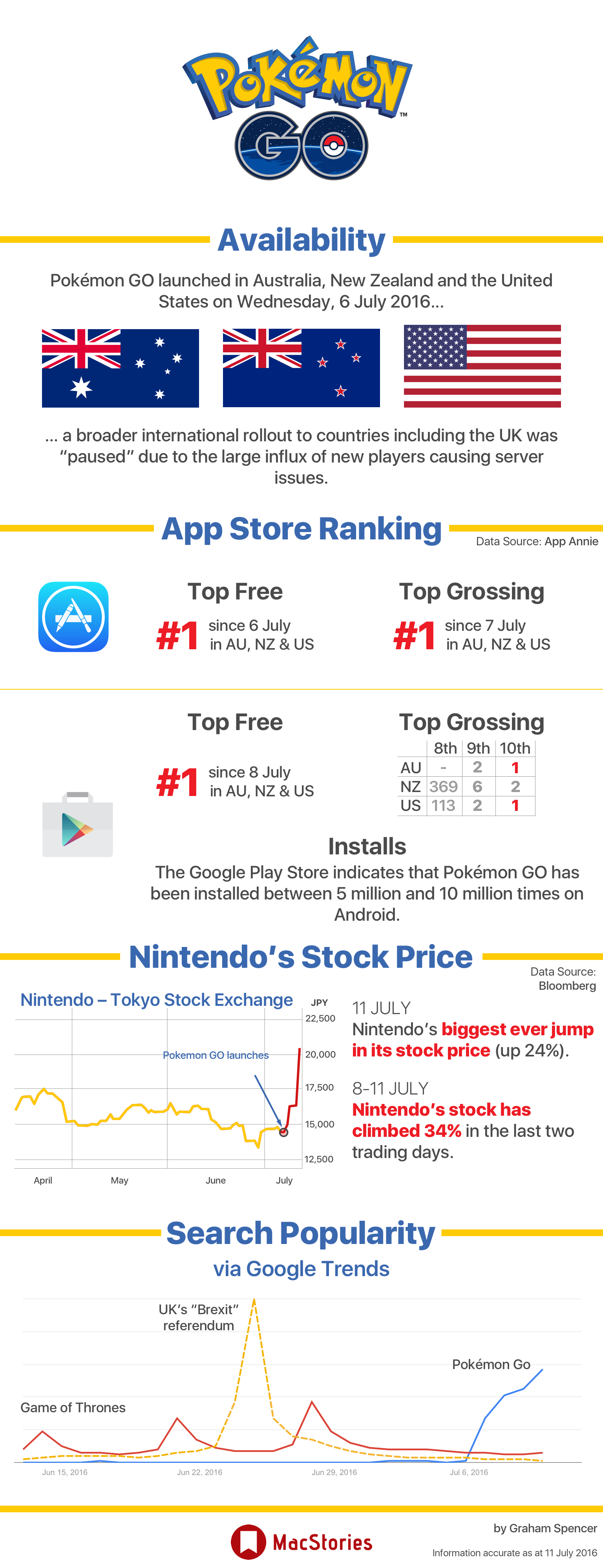
Pokémon GO launched last week, and it has quickly captured the attention of millions who are now playing the augmented reality game created by Niantic in collaboration with The Pokémon Company (which is partially owned by Nintendo). After launching in Australia, New Zealand and the United States, the staggering popularity of the game appeared to catch Niantic off-guard, which had to make the decision to temporarily pause the international rollout. However, there are reports today that the game’s European and Asian rollout will commence “within a few days”.
Despite the limited geographical rollout thus far, Pokémon GO has been a huge early success in Australia, New Zealand and the United States. Across almost every publically accessible metric, across iOS and Android, the game has done incredibly well. Most notably, Pokémon GO has been the number 1 free app and number 1 top grossing app on the iOS App Store essentially since it launched.
It is early days, but given the quite spectacular launch that Pokémon GO has experienced, here’s an infographic that attempts to capture its early success.
https://twitter.com/jamescroft/status/752014907999002624
https://twitter.com/kylesethgray/status/752368208435253248
Apple, Client-Side Applications and Being “Good at Web Services”→
Apple now claims that being a services company is important to them. If they’re able to address the latency and reliability issues that their services have historically been plagued with, they may have succeeded at exactly what they set out to improve. But I still personally won’t consider them a good services company until they take tangible steps towards making their APIs far more open than they have been to date. These types of companies understand that they alone cannot build all of the interactions their users would find useful (nor would targeted, limited partnerships suffice). They earn the adoration of their developer community by empowering them to create the next big app or feature, standing on the shoulders of giants rather than sitting in their pocket.
I completely agree with Bryan. iOS devices have become more powerful and capable in recent years as Apple has opened up the platform with extension support, custom keyboards, widgets, new developer APIs and more. In that same way, Apple’s services from Apple Music to Apple’s Notes app, could be improved through new APIs that go beyond client-side features. Imagine being able to connect something like IFTTT to Notes.app and creating a recipe to automatically append any links you favorite in Pocket to a note in Notes.app.
I think it will happen, but it could be a long wait. We’ve seen through the introduction of various extension points in iOS that Apple is extremely cautious about relinquishing control. It just won’t happen overnight, it’ll be a gradual expansion in carefully considered and controlled stages. As Bryan points out, CloudKit web services (which can be openly communicated with over HTTP) may be an early reason for optimism.
Closed systems have enabled Apple (and members of their developer programs) to deliver many of the user experiences we know and love, but past performance does not equal future success. While embracing interoperability might require a philosophical shift away from what has worked to date, I worry that the alternative is Apple continuing to stretch themselves thinner and thinner as software continues to eat the world and hardware continues to become smaller, cheaper, and more ubiquitous.
Homescreen.me: Upload and Share Your iPhone Home Screen
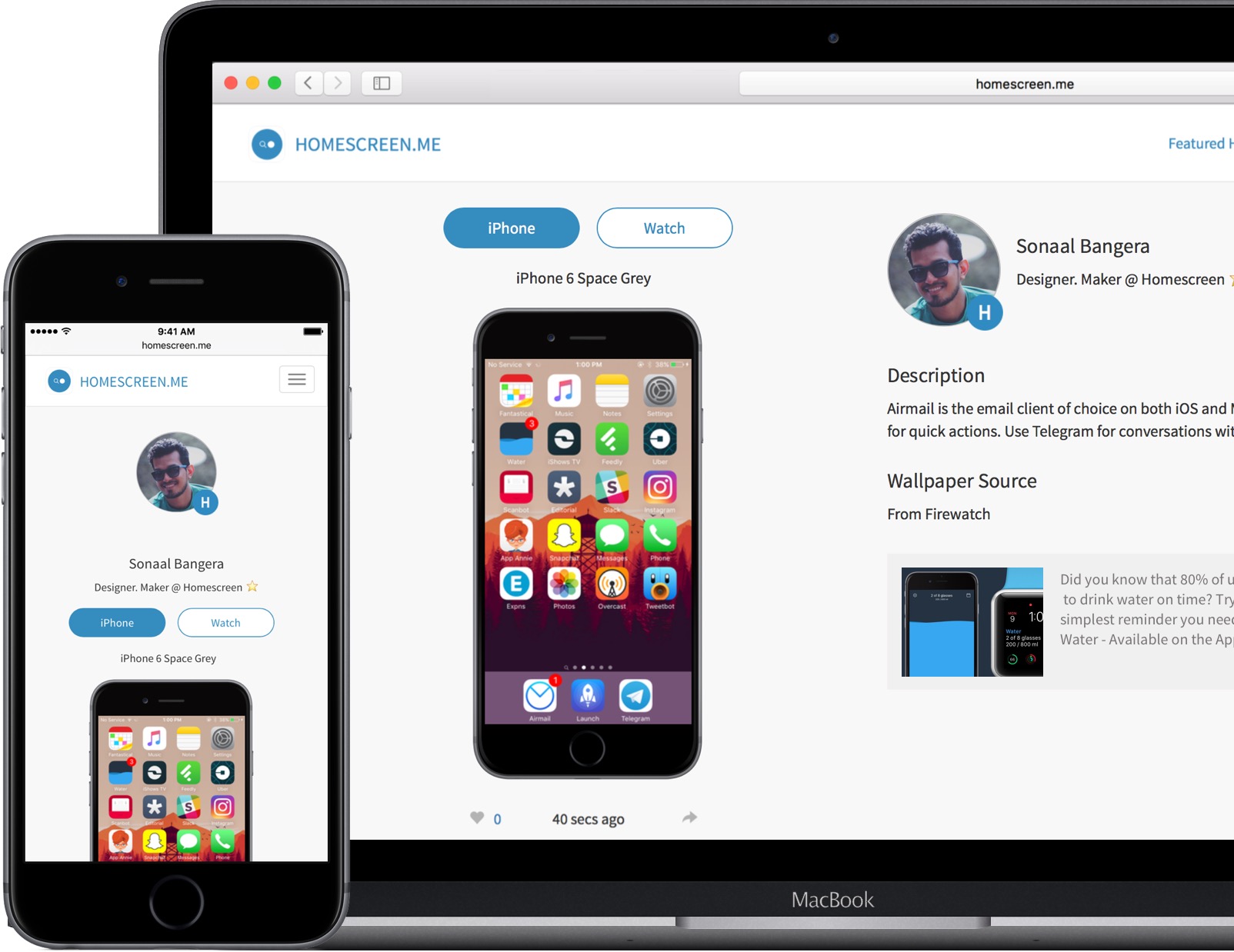
How different people arrange their iPhone Home screen is a natural curiosity for most of us with an interest in technology. We’ve featured Home screens in the vast majority of MacStories Weekly email newsletters, and it has easily been one of the most popular sections.
The iPhone has become an integral part of our lives, and seeing the apps that different people elevate to their Home screen provides insights into how they work and live their lives. But it also gives us the opportunity to discover new apps, find a new wallpaper, or re-think the layout and structure of how we organize the apps on our own Home screens.
If you find yourself curious about the iPhone Home screens of others, the relaunch of the Homescreen.me website might interest you. The basic pitch is that it allows anyone to upload and share their iPhone Home screen and Apple Watch watch face. The team behind Homescreen.me is also featuring the Home screens of different users, giving you the opportunity to get inspired and discover new apps.
A particularly nice touch with Homescreen.me is that in your profile settings you can choose which iPhone (model and color) and Watch (model) you own. This selection has an impact because the screenshots you upload will be superimposed onto the correct device. When you upload your screenshot you’re also given the option to provide a description, and a wallpaper source.
 INKS.
INKS.
INKS. is the latest in a niche category of iOS games that are not only immensely fun to play, but could also stand on their own as pieces of art (some of the others would include Monument Valley, Alto’s Adventure, LIMBO, and Sword and Sworcery). When you look at the App Store screenshots it looks...
Q&A
Question: Is the newsletter completely made in Markdown? Can you give some tips where to learn Markdown and how you format everything? I create a newsletter in Markdown but it’s really basic now. (Bart Vermeiren, @Bart2525)
 Federico
The best way to learn the basics of Markdown is through John Gruber’s original documentation and interactive dingus...
Understanding the New Territory Pricing and Expanded Subscription Price Tiers
Apple yesterday announced a slew of changes to the App Store including an overhaul of subscription pricing policies, paid search ads, faster App Store review times, and more. Amongst the changes to subscription prices was one particular change that I think is really significant, but hasn’t yet got much attention: territory pricing and more pricing tiers.
Apple is saying that starting this Fall, developers will be able to price their in-app subscriptions at different levels depending on the territory of the customer. Currently, apart from a minor exception, developers must set a price by selecting a single “tier” which results in a price that is effectively the same across the world. Here’s how Apple describes the change:
Starting this fall, apps with auto-renewable subscriptions will be able to offer territory-specific prices and will have access to 200 price points across all currencies. You will be able to set the prices you think are suitable for subscribers in different markets, and you will have the flexibility to price your subscriptions at parity if they’re available elsewhere. A new iTunes Connect pricing tool will help you manage pricing based on current exchange rates. If there is a tax increase or currency adjustment in a particular region, the price of subscriptions will generally not be affected unless you decide to pass the adjustment on to your users.