

[[graham]] At this point most websites work fine on Safari for iOS, but occasionally (as I discovered this week) some still offer up a very dated and incomplete mobile interface, with no clear option of how to get the “full” website. Fortunately, Safari has the ability to change its user agent to trick the website...
 ReplacingPhotoshop with Workflow
[[graham]] A few weeks ago I began a process of simplifying my workflow for The Daily App. A particular focus was to streamline the image creation, which was done with Photoshop and was quite fiddly, even though I had previously taken the time to create Photoshop Actions. After briefly dabbling with Pythonista, I realised that...
App Debuts
 Federico
Hemingboard Hemingboard is a thesaurus app that puts synonyms, rhymes, and even puns in a custom keyboard. It’s very easy to select alternative words for what you’re typing, and this can come in handy when writing long posts and notes on iOS. Vitals Vitals is a new iPhone app to track and visualize blood...
iOS Apps for Students Preparing for Exams
[[graham]] Fantastical 2 Addingyour exam dates and times onto your calendar is very important, but in addition, it can also be helpful to add your study plans and any revision lectures to your calendar as well. The default iOS calendar app is fine, but Fantastical is better – a lot better. With Fantastical youcan...
Comparing Siri and Alexa→
Rene Ritchie at iMore, in an article titled “Siri vs. Alexa is hilarious to people outside the U.S.”:
Imagine if, on a weekly basis, you saw or heard “Xinghua” being compared to Siri. But “Xinghua” was available only in China and only to people who spoke Mandarin. How meaningful would those comparisons really be to you in the U.S.? That’s about as meaningful as headlines comparing Amazon’s virtual assistant, Alexa to Apple’s Siri are to the vast majority of the world’s population.
Right now Alexa is solving only for people in America who speak English. That’s an incredibly small subset of what Siri, which just recently added Hebrew and several other languages in several other reasons, solves for.
With all due respect to Rene, I think this is a disingenuous way of defending Siri from the comparisons to the Amazon Echo’s Alexa.
It is, of course, a fair complaint that the Amazon Echo is not available in countries outside the United States, and that it can only understand US English.1 But I do not think it is legitimate to imply that the Echo’s geographic and lingual limitations somehow undermines the advances that the Echo offers in other areas such as its integrations with services which is seeing it receive praise from all-corners of the industry in recent months.
A large part of the praise of the Amazon Echo is because in 18 months it has gone from a product that didn’t exist, into one that many in the US find incredibly useful. Also significant is that in those 18 months it has evolved rapidly, adding great new features that make it even more useful. That is why people are comparing it to Siri, which launched in 2011 and has undoubtedly improved, but at a much slower pace and in less substantial ways (multi-lingual support aside).
I’m an Australian and I don’t think this Siri vs Alexa debate is “laughably US-centric”, I think it’s important, even if I can’t personally use Alexa. Just last week, Google announced that it will be releasing a very similar product later this year, and credited Amazon for their pioneering work with the Echo. I am certain Apple has taken similar notice of Amazon’s (seemingly successful) efforts with the Echo, and if Apple acts on those observations, then everyone with access to Siri will benefit.
So I’m not laughing, I’m grateful, if a little envious that my friends in the US are (yet again) getting a taste of the future before me. But I know it’ll reach me soon enough, whether it’s via Apple, Google, Amazon, or even Microsoft.
- I regularly make these kinds of observations/complaints about various products and services. Two years ago I even spent days researching and putting together this extensive examination of just how far ahead Apple was in terms of the availability of media content in countries around the world, so I understand this frustration very well. ↩
Apple Denied Key Exemption for Retail Stores in India→
Bloomberg reports that Apple has been denied a key exemption that will likely scuttle Apple’s plans in the short term to open official Apple Retail Stores in India:
India’s finance minister has ratified a decision that Apple Inc. must meet local sourcing rules to open its own stores, according to people familiar with the matter, dealing what may be a fatal blow to the iPhone maker’s effort to open retail outlets in the country.
Minister Arun Jaitley decided to support the decision by India’s Foreign Investment Promotion Board that Apple will have to procure 30 percent of components locally if it wants to sell through its own retail stores, said the people, asking not to be identified because the matter is private. The company makes most of its products in China and doesn’t currently meet that criteria.
It comes after another government panel had recommended, in late April, that Apple be granted the exemption. But more significantly, today’s move comes after Tim Cook visited India in his first official trip to the country as CEO of Apple.
The decision by India’s finance minister may not be the last word, as Indian Prime Minister Narendra Modi could theoretically intervene. During Cook’s trip to India he met with Prime Minister Modi and Apple’s retail plans were reportedly discussed, as was Modi’s “Made in India” program which encourages foreign companies to manufacture in India. In public comments during the week Cook suggested that Apple was looking to establish a facility in India that would refurbish old iPhones for resale in India, but had no plans for other manufacturing at this stage.
If you’re interested in reading more about Cook’s week-long tour of India and China (which occurred last week), I wrote about the context of the trip as well as providing a timeline of what actually happened.
Tim Cook’s Big Week in India and China: Context and Timeline
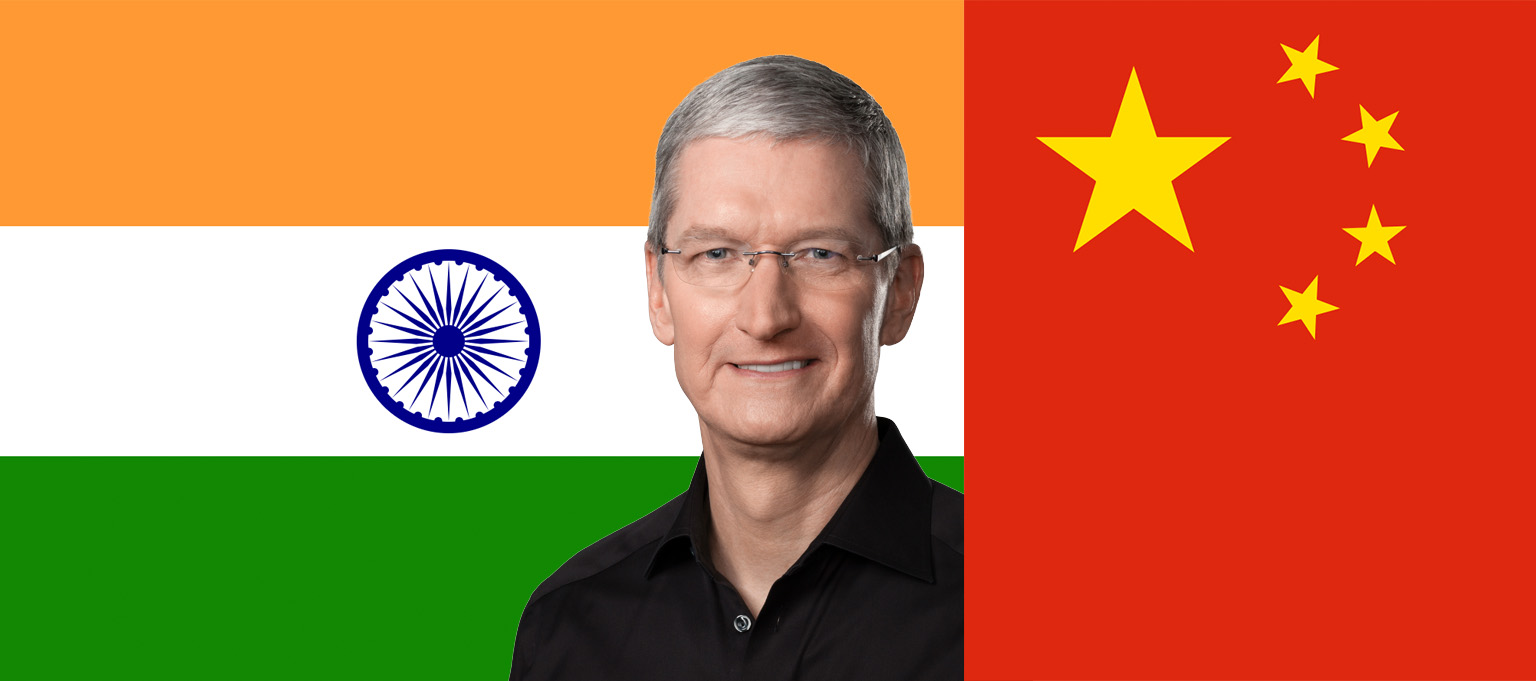
It may not have made the front page headlines, but Apple just concluded a significant week-long tour of India and China. Tim Cook has made numerous trips to China in recent years, but this was the first time that Cook visited India on an official trip as CEO of Apple. The trip also comes at a crucial time for the company as it begins to make big strategic moves to attract more Indian consumers, and at a time when Apple’s growth in China last quarter screeched to a halt after a period of huge growth.
Apple Announces New iOS App Design and Development Accelerator in Bengaluru, India→
Apple today announced a new initiative to support engineering talent and accelerate growth in India’s iOS developer community.
The company will establish a Design and Development Accelerator in Bengaluru, the home of India’s startup scene. Tens of thousands of developers in India make apps for iOS, the world’s most powerful mobile operating system and the foundation for iPhone, iPad and iPod touch. This initiative will provide additional, specialized support for them.
This new Design and Development Accelerator (which will open in early 2017) is similar to the announcement from January this year where Apple committed to opening an iOS App Development Center in Naples, Italy.
“India is home to one of the most vibrant and entrepreneurial iOS development communities in the world,” said Tim Cook, Apple’s CEO. “With the opening of this new facility in Bengaluru, we’re giving developers access to tools which will help them create innovative apps for customers around the world.”
Today’s India-specific press release comes after another Apple press release yesterday which announced that GarageBand added Chinese instruments and sounds. Tim Cook was in China, but arrived in India last night for his first official visit to India as Apple CEO. Cook is expected to visit Gurgaon, Delhi, Hyderabad and Mumbai, as well as meet Indian Prime Minister Narendra Modi.
Putting Recent App Review Time Improvements in Visual Context
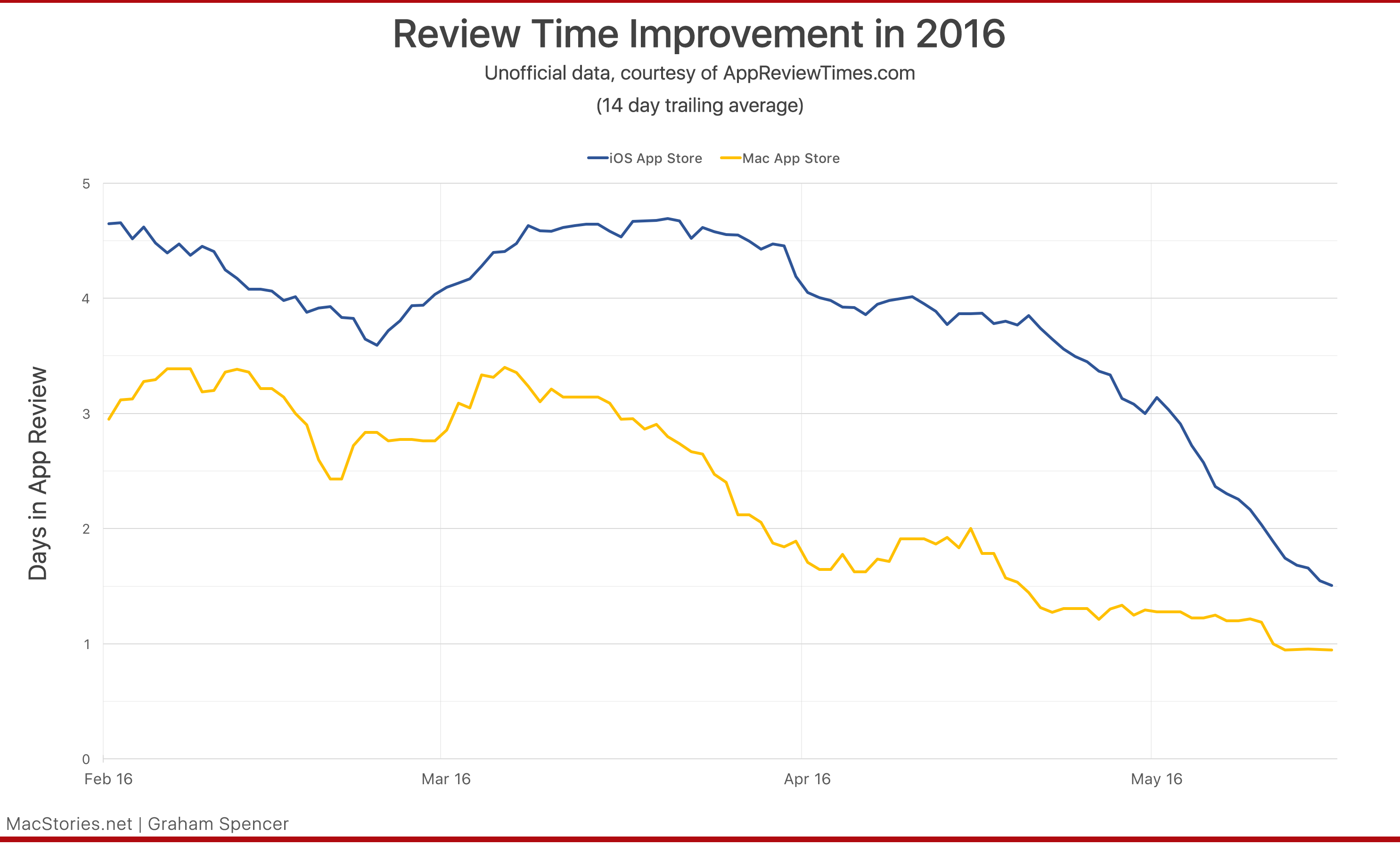
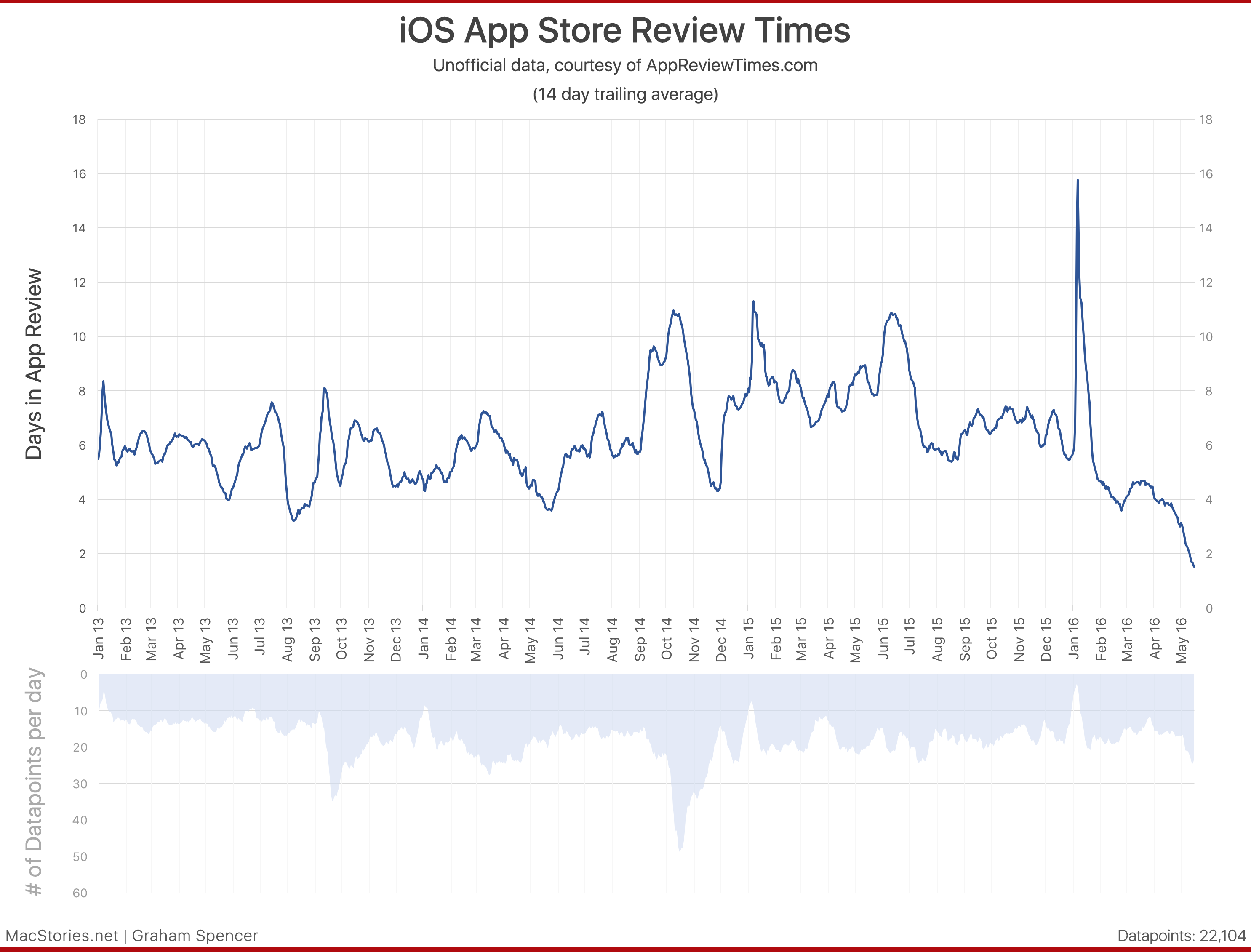
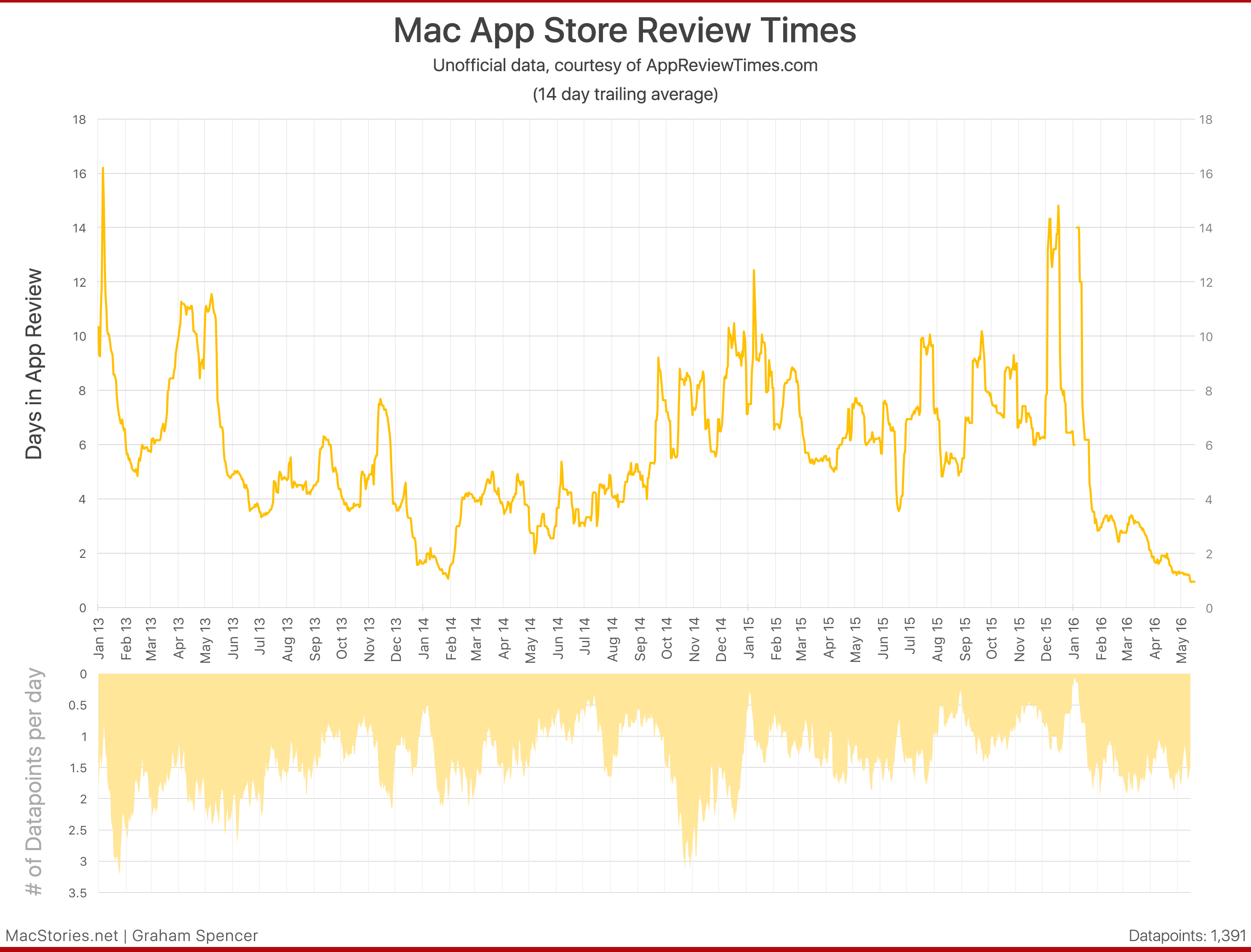
As many have noted this month, including Bloomberg, App Review has been processing app updates at a much quicker rate than usual. In the past week the average time for an iOS app to be approved by App Review has fallen to just 1.5 days. Apple itself doesn’t publish times, but there is unofficial crowd-sourced data at AppReviewTimes.com.
Dave Verwer of AppReviewTimes.com was kind enough to share the raw data with MacStories, and we produced the above and below charts which provide some visual context and demonstrate just how out of the ordinary the recent improvement in App Review time is. It is too early to say conclusively, but given the extent of the reduction (and the sudden nature of it), I think it is fairly safe to guess that Apple has made some internal changes in order to improve the speed of App Review.
Earlier this year we published an extensive survey which detailed a number of frustrations that developers had with App Review, and suggestions for how Apple could improve App Review. At the top of that list of developer frustrations was the slow speed of App Review, with 78% saying it was bad or terrible.