Federico Viticci

10752 posts on MacStories since April 2009

Federico is the founder and Editor-in-Chief of MacStories, where he writes about Apple with a focus on apps, developers, iPad, and iOS productivity. He founded MacStories in April 2009 and has been writing about Apple since. Federico is also the co-host of AppStories, a weekly podcast exploring the world of apps, Unwind, a fun exploration of media and more, and NPC: Next Portable Console, a show about portable gaming and the handheld revolution.

This Week's Sponsor:

Dropzone 5

Improve your Drag-and-Drop Workflow


Why Foldable Phones Matter: The Case for an iPhone Duo

This week on AppStories, Federico shares his experiences with foldable Android phones and what Apple might do for its first foldable hardware and its software.

On AppStories+, Federico shares his experience using Samsung DeX.

Also available on YouTube here.


Subscribe here.

Subscribe here.

We deliver AppStories+ to subscribers with bonus content, ad-free, and at a high bitrate early every week.

To learn more about an AppStories+ subscription, visit our [Plans page](https://appstories.net/plans, or read the AppStories+ FAQ.


AppStories+ Deeper into the world of apps

AppStories Episode 477 - Why Foldable Phones Matter: The Case for an iPhone Duo

0:00
42:12

AppStories+ Deeper into the world of apps

This episode is sponsored by:

  • Claude – Ready to tackle bigger problems? Get started with Claude today.

Read more


A Developer’s Month with OpenAI’s Codex

An eye-opening story from Steve Troughton-Smith, who tested Codex for a month and ended up rewriting a bunch of his apps and shipping versions for Windows and Android:

I spent one month battle-testing Codex 5.3, the latest model from OpenAI, since I was already paying for the $20 ChatGPT Plus plan and already had access to it at no additional cost, with task after task. It didn’t just blow away my expectations, it showed me the world has changed: we’ve just undergone a permanent, irreversible abstraction level shift. I think it will be nigh-impossible to convince somebody who grows up with this stuff that they should ever drop down and write code the old way, like we do, akin to trying to convince the average Swift developer to use assembly language.

From his conclusion:

This story is unfinished; this feels like a first foray into what software development will look like for the rest of my life. Transitioning from the instrument player to the conductor of the orchestra. I can acknowledge that this is both incredibly exciting, and deeply terrifying.

I have perused the source code of some of these projects, especially during the first few days. But very quickly I learned there’s simply nothing gained from that. Code is trivial, implementations are ephemeral, and something like Codex can chew through and rewrite a thousand lines of code in a second. Eventually, I just trusted it. Granted, I almost always had a handwritten source of truth, as detailed a spec as any, so it had patterns and structure to follow.

The models are good now. A year ago, none of them could do any of this, certainly not to this quality level. But they don’t do it alone. A ton of work went into everything here, just a different kind of work to before. Above all, what mattered most in all of the above examples was taste. My taste, the human touch. I fear for the companies, oblivious to this, that trade their priceless human resources for OpenClaw nodes in a box.

The entire story is well-documented, rich in screenshots, and full of practical details for developers who may want to attempt a similar experiment.

It’s undeniable that programming is undergoing a massive shift that has possibly already changed the profession forever. Knowing what code is and does is still essential; writing it by hand does not seem to be anymore. And it sounds like the developers who are embracing this shift are happier than ever.

I’ve been thinking about this a lot: why are some of us okay with the concept of AI displacing humans in writing code, but not so much when it comes to, say, writing prose or music? I certainly wouldn’t want AI to replace me writing this, and I absolutely cannot stand the whole concept of “AI music” (here’s a great Rick Beato video on the matter). I don’t think I have a good answer to this, but the closest I can get is: code was always a means to an end – an abstraction layer to get to the actual user experience of a digital artifact. It just so happened that humans created it and had to learn it first. With text and storytelling, the raw material is the art form itself: what you read is the experience itself. But even then, what happens when the human-sourced art form gets augmented by AI in ways that increasingly blur the lines between what is real and artificial? What happens when a videogame gets enhanced by DLSS 5 or an article is a hybrid mesh of human- and AI-generated text? I don’t have answers to these questions.

I find what’s happening to software development so scary and fascinating at the same time: developers are reinventing themselves as “orchestrators” of tools and following new agentic engineering patterns. The results, like with Steve’s story, are out there and speak for themselves. I wish more people in our community were willing to have nuanced and pragmatic conversations about it rather than blindly taking sides.

Permalink

Comet Is the First Agentic Browser for iOS Worth Trying

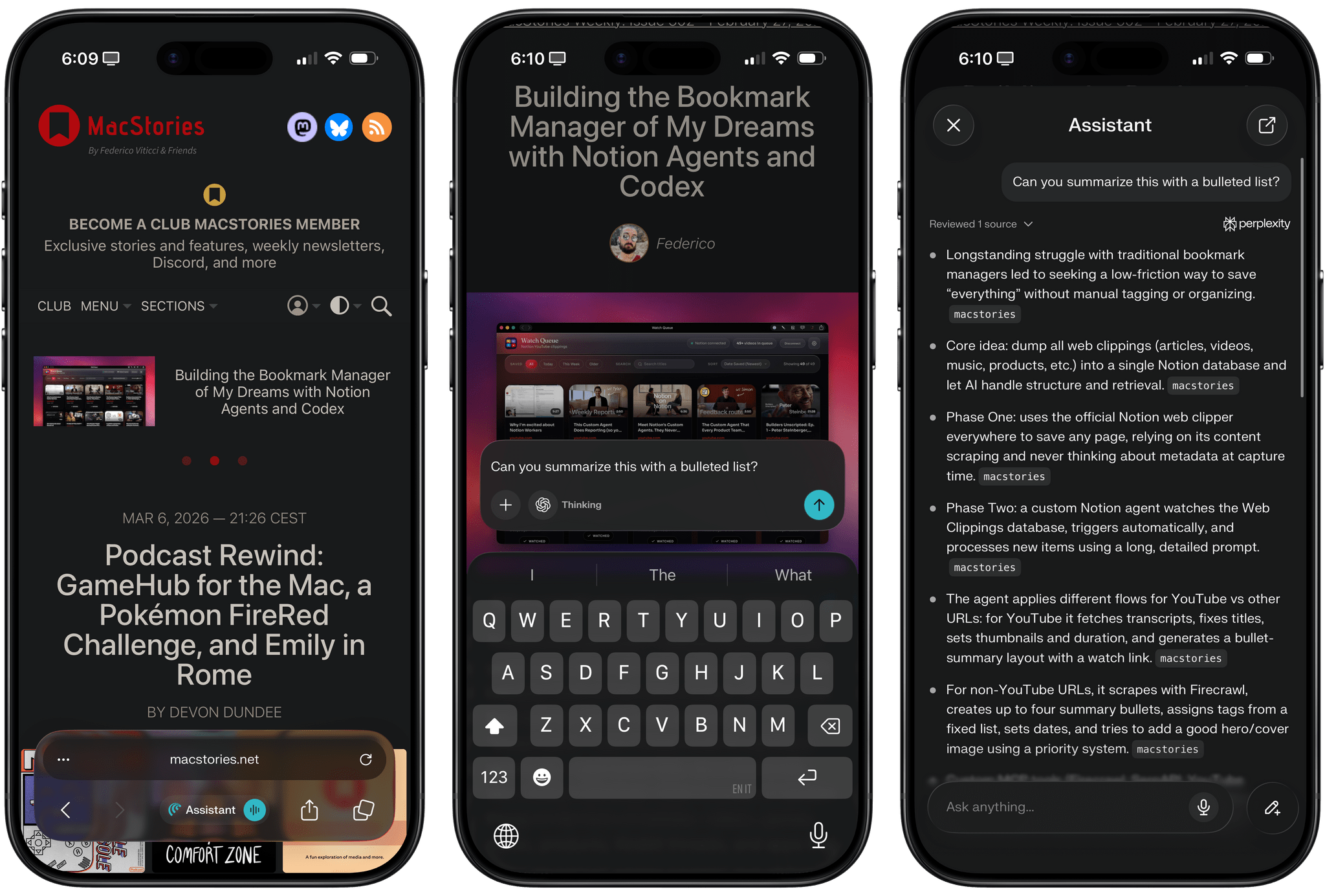
Comet for iOS.

Comet for iOS.

[Update: Perplexity has released an iPad version of Comet alongside the iPhone version, which you can install using the same App Store links below. However, because it wasn’t part of the TestFlight version of the app that we tested, we were unaware that it was launching with the iPhone version.]

For the past three weeks, I’ve been testing Comet, Perplexity’s cross-platform agentic web browser, on my iPhone Air. The iOS version of Comet, launching today on the App Store and (sadly) lacking an iPad counterpart, follows the expansion of Comet from macOS to Windows and Android devices, and it carries the inherent limitations of Apple’s platform. Comet for iOS is based on Safari’s WebKit engine; you cannot install third-party browser extensions due to iOS sandboxing restrictions; you can make Comet your default iOS browser, but in-app web views in third-party apps will still open with Safari View Controller, not Comet. By and large, Comet on iOS is a skin of Safari, but for the first time since the debut of Arc Search on iPhone two years ago (R.I.P.), I’m actually excited about an alternative to Safari on iOS once again.

Read more


The iPhone Fold Doesn’t Need iPadOS to Be a Great “Tablet”

I meant to link this at the beginning of the year, then I forgot, but I guess the story is still as timely as ever given the state of the latest rumors. A few months back, Jason Snell 3D-printed a mockup of the upcoming iPhone Fold (which I still think should be called iPhone Duo), which revealed a surprising design decision:

If these mock-ups are real, this folding iPhone is not going to be what you may have pictured in your head: a modern iPhone, roughly the shape of an iPhone Pro, that folds open to reveal a larger screen inside.

Instead, Apple may be making a device that’s much wider and squatter than existing iPhones when it’s folded up. The mock-ups people are printing show a phone that’s squatter than an iPhone mini and wider than an iPhone Pro Max! If that shape is right, the iPhone Fold will look a bit more like a mini notebook when it’s folded, unlike any iPhone that has ever existed.

And:

The shape makes sense, however, when you imagine what that phone looks like when it’s unfolded: a screen with a 4:3 aspect ratio, the shape of an old-school television and—more importantly—an old-school iPad. In fact, this rumored design would make the unfolded iPhone the shape of an iPad, just slightly smaller than the iPad mini. (The iPad mini’s screen is 8.3 inches when measured diagonally, while this screen is rumored to be 7.76 inches.)

Read more


The Fractal Fragmentation of AI Tools

This week on AppStories, Federico and John look at the confusing array of tools and naming conventions used by Anthropic and OpenAI.

On AppStories+, John explains how he automated two unautomatable Mac apps.

Also available on YouTube here.


Subscribe here.

Subscribe here.

We deliver AppStories+ to subscribers with bonus content, ad-free, and at a high bitrate early every week.

To learn more about an AppStories+ subscription, visit our [Plans page](https://appstories.net/plans, or read the AppStories+ FAQ.


AppStories+ Deeper into the world of apps

AppStories Episode 476 - The Fractal Fragmentation of AI Tools

0:00
51:10

AppStories+ Deeper into the world of apps

This episode is sponsored by:

  • Vitally: Your Copilot for AI-Powered Customer Success. Get a free pair of AirPods Pro when you book a qualified meeting.

Read more


“This Is Not The Computer For You”

I loved this essay by Sam Henri Gold on the MacBook Neo but, really, about where the “wrong” computer in your life can take you:

There is a certain kind of computer review that is really a permission slip. It tells you what you’re allowed to want. It locates you in a taxonomy — student, creative, professional, power user — and assigns you a product. It is helpful. It is responsible. It has very little interest in what you might become.

The MacBook Neo has attracted a lot of these reviews.

The consensus is reasonable: $599, A18 Pro, 8GB RAM, stripped-down I/O. A Chromebook killer, a first laptop, a sensible machine for sensible tasks. “If you are thinking about Xcode or Final Cut, this is not the computer for you.” The people saying this are not wrong. It is also not the point.

Nobody starts in the right place. You don’t begin with the correct tool and work sensibly within its constraints until you organically graduate to a more capable one. That is not how obsession works. Obsession works by taking whatever is available and pressing on it until it either breaks or reveals something. The machine’s limits become a map of the territory. You learn what computing actually costs by paying too much of it on hardware that can barely afford it.

(The MacBook Neo is a lovely computer that feels futuristic despite its specs. I was about to return mine, then decided to keep it because there’s something special about it. You can listen to the latest episode of Connected to hear my take on it.)

Sam’s story resonated with me because I’ve been there, not as a kid, but as a 24-year-old who needed to get work done from a hospital bed and chose to do so with an iPad. I stuck with it after that, despite a lot of people telling me it was the wrong computer for me.

Sometimes the “wrong” computer is the right obsession for you. You never know where that can take you. Go read Sam’s full story if you need a reminder of why specs don’t ultimately dictate someone’s creativity.

Permalink