Still reeling from the Apple/Beats news, the boys sit down to talk about music, apps and WWDC.
For our 50th episode of The Prompt, topics that are dear to us: Beats and curation, iOS 8 and the upcoming WWDC, and a lot of apps. Get the episode here.

Tim Cook, in an interview with Re/Code’s Peter Kafka about the Beats deal and Beats Music’s curation:
We get a subscription music service that we believe is the first subscription service that really got it right. They had the insight early on to know how important human curation is. That technology by itself wasn’t enough — that it was the marriage of the two that would really be great and produce a feeling in people that we want to produce. They’ve also built an incredible premium headphone business that’s been tuned by experts and critical ears. We’re fans of that. It’s a reasonable-size business that’s fast-growing.
The focus on curation and editorial picks was immediately clear when Beats Music launched in January. The service’s front page featured a collection of curated playlists (handpicked by humans) provided through automatic recommendations based on user taste and listening habits.
From my original article, Why Beats Music Matters:
Computers and algorithms, in spite of modern advancements in data extraction and parsing, don’t understand things like artistic influences, song meanings, subtle references, or the “mood” of a song. Computers can’t compute emotion. They can’t understand what’s behind Dave Grohl’s “Best of You” at Wembley or why Death Cab For Cutie’s Transatlanticism is an album about long distance love. Computers don’t have the human touch, and I believe that they will never be able to fully, empathically replicate the ability to appreciate music as an artistic expression.
That’s why Beats Music hired people knowledgeable about music and uses algorithms as a tool, and not the medium: there’s more to music than data.
If the plan comes together, Beats Music has a serious chance at reinventing how music streaming services should work. I’m optimistic.
And here’s how Beats Music describes their editorial team’s efforts:
At Beats Music, our mission is to create playlists and make music recommendations based on songs that feel right together, at the right time, and for the right person… not just that sound alike.
That can’t be done with an algorithm. It requires a real human with a trained ear for blending genres and styles and a knowledge of what song comes next.
The Beats Music part of the Apple-Beats deal was highlighted in several sections of today’s press statements and interviews, suggesting that Apple (unlike what speculation implied over the past weeks) saw potential in the relatively young Beats Music service. Here’s Tim Cook in an interview with The New York Times:
“Could Eddy’s team have built a subscription service? Of course,” he said. “We could’ve built those 27 other things ourselves, too. You don’t build everything yourself. It’s not one thing that excites us here. It’s the people. It’s the service.”
Unlike subscriber numbers and country availability, music knowledge and culture can’t be quantified, but they’re extremely valuable. With Beats, Apple isn’t simply buying a popular brand of headphones and a music app – they’re investing in fashion sense, the interplay of technology and culture for music, and a team of people with a profound appreciation and understanding of music history and trends. And this drives analysts crazy because it can’t be visualized with a pie chart.
In fact, Esslinger goes so far as to say in his recent book, Keep it Simple, that he was the one who taught Steve Jobs to put design first. First published late last year, the book recounts Esslinger’s famous collaboration with Jobs, and it includes amazing photos of some of the many, many prototypes to come out of it. They’re incredibly wide ranging, from familiar-looking computers to bizarre tablets to an early phone and even a watch, of sorts.
The Verge has a collection of photos showing old Apple prototypes by Frog, the design company founded by Hartmut Esslinger and responsible for the Snow White design language. The Macintosh/tablet hybrid with a keyboard would have been interesting.
Myke and Federico follow up on last week’s special episode with some unique feedback before discussing integrated accessories and store curation.
In last week’s episode of Directional, we discussed the idea of integrating mobile devices as core aspects of console gaming experiences, and we also considered Sony’s latest approach to digital storefront curation.
This week, we’re taking questions for a Q&A episode we’re recording tonight. Have questions? Let us know on Twitter or through the Directional Contact link.
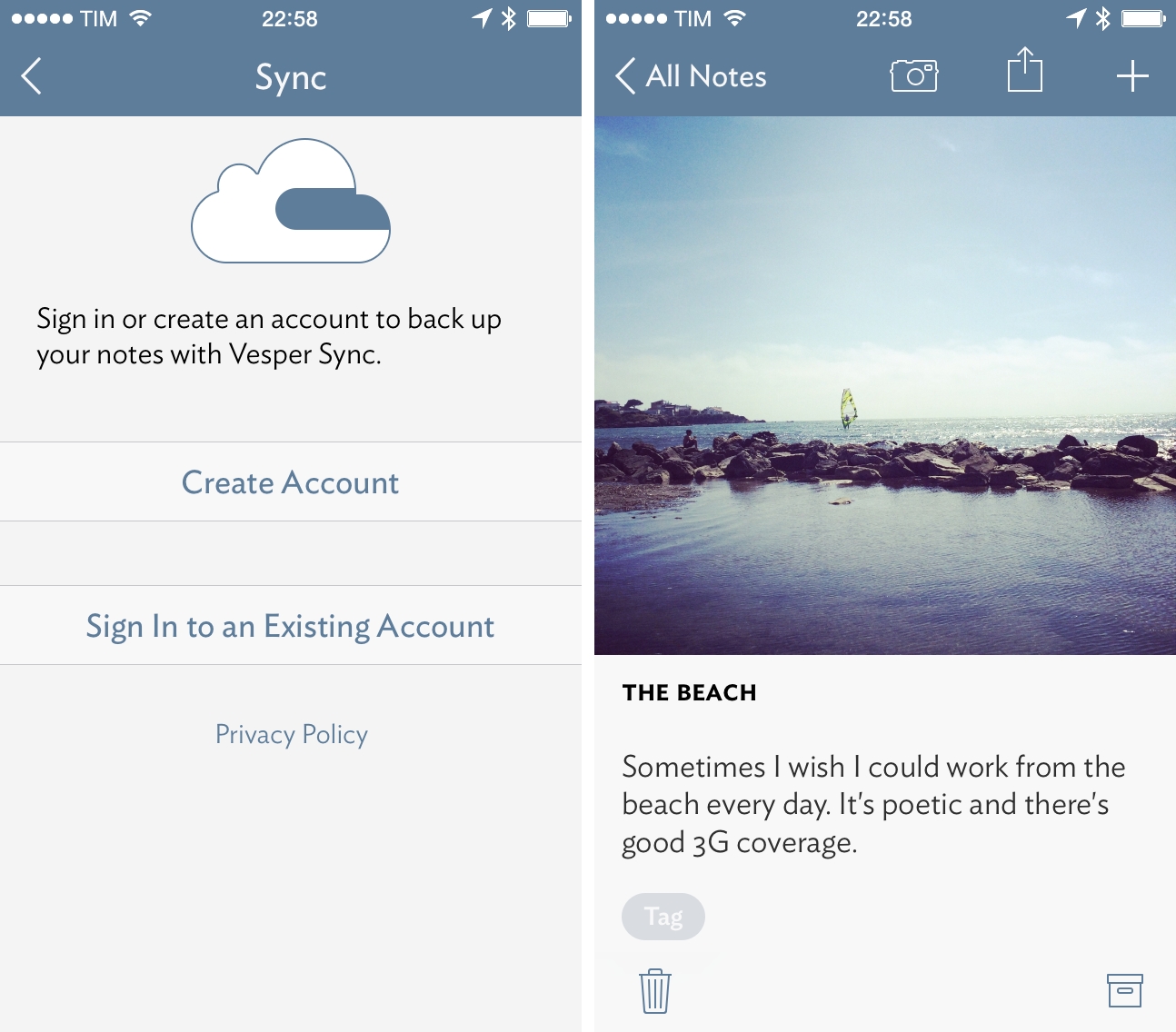
Vesper, Q Branch’s note-taking app for iPhone that I reviewed last year, added sync support with version 2.0, available today on the App Store. Q Branch is calling the (optional) service “Vesper Sync”, but right now it’s primarily intended to serve as a backup for your notes because Vesper is still iPhone-only (of course, there are also people who use two iPhones).
I’ve been following the development of Vesper Sync through the excellent Vesper Sync Diary series on Brent Simmons’ blog. It sounded like Q Branch wanted to ship fast, reliable, and invisible sync with the app and that’s exactly what they did. I like how Vesper Sync updates in (almost) real-time and how it doesn’t feel like something that you have to manage inside the app – you only see a network spinner for a second in the status bar and then sync disappears in the background. It’s a pretty sweet and elegant implementation, and it bodes well for Vesper’s likely future availability on more platforms.
Vesper 2.0 is available on the App Store as a free update.
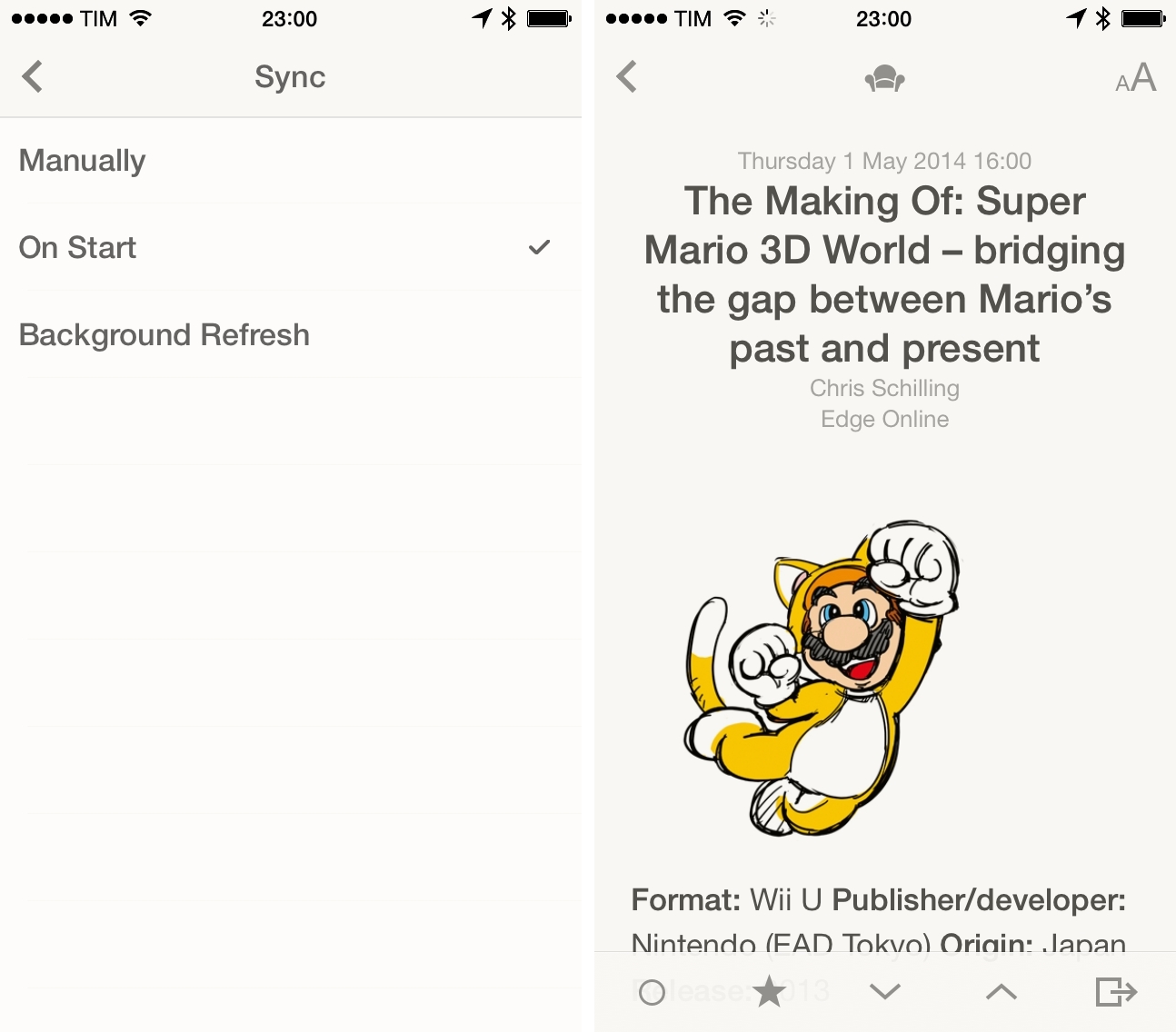
Reeder 2.2 for iOS, out today on the App Store, fixes one of the major annoyances that I mentioned in my original review: lack of background app refresh on iOS 7. I find having content from feed readers or podcast clients ready when you launch an app is a great experience, and now Reeder can download articles in the background on a per-account basis (smart choice).
In the update, Silvio Rizzi also switched to new authentication methods for Pocket and Pinboard (nice), updated Messages sharing (much better now), and increased gesture support for navigation inside the app.
Reeder 2.2 is available on the App Store.
There’s no denying that WWDC 2013 was one of the most exciting in recent years - however, for all the new technologies Apple announced the thing that struck me most - the thing that excited me most as someone building things for the Apple ecosystem - was a single phrase in many of the sessions: “Also available on the Mac”.
A thoughtful article by Nik Fletcher, who takes a look at the state of developer technologies for iOS and OS X. Better developer tools typically equal less time spent working around OS limitations or outdated web interfaces, resulting in leaner development workflows, more apps, and faster updates – which is what everybody wants. Nik offers some great suggestions.
I don’t usually link to dance remixes of popular songs, but this remix (via TechCrunch) of the default iOS 7 ringtone is simply great. MetroGnome did an impressive job with the various sections of the remix (I especially like the build-up in the middle) and the end has a nice surprise.
Download links for the MP3 and ringtone versions are available on MetroGnome’s YouTube channel.
Igloo, the intranet you’ll actually like, is about to get better.
Igloo’s next release, Unicorn, is coming this summer. With it comes social task management, a brand new feature fully integrated throughout the Igloo platform, providing the perfect balance between project management and getting your day-to-day work done.
You can manage projects with task lists, optimized for large groups of people; assign tasks from any piece of content, like requesting changes be made on a document; and you can create personal tasks that are assigned to you or another person. And you can see all your tasks in one unified view.
Learn more at Igloo’s Unicorn landing page. Or come see Unicorn in person – Igloo is hosting an event in Toronto on June 12, with customer presentations by Hulu and Nextel International. Register today as seating is limited.
Our thanks to Igloo for sponsoring MacStories this week.